
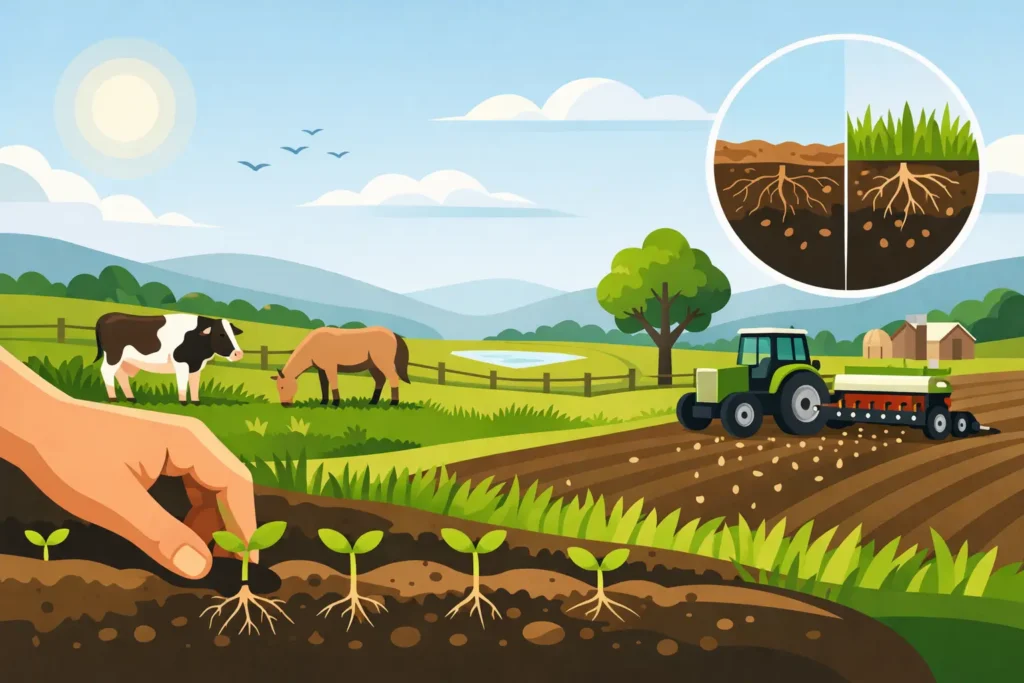
A pasture usually tells you early whether the job was done right. Thin patches, weed pressure, and weak early growth rarely start with bad luck alone. If you are asking how to improve pasture establishment, the answer is usually found in the basics done well – matching the seed to the site, preparing a clean seedbed, seeding at the right depth, and managing moisture and grazing pressure from day one.
For producers and land managers, establishment is the stage that sets the ceiling for everything that comes next. A strong start supports forage yield, stand persistence, weed competition, and overall field performance. A poor start is expensive to live with, even if it does not fully fail.
How to improve pasture establishment starts before seeding
Good pasture establishment begins long before the drill enters the field. Site history matters. A field coming out of annual crop, hay, or long-term sod brings different residue levels, weed pressure, compaction risks, and nutrient carryover. The right approach depends on what was there before and what you want the pasture to do in the years ahead.
Start with a clear objective. Some pastures are built for intensive grazing, others for season-long use, mixed hay and grazing, or drought tolerance on lighter ground. That goal should shape the species mix, expected stand density, and management plan. A pasture intended for high production on productive soil should not be seeded the same way as a lower-input stand on dry or variable land.
Soil testing is one of the most practical early steps. It gives you a read on pH, phosphorus, potassium, sulfur, and organic matter, and it often explains why fields underperform. Many establishment problems get blamed on seed quality when the real issue is that the stand never had adequate fertility to begin with.
Build the right seed mix for the field
The fastest way to struggle with establishment is to choose species that do not fit the soil, moisture, or management style. A pasture blend should reflect local growing conditions and intended use, not just what performed well on another farm or project site.
In Western Canadian conditions, and in similar climates across the northern US, species selection often comes down to balancing productivity with persistence. Fast-establishing grasses can help cover ground quickly, but some slower-starting species contribute more to long-term stand strength. Legumes can improve feed quality and support nitrogen cycling, but they also need the right fertility, inoculation, and grazing management to persist.
This is where custom blend design has real value. Wet ground, saline patches, sandy ridges, shaded areas, and heavy traffic zones do not all respond the same way. A mix that matches those realities is easier to establish and more likely to hold over time. There is no perfect universal blend, and that is exactly the point.
Seedbed preparation matters more than most people want to admit
Pastures do not need a golf-course finish, but they do need a seedbed that gives small seed a fair chance. The goal is firm soil, good seed-to-soil contact, controlled residue, and reduced competition from weeds or volunteer growth.
If the seedbed is fluffy, rough, or full of clods, seed placement becomes inconsistent. Some seed ends up too deep and struggles to emerge. Some sits too shallow and dries out. If there is heavy trash or uneven residue, the drill may not place seed uniformly, and germination can become patchy across the field.
On reclaimed or disturbed ground, the challenge may be different. Compaction, uneven topsoil distribution, and poor soil structure can limit emergence even when seeding is done on time. In those cases, addressing soil physical condition is just as important as selecting the right mix.
Weed control before seeding is another place where results are won or lost. Young pasture seedlings are not strong competitors. If broadleaf weeds or annual grasses are already established, they can take moisture, light, and nutrients at exactly the wrong time. A clean start is usually worth the effort.
Seeding depth and timing can make or break emergence
Most pasture seed should be placed shallower than many people think. Small-seeded grasses and legumes generally perform best when seeded at roughly one-quarter to one-half inch deep, depending on soil texture and moisture. Going deeper in search of moisture often backfires. Seedlings use a lot of energy getting to the surface, and many never make it.
Uniform depth matters as much as average depth. A field seeded half right and half wrong will not establish evenly, and uneven stands are harder to manage in the first season.
Timing depends on local moisture patterns and temperature. In many regions, spring seeding offers the best chance to use stored moisture and avoid heat stress during emergence. Late summer seeding can also work well where there is enough moisture and enough time for seedlings to establish before frost. The trade-off is that summer dry spells and narrow planting windows leave less room for error.
There is no single date that fits every operation. The right timing is the one that aligns seedbed conditions, forecast moisture, and realistic field access.
Fertility should support seedlings, not just the mature stand
One common mistake is thinking of fertility only in terms of long-term production. Establishment has its own fertility needs. Phosphorus is especially important for early root development, and sulfur can be limiting on lighter soils or lower-organic-matter sites. Potassium also matters where soil reserves are low.
Nitrogen is more nuanced. Grass seedlings respond to it, but too much available nitrogen can also push weed growth and increase competition, especially if the field is not clean going in. In mixed grass-legume stands, nitrogen strategy should reflect whether you are trying to encourage legume contribution over time.
Fertility decisions should follow the soil test and the species plan. Applying the same blend and rate across every pasture field may be simple, but it is rarely the best way to improve establishment.
Moisture management is the factor no one controls fully
Moisture drives emergence, but it is also the least controllable part of the equation. That is why the rest of the system has to be tight. Proper seed depth, a firm seedbed, appropriate species selection, and controlled competition all help the stand make the most of available moisture.
On dryland acres, preserving seed-zone moisture is often more valuable than chasing perfect appearance. Excess tillage, delayed seeding, and loose seedbeds all cost moisture. On wetter ground, poor drainage or compaction can be just as damaging because seedlings need oxygen as much as they need water.
If conditions are marginal, patience can be the better choice. Seeding into poor moisture with the hope that rain will rescue the stand is a gamble. Sometimes it works. Often it creates an uneven field that never reaches its full potential.
The first-year management plan is part of establishment
A pasture is not established just because it emerged. The first season decides whether seedlings become a durable stand or simply survive. That means post-seeding management should be planned in advance, not improvised once the field turns green.
Weed pressure needs to be watched closely. In some cases, clipping weeds before they set seed can reduce competition without harming the young stand. In other cases, herbicide options may be limited by the species in the mix. That is another reason species planning and weed planning need to happen together.
Grazing too early is one of the most common setbacks. Young plants need time to root and store energy. Turning cattle in before seedlings are anchored can pull plants out and thin the stand fast. Even when forage looks ready from the road, the roots may not be. A light, controlled first grazing can work in some systems, but only if plants are well established and soil conditions are firm.
Traffic matters too. Wet soils, repeated equipment passes, and concentrated livestock pressure can undo a good seeding job in a short time.
How to improve pasture establishment over the long term
Better establishment is not just about getting a stand this year. It is about building a pasture that holds density, resists weeds, and stays productive under use. That is why the best results usually come from seeing establishment as a system rather than a single seeding event.
When seed selection matches the field, when the seedbed is properly prepared, when seeding depth is controlled, and when the first-year management is disciplined, the odds improve substantially. There are still years when weather gets the final say. But fields with the fundamentals in place are far better equipped to handle that stress.
For operations across variable climates and mixed land conditions, local knowledge matters. Soil type, precipitation pattern, frost risk, and intended use all shape what success looks like. A practical plan built around those realities will outperform a generic recipe every time.
Pasture establishment rewards the people who pay attention early. If the goal is stronger forage performance, fewer weak spots, and a stand that lasts, the smartest move is to treat every decision before and after seeding as part of the same job.