
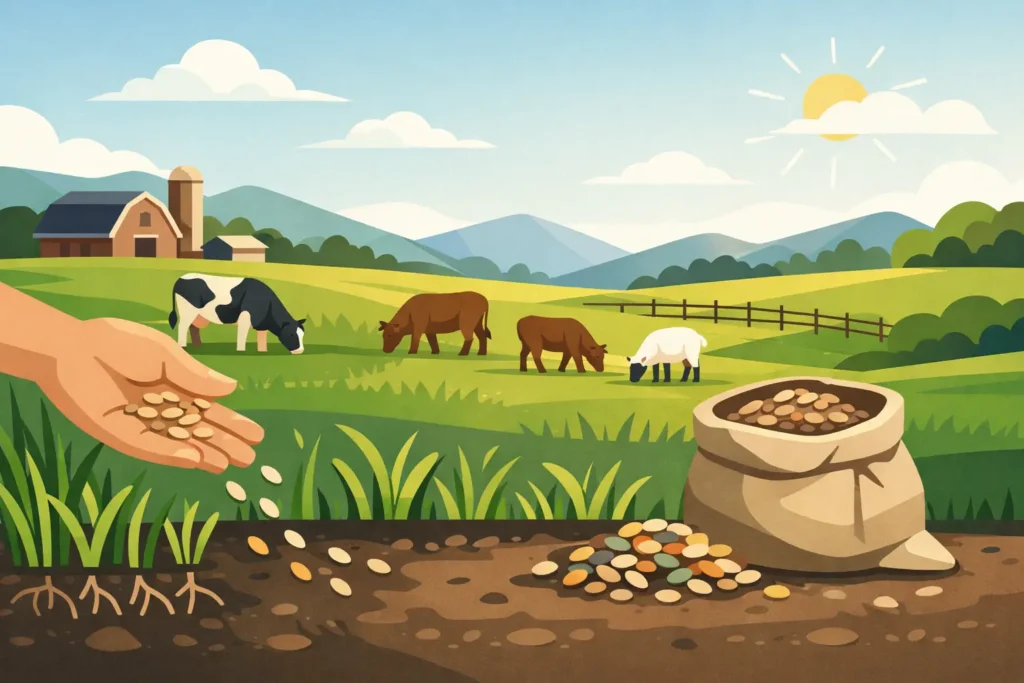
A pasture that looks good in spring but thins out by late summer usually has a mix problem, not just a management problem. The best pasture seed mix is not the one with the longest species list or the lowest upfront cost. It is the one that matches your livestock, your soil, your moisture pattern, and the way you plan to graze.
That sounds simple, but this is where many pasture decisions go sideways. A blend that works on one quarter can disappoint badly on another. A high-yield mix may not hold up under constant pressure. A durable stand may not deliver the feed quality a producer wants for a specific class of cattle. Good seed selection starts with the job the pasture needs to do.
What makes the best pasture seed mix?
The best pasture seed mix balances three things – establishment, persistence, and usable forage quality. If one of those is missing, the stand usually underperforms over time.
Establishment matters because a slow, uneven stand leaves open ground for weeds and weakens production in year one. Persistence matters because reseeding pasture is expensive in time and lost use. Forage quality matters because there is no value in growing a lot of feed that does not fit the livestock program.
This is why single-species thinking often falls short. One grass may establish fast but lose quality quickly. Another may be long-lived but slow to get going. Legumes can improve protein and reduce nitrogen needs, but they also bring management considerations. A well-built mix uses species that cover each other’s weaknesses without creating competition problems.
Start with the pasture’s job
Before choosing species, define the purpose of the field. Grazing pasture, hay aftermath grazing, horse pasture, and long-term beef pasture do not all need the same blend.
For a cow-calf operation, persistence and season-long productivity usually matter more than maximum top-end yield. For intensive rotational grazing, regrowth and traffic tolerance become more important. For horse pasture, palatability and stand density may be priorities, but you also need to think carefully about species that fit horse health and grazing behavior.
If the ground is expected to do double duty, be honest about that from the start. A field managed mainly for hay and occasionally grazed should not be seeded the same way as a dedicated grazing pasture. The right answer depends on how the field will actually be used, not how you hope to use it someday.
Match the mix to soil and moisture
Soil texture, drainage, salinity, and moisture pattern usually tell you more than the calendar does. A productive mix on deep, moisture-holding ground can struggle badly on lighter soils or exposed sites.
On drier acres, species choice needs to lean toward drought tolerance and persistence. On heavier or wetter ground, tolerance to prolonged moisture and traffic can become the bigger issue. If there are saline areas, low spots, or variable slopes, a uniform blend across the whole field may not be the best fit.
This is especially true across Western conditions, where a pasture in central Alberta may have very different limitations than one closer to the Peace region or parts of Saskatchewan. Regional fit matters because winter hardiness, spring vigor, and summer performance are not equal across species.
Grasses that often anchor a strong pasture mix
Most productive pasture blends start with dependable perennial grasses. The exact balance will vary, but the role of the grasses is usually clear – they provide volume, structure, and long-term sod strength.
Orchardgrass is often chosen for its strong regrowth and good palatability. It fits well in managed grazing systems, but it generally prefers decent fertility and does not love prolonged close grazing.
Timothy remains useful where producers want reliable forage quality and broad adaptability. It is familiar for a reason, though it may not be the best choice where aggressive regrowth after repeated grazing is the main goal.
Smooth bromegrass can bring persistence and strong early production. It is a workhorse in many pasture settings, but it can become dominant if the mix is not balanced properly.
Meadow brome is a strong option for grazing because of its palatability and recovery after defoliation. In many pasture situations, it deserves a hard look when long-term grazing performance is the priority.
Tall fescue and meadow fescue can also fit certain environments well, particularly where durability and cool-season production are needed. The right fescue choice depends on region, moisture, and intended management.
Why legumes often improve the best pasture seed mix
A pasture without legumes can still work, but legumes often make a good mix better. They can improve protein, support animal performance, and help reduce dependence on applied nitrogen.
Alfalfa is a common inclusion where drainage is good and productivity is the goal. It brings strong yield and quality, but it is not ideal for every grazing system or soil condition. It also requires careful management if bloat risk is a concern.
Clovers can help fill that gap. Red clover can add forage quality and good production, while white clover can contribute persistence in grazed systems, especially where moisture is more reliable. Birdsfoot trefoil is another valuable legume in some pasture programs because it offers quality benefits with lower bloat concern, though establishment can be slower and management still matters.
The key is proportion. Too little legume and you may miss the benefit. Too much, and the stand can become harder to manage consistently. A balanced mix usually performs better than one built around a single legume idea.
Common mistakes that weaken pasture stands
One of the biggest mistakes is picking a mix based only on what worked for a neighbor. Similar farms can still have different soils, stocking rates, drainage patterns, and grazing pressure.
Another common problem is adding too many species without a clear reason. Diversity can be useful, but more is not automatically better. If several species fill the same role, the stronger one usually wins and the others fade out. A crowded blend can also make it harder to predict stand behavior.
Ignoring management is another issue. No seed mix can outwork chronic overgrazing, poor fertility, or repeated traffic on wet ground. The best blend gives you a stronger starting point, but it still needs a workable pasture plan behind it.
How to choose a mix that lasts
A practical approach is to narrow the decision through a few field-level questions. What class of livestock will graze it? Is the field dry, variable, or consistently moist? Will the stand be rotationally grazed or set-stocked? Is fast establishment the main concern, or is long-term persistence the bigger priority?
Once those answers are clear, the species list usually gets more focused. A durable beef pasture may need a different grass-legume balance than a high-performance grazing system aimed at maximizing forage quality. A variable field may benefit from species with broader adaptability rather than a narrow high-yield play.
This is where custom thinking pays off. A standard pasture blend can be a good fit for many acres, but some sites need a more tailored answer. If the land has specific constraints, or if the operation has a clear production goal, it makes sense to build the mix around those realities instead of forcing the field into a generic formula.
The best pasture seed mix is the one that fits your management
There is no universal winner because pasture performance is tied to management as much as genetics. A blend that includes productive grasses and well-chosen legumes can deliver excellent results, but only if those species match your grazing timing, fertility program, and recovery periods.
That is why the best pasture seed mix usually looks less exciting on paper than people expect. It is not trying to do everything. It is trying to do the right things, year after year, under real farm conditions.
For producers and land managers, that is the standard that matters. Choose species that fit the site, build a mix around the pasture’s actual job, and give the stand a management plan it can succeed under. Good pasture starts with good seed, but lasting pasture comes from making the mix work where it is planted.