
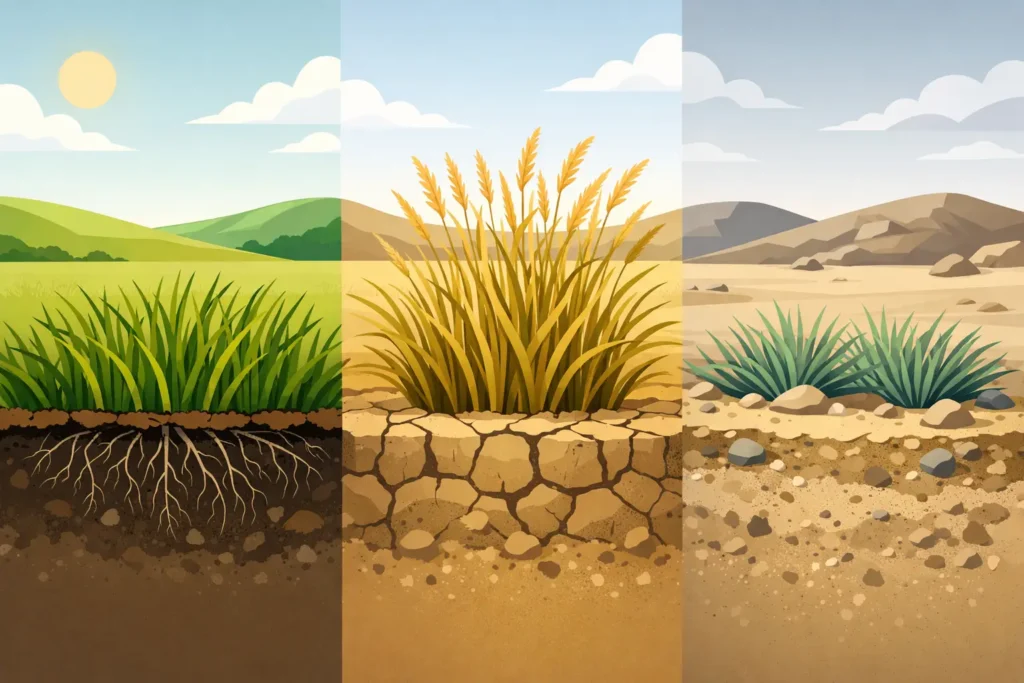
Poor soil usually shows up the same way, whether you are looking at a roadside slope, a reclaimed worksite, a dry acreage, or a thin patch around a commercial landscape. The stand is uneven, growth is slow, and anything demanding quickly gives up. If you are asking which grass grows on poor soil, the better question is often which grass will establish, hold, and keep performing under the exact limits of that site.
That distinction matters. Poor soil is not one single condition. It can mean low fertility, low organic matter, shallow topsoil, compaction, salinity, drought stress, gravelly texture, or a disturbed profile with very little biological activity. The right grass for one kind of poor soil may struggle badly in another. In practical terms, success comes from matching the species to the limitation, not just choosing the toughest name on a seed tag.
Which grass grows on poor soil depends on the soil problem
On most challenging sites, grass performance comes down to four things: rooting depth, tolerance to drought or low fertility, speed of establishment, and persistence over time. A species that germinates quickly can be valuable for erosion control, but it may not be the best long-term fit. A species that survives harsh conditions for years may establish more slowly and need better planning at seeding.
That is why poor-soil grass selection is usually a balancing act. If the site is exposed and erosive, early cover matters. If the site is dry and nutrient-poor, persistence matters more. If the ground has been heavily disturbed by industrial work or grading, the seed mix may need to do more than simply green up the surface. It may need to stabilize soil, support ecological recovery, and tolerate uneven site conditions at the same time.
The best grasses for poor soil
Tall fescue
Tall fescue is one of the most dependable options when poor soil also means drought, low fertility, or wear. It has a deep root system compared with many turf-type grasses, and that helps it hold on when moisture is limited. On commercial landscapes, utility corridors, and lower-input green spaces, it often performs better than species that need richer topsoil and more regular irrigation.
The trade-off is appearance and use. Tall fescue can provide a strong, durable stand, but it does not always deliver the same fine texture some buyers want in highly manicured settings. It is usually chosen for performance first.
Fine fescues
Fine fescues are strong candidates where soils are lean, dry, and not heavily trafficked. Hard fescue, sheep fescue, and creeping red fescue are commonly used on difficult ground because they tolerate lower fertility and generally need less water than more demanding turf species. They are especially useful on slopes, rights-of-way, naturalized areas, and sites where a lower-maintenance cover is the goal.
These grasses are not all interchangeable. Creeping red fescue offers spread through rhizomes, which can help with soil coverage. Hard and sheep fescue are often valued for toughness and lower input needs. On poor soil, fine fescues are often more reliable than Kentucky bluegrass unless the site has been significantly improved.
Smooth bromegrass
For larger-scale reclamation, forage, and disturbed land applications, smooth bromegrass has long been used because it is adaptable and persistent. It handles a range of soils, including lower-fertility ground, and it develops a strong sod-forming root system that helps with soil stabilization.
That said, smooth brome is not the answer for every project. It can be aggressive, which may be an advantage for erosion control and long-term cover but less desirable where plant diversity is a priority. On reclamation sites, broader seed mix design often matters more than any one species.
Crested wheatgrass
If the site is dry, exposed, and low in fertility, crested wheatgrass is often worth serious consideration. It is well known for drought tolerance and its ability to establish on marginal land. In western conditions especially, it has a practical reputation for surviving where more demanding grasses thin out.
Its strengths are durability and adaptation. Its limitation is that it is more functional than refined. For forage, reclamation support, and basic cover on difficult sites, it can be a strong fit. For a softer, more conventional lawn look, it is usually not the first choice.
Slender wheatgrass
Slender wheatgrass is commonly included in reclamation and restoration seedings because it establishes relatively quickly and adapts to a wide range of disturbed soils. It is useful where fast early cover is needed, especially on sites that have been stripped, graded, or otherwise disrupted.
It is often best viewed as part of a system rather than a stand-alone long-term answer. In many mixes, slender wheatgrass helps stabilize the site in the early phase while slower, longer-lived species develop.
Annual or short-term nurse grasses
On very poor soil, the first challenge is often simply getting cover started. In those situations, an annual nurse crop or short-term grass can help reduce erosion, moderate the soil surface, and support establishment of permanent species. This approach is common in reclamation and roadside work.
The caution is simple. Fast cover is not the same as lasting performance. If the permanent mix underneath is weak, or if the nurse component is too competitive, the site may look good early and thin later.
What usually fails on poor soil
Kentucky bluegrass is a good example of a grass people often expect to work everywhere, but it does not always deliver on poor soil. In fertile, managed settings, it can produce an attractive stand. On dry, compacted, low-organic ground, it often struggles unless the site receives meaningful soil improvement and ongoing maintenance.
Perennial ryegrass can establish quickly, which is useful in some blends, but it generally prefers better conditions than the toughest fescues or wheatgrasses. On truly marginal ground, speed alone does not make it the best long-term choice.
This is where many projects go sideways. The seed is selected based on familiarity or appearance instead of site limits. Poor soil tends to expose that mistake quickly.
How to choose which grass grows on poor soil at your site
Start with the intended use of the area. A low-maintenance industrial site, a reclaimed corridor, a forage field, and a commercial lawn all ask for different things from the stand. The best species for one may be the wrong species for another, even if the soil conditions look similar.
Next, look honestly at the limiting factor. If moisture is the main problem, drought tolerance should lead the decision. If the site is compacted or shallow, rooting behavior matters. If topsoil is missing and fertility is low, species that tolerate lean conditions should move up the list. If erosion is immediate, early establishment becomes more important.
Then consider whether a single species is enough. On many poor-soil sites, a blend performs better because each component does a different job. One grass may establish quickly, another may persist through dry years, and another may provide better sod strength or seasonal performance. For reclamation and disturbed ground especially, custom mix design often gives better results than trying to force one species to do everything.
Soil improvement still matters
Even the right grass has limits. Poor soil can often be made more workable with practical improvements such as relieving compaction, adjusting grading, adding organic matter where appropriate, or addressing fertility gaps identified through soil testing. Those changes do not need to turn the site into premium topsoil. They only need to improve the odds of establishment and persistence.
This is especially true on commercial and industrial projects where failure costs time. If the site is severely compacted, crusted, saline, or stripped of topsoil, seed choice alone may not carry the project. Establishment planning, timing, and site prep matter just as much.
A practical answer for tough sites
So which grass grows on poor soil best? In many cases, fine fescues, tall fescue, crested wheatgrass, smooth bromegrass, or slender wheatgrass are the leading candidates, depending on whether the job is turf, forage, erosion control, or reclamation. None of them is universally best. The strongest choice depends on what poor soil means on your site and what the stand needs to do after it emerges.
That is why the best results usually come from working backward from the site condition and the project goal. Poor soil does not rule out a successful stand, but it does punish generic seed decisions. Match the grass to the limitation, give establishment the support it needs, and the site has a much better chance to hold for the long term.