
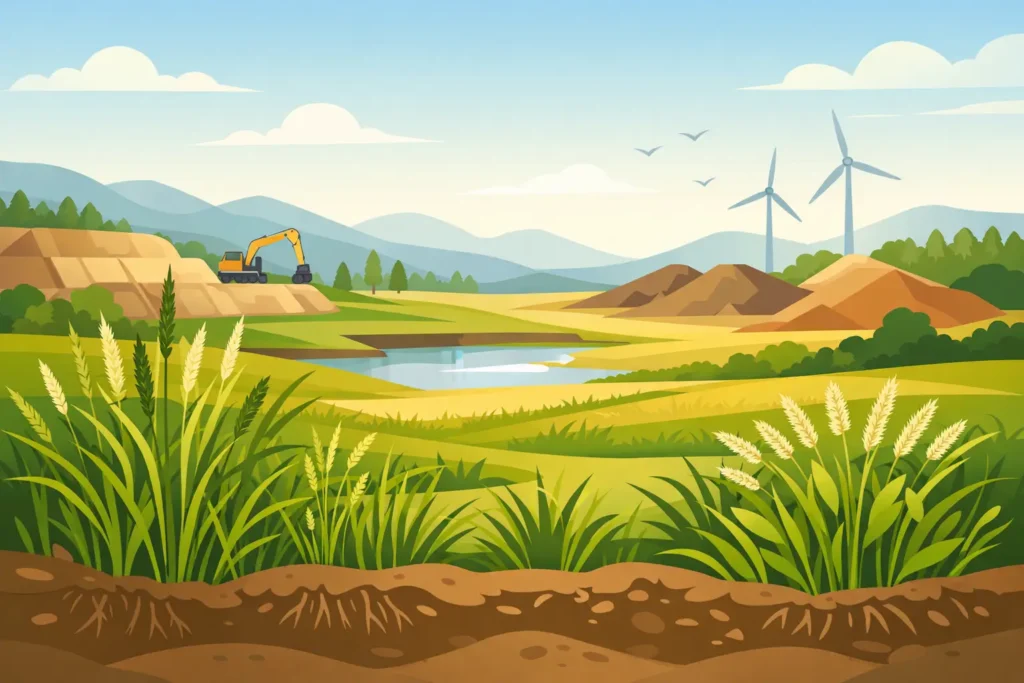
A reclamation site can look stable on paper and still fail in the field. The difference is often the seed mix. Choosing the best grasses for reclamation sites is not about picking the toughest species on a list. It is about matching grass traits to slope, soil condition, moisture, end land use, and the timeline for cover and persistence.
On disturbed ground, grasses do a lot of the heavy lifting early. They slow erosion, improve trafficability, build root mass, and create the conditions other species need to establish. But not every grass belongs on every site. A species that performs well on a pipeline right-of-way may be the wrong fit for a saline roadside, a dry borrow area, or a reclamation project that needs strong native character over time.
What makes the best grasses for reclamation sites?
The best performers usually bring a few core strengths. They establish reliably, compete well enough to stabilize the site, and hold on through weather swings and uneven soils. In practical terms, that means looking at rooting depth, tolerance to drought or wet feet, soil salinity, fertility levels, and how aggressively a grass spreads.
This is where reclamation gets more nuanced than standard turf or forage seeding. Fast cover matters, but so does long-term balance. If a grass is too aggressive, it can crowd out the broader plant community you are trying to build. If it is too slow, the site may erode or stay open to weeds for too long. Most successful reclamation mixes balance short-term function with long-term land goals.
Cool-season grasses that do the work
In many reclamation settings across the northern U.S. and Western Canadian-style climates, cool-season grasses are the backbone of the mix. They establish in moderate temperatures, respond well to spring moisture, and offer dependable root development.
Slender wheatgrass
Slender wheatgrass is often one of the first species considered for reclamation, and for good reason. It establishes quickly, handles a range of soils, and brings useful tolerance to saline conditions. That combination makes it a strong fit for disturbed sites where topsoil quality is inconsistent and early stabilization is a priority.
Its trade-off is longevity. Slender wheatgrass is often short-lived compared with some other perennial grasses. That does not make it a poor choice. It just means it works best when paired with longer-lived species that can carry the stand after the early establishment phase.
Western wheatgrass
Western wheatgrass is a dependable native option for long-term persistence. It spreads by rhizomes, which helps with soil stabilization and recovery over time. Once established, it offers strong staying power on many dryland and moderately saline sites.
The challenge is patience. Western wheatgrass is not always the fastest species out of the gate, especially on harsh sites with low moisture. In a reclamation blend, it often performs best alongside species that provide quicker early cover while it develops.
Streambank wheatgrass
Where erosion control is a major concern, streambank wheatgrass deserves serious attention. It establishes relatively quickly and produces a dense root system that helps hold soil in place. That makes it useful on slopes, rights-of-way, and other areas where soil movement is a real risk.
It can be an especially practical choice when the site needs both rapid stabilization and multi-year performance. As with most reclamation species, though, placement matters. It is a better fit for certain disturbed upland and corridor applications than for highly specialized native restoration goals.
Thickspike wheatgrass
Thickspike wheatgrass is another rhizomatous option that brings durability to sandy or drought-prone ground. Its spreading habit helps close gaps and support long-term cover, especially where wind erosion is part of the concern.
That same spreading trait can be a benefit or a drawback depending on project objectives. If the goal is strong stabilization on a tough site, it can be an asset. If the goal is a more diverse and delicate native plant community, it may need to be used more carefully in the mix.
Canada wildrye
Canada wildrye is often valued for early vigor and visual cover. It can help sites green up quickly and provide a bridge while slower, long-lived species establish. On projects where appearance, weed competition, and first-year stabilization all matter, it can be a useful tool.
It is not typically the species that defines the stand ten years later. Think of it more as a functional early contributor in a broader reclamation strategy.
Fescues
Fescues, including hard fescue and sheep fescue in the right applications, can bring drought tolerance and lower-input persistence. They are often used where a finer-textured, lower-growing grass is desirable or where soils are lean and moisture is limited.
Their value depends heavily on the site. Fescues are not a one-size-fits-all answer for industrial reclamation, but on certain upland sites or low-maintenance cover areas, they can add lasting density without excessive growth.
When non-native grasses can make sense
Not every reclamation project has the same endpoint. Some sites need immediate soil security and operational function first, with ecological succession managed over time. In those situations, selected introduced grasses may still have a place, especially where regulations, land use goals, and site conditions allow for them.
Crested wheatgrass is a common example in dry, disturbed settings. It establishes well, tolerates drought, and provides strong competition against erosion and weeds. The downside is that it can dominate a stand and reduce broader diversity if it is overused. For projects focused on native restoration, that is a serious limitation. For tough, erosion-prone ground where rapid stabilization is the first order of business, it can still be practical.
Smooth brome has also been used historically on some disturbed lands because of its vigor and sod-forming habit. But it can be highly competitive, and many reclamation programs now use it much more selectively or avoid it altogether where native recovery is a priority. This is a good example of why the best grass on paper is not always the best grass for the job.
Site conditions should drive the mix
When buyers ask for the best grasses for reclamation sites, the honest answer is usually, it depends on the constraints. A dry upland slope, a compacted subsoil, and a moist low area should not get the same recommendation just because they fall under the same project name.
Soil texture matters because it affects moisture holding capacity and root penetration. Salinity matters because some species will fail slowly and expensively if the salt load is higher than expected. Topsoil availability matters because a site seeded into salvaged topsoil behaves differently than one seeded into subsoil or spoil. Even the season of seeding changes the odds for certain species.
End use matters too. A pipeline corridor, a municipal utility site, a solar project, and a post-construction slope may all need stabilization, but they may not need the same plant community. Some projects need a native-forward mix for long-term ecological performance. Others need dependable cover, manageable growth, and low maintenance around infrastructure.
Why blends usually outperform single-species thinking
Single-species seedings can look simple, but they rarely solve the whole problem on reclamation ground. Blends spread risk. One species may establish fast, another may handle salinity, and another may provide the long-term root structure needed after the first few years.
A well-built reclamation blend also responds better to variable weather. If spring is dry, one grass may carry the stand. If moisture improves later, slower species can catch up. That kind of built-in flexibility is part of what makes a mix perform more reliably than a one-note approach.
For many projects, grasses should also be considered alongside legumes and native forbs where appropriate. Grasses create structure and stability, but a healthier reclaimed site often needs more than grass alone. The right combination depends on reclamation targets, maintenance expectations, and the level of biodiversity the project is designed to support.
Common mistakes when choosing reclamation grasses
One of the biggest mistakes is choosing for speed alone. Fast establishment is valuable, but not if the species burns out early or suppresses the rest of the stand. Another common issue is ignoring soil limitations, especially salinity and compaction. A mix can look excellent on the spec sheet and still underperform if the site was not read correctly.
There is also a tendency to overgeneralize from past jobs. A blend that worked on one roadside or wellsite may not translate to another site with different soil handling, drainage, or reclamation objectives. Good seed selection is site-specific work.
That is where practical regional knowledge matters. Contractors and land managers do not need a theoretical list. They need species and blends that match real field conditions, permit requirements, and establishment windows.
The right grass is the one that fits the land
Reclamation success usually comes from matching species behavior to site reality. Slender wheatgrass, western wheatgrass, streambank wheatgrass, thickspike wheatgrass, Canada wildrye, and selected fescues all have a place. None of them is the answer to every problem.
The strongest reclamation results come from looking at the whole picture – soil, moisture, salinity, slope, land use, and the kind of plant community the site needs to become. If you start there, the seed mix has a much better chance of doing what it is supposed to do after the equipment is gone and the site is left to perform on its own.
A good reclamation stand should not just germinate. It should hold, recover, and keep earning its place year after year.