
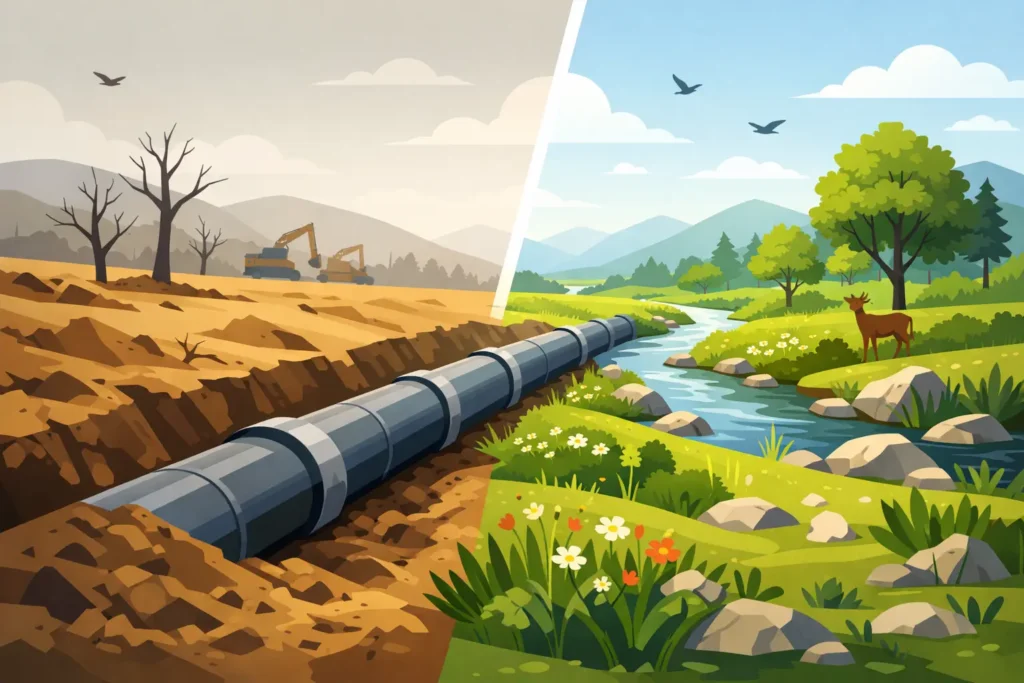
A successful pipeline right-of-way does not look the same on every kilometer. One section may cross productive pasture, another may run through native grassland, and another may include steep, erosion-prone slopes with compacted subsoil. This pipeline revegetation project example shows how a practical, site-led seed plan can help restore cover, protect soil, and support long-term land performance after construction.
The scenario is representative of projects across Western Canada. It is not a substitute for project-specific reclamation requirements, landowner commitments, or regulatory direction. Those details should always shape the final seed mix and establishment plan.
Pipeline revegetation project example: a mixed-site right-of-way
Consider a newly constructed pipeline corridor in central Alberta. Construction has left a 30-meter-wide disturbed right-of-way crossing three distinct areas: an annually grazed pasture, a low swale that stays wet through spring, and an upland slope exposed to wind and runoff. Topsoil was stripped and replaced, but the soil profile is not uniform. Some areas have good topsoil depth, while others show compaction, low organic matter, and exposed subsoil.
The project team has four practical objectives. They need quick ground cover to reduce erosion, a stable plant community that will persist after the initial establishment period, vegetation compatible with the surrounding land use, and a result that meets the approved reclamation objectives. A single generic grass mix may establish in parts of the corridor, but it is unlikely to perform equally well across all three zones.
The better approach is to divide the corridor into seed management areas. This adds planning and coordination, but it avoids forcing one blend to solve several different site problems.
The pasture section
The pasture portion needs a durable, palatable stand that can tolerate traffic, variable moisture, and eventual grazing. The seed blend may include persistent grasses selected for the local soil and climate, supported by appropriate legumes where they fit the land use plan. The goal is not simply a green cover in the first season. It is to establish a stand that can contribute to forage production and remain stable under managed use.
Species choice depends on factors such as soil texture, salinity risk, expected grazing pressure, and the existing pasture composition. On a productive agricultural corridor, a forage-oriented mix may be the right answer. On native range or land intended to return to a more natural plant community, the mix and establishment expectations will be different.
The wet swale
The low area presents a separate challenge. Water can collect after snowmelt and heavy rain, while the ground may dry considerably later in the season. Seed selected for the upland slope may struggle here, especially if it does not tolerate periodic saturation.
For this zone, the seed plan should favor species that handle wetter soils and establish dependable cover without creating an unsuitable community for the site. Timing also matters. Seeding into a wet area when soils are saturated can lead to poor seed placement and compaction. In some cases, the practical decision is to complete the main corridor seeding first and return to the wet section once conditions allow proper equipment access.
The exposed slope
The slope is where poor establishment becomes expensive quickly. Rainfall can move loose soil and seed downslope before seedlings develop enough root mass to hold the surface. Wind can also dry the seedbed and reduce emergence.
A slope blend should emphasize quick early cover and strong rooting, while still supporting the long-term reclamation target. Seed alone may not be enough. Depending on grade, soil condition, and weather risk, the crew may need surface roughening, erosion control blanket, tackifier, straw mulch, or other approved stabilization measures. These tools protect the seedbed, but they do not replace correct seed selection or sound site preparation.
Start with the soil, not the seed bag
The most common weakness in pipeline revegetation is treating seed as the entire solution. Seed performance starts with the seedbed. If topsoil is heavily compacted, placed unevenly, or left smooth enough to shed water, even a well-designed blend faces an uphill battle.
Before seeding, the project team should confirm topsoil placement, relieve compaction where needed, and create a firm but receptive seedbed. A surface that is too loose can bury seed too deeply. A surface that is too hard or crusted can prevent good seed-to-soil contact. Small seed is especially vulnerable to excessive depth, which is why calibration and planting depth deserve close attention.
Soil testing can also clarify whether pH, salinity, nutrient availability, or organic matter limitations may affect establishment. Fertility decisions should support the desired vegetation without encouraging a short-lived flush of growth that leaves the stand weak later. The right approach depends on the reclamation target and site conditions, not a standard application rate.
Build the blend around function and persistence
A well-built pipeline blend gives each component a job. Some species provide early cover. Others contribute fibrous roots for soil stabilization. Longer-lived grasses help maintain the stand over time, while legumes may add value on appropriate sites through forage quality and nitrogen contribution. Where biodiversity restoration is part of the objective, native grasses, forbs, or shrubs may be needed as well.
That does not mean every blend should contain every possible component. A diverse mix can be valuable, but diversity without a clear site purpose can complicate establishment and make results harder to assess. For example, a broad native restoration mix may be appropriate on a designated natural area, while a highly practical pasture blend may better serve a working agricultural operation.
Seed quality and lot information matter alongside species selection. Germination, purity, weed seed content, and the proportion of each species affect what is actually being planted. A custom mix should be developed against the project specification, local conditions, and the desired post-construction land use.
Match the seeding method to the corridor
On accessible, prepared ground, drill seeding often provides consistent depth and seed-to-soil contact. It can be an effective option for larger right-of-way sections where equipment can travel safely. Broadcast seeding may be necessary on rough terrain, narrow access areas, or slopes, but it typically needs careful surface preparation and light incorporation or packing to improve contact.
Hydroseeding can help on difficult slopes or sites requiring mulch and tackifier as part of the application. It is useful when erosion protection is a priority, but crews should recognize the trade-off: application quality, weather, surface condition, and follow-up management still determine whether the seed establishes.
The timing window also matters. Spring seeding can take advantage of moisture, but cold soils and early weeds can slow development. Late summer or dormant seeding can fit construction schedules and site conditions in some areas, although winter exposure, spring runoff, and variable emergence must be considered. There is no universally best date. The best timing is the one that gives the chosen species a reasonable establishment window and allows the crew to prepare the ground properly.
Monitor the first two growing seasons
A green corridor shortly after seeding is encouraging, but it is not proof of long-term success. Monitoring should check whether desirable species are establishing across the full right-of-way, whether bare areas are expanding, and whether erosion or weeds are limiting progress.
Early inspections are especially valuable after major rain events. Rills, sediment movement, ponding, or seed washouts should be addressed before they grow into larger failures. Where establishment is uneven, the remedy may be localized reseeding, erosion-control repair, weed management, or a closer look at the underlying soil condition.
Land use needs to be managed during establishment as well. If a pasture section is grazed too soon, seedlings can be pulled out or weakened before roots are established. A temporary rest period and a planned return to grazing can protect the investment and improve persistence.
Use the example to ask better project questions
The value of a pipeline revegetation project example is not copying one blend from one corridor to another. It is learning to ask the right questions before seed is ordered: What is the final land use? Where are the wet, dry, saline, steep, compacted, or high-traffic areas? What does the approval require? How will the site be seeded, protected, and monitored?
For contractors and operators, this planning reduces avoidable rework. For landowners, it supports a return to productive and stable ground. Proterra Seeds works with project teams to develop seed solutions around those real field conditions, with the practical goal of establishment that holds up after the equipment has left.
The strongest reclamation results usually begin with a simple decision: treat each part of the corridor as the site it is, then give the seed and soil the conditions they need to perform.