
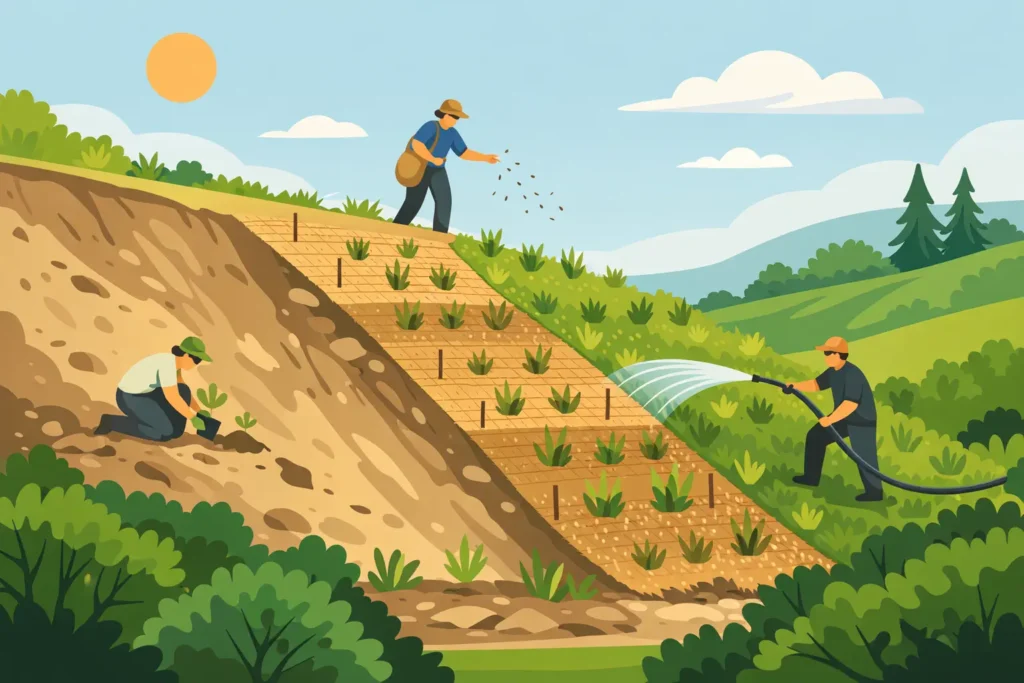
A slope can look stable on the day grading wraps up and still fail the first time a hard rain hits it. That is why knowing how to revegetate disturbed slopes matters well beyond appearance. On roadbanks, utility corridors, well sites, construction grades, and reclaimed ground, vegetation is what turns loose soil into a functioning surface again.
The challenge is that slopes do not forgive shortcuts. Seed that performs well on flat ground may wash, dry out, or fail to root on an exposed incline. A mix that looks good on paper can struggle if the soil profile is compacted, nutrient-poor, or missing topsoil altogether. Good slope revegetation starts with reading the site honestly and matching the seed and stabilization approach to the conditions you actually have.
How to revegetate disturbed slopes starts with site reality
Before choosing a seed mix, look at the slope as a system. Grade, aspect, soil texture, erosion risk, water movement, and intended land use all affect establishment. A south-facing sandy slope in a dry corridor behaves very differently from a north-facing clay slope beside a drainage channel.
Steepness is the first practical filter. Mild slopes may establish with standard seeding and surface protection, while steep or highly erodible slopes often need a more coordinated approach that combines soil preparation, tackifiers or blankets, and species chosen for quick cover and dependable root mass. If rills or gullies are already forming, vegetation alone is not the first fix. Water needs to be slowed and directed before seed has much chance to hold.
Soil condition is just as important. Many disturbed slopes are compacted from equipment traffic or stripped of organic matter during construction. Some have saline influence, low fertility, or poor structure that limits infiltration. If roots cannot move into the soil profile, even quality seed will struggle. In those cases, the better investment is often in amending or loosening the soil first rather than simply increasing seeding rates.
Start with slope stabilization, not just seed
Revegetation works best when physical erosion is already being managed. If runoff is concentrating down the face of the slope, seed will be asked to solve a grading problem it cannot solve.
That does not always mean major earthwork. Sometimes it means breaking up compaction, reinstalling topsoil more evenly, tracking the slope to create shallow surface roughness, or adding erosion control materials that reduce raindrop impact and help seed stay in place. On longer or steeper slopes, check dams, diversion features, or armoring in concentrated flow areas may be needed before seeding begins.
Surface roughness matters more than many people expect. A smooth, tightly packed slope sheds water and gives seed very few protected microsites. A roughened surface slows runoff, captures seed, and improves seed-to-soil contact. On difficult slopes, that difference can be the line between even establishment and patchy failure.
Seed selection should match function first
When people ask how to revegetate disturbed slopes, the conversation often jumps straight to species names. That is understandable, but the better question is what the vegetation needs to do in the first 12 months and what it needs to become over time.
On many slopes, the first job is rapid surface cover and root development to reduce erosion. The second job is persistence under the site conditions. The third, depending on the project, may be restoring native plant communities, supporting pollinators, meeting reclamation targets, or creating a manageable long-term stand beside infrastructure.
That is why one-size-fits-all mixes usually disappoint. A temporary cover crop can help protect soil quickly, but it should not overwhelm the long-term species. A native-focused restoration mix may be the right ecological choice, but some native species establish more slowly and benefit from companion species or stronger erosion control measures early on. In industrial reclamation, municipalities, and agricultural settings, the right answer often involves balancing fast establishment with long-term suitability.
Grasses are usually the backbone of slope stabilization because fibrous root systems help bind soil and provide early cover. Legumes may improve diversity and contribute nitrogen, but they are not always suited to every slope environment or maintenance plan. Broadleaf species can add ecological value, though they need to be selected carefully if sightlines, mowing, or regulatory requirements are part of the project.
Regional fit matters. Western Canadian conditions, especially in Alberta and surrounding areas, can bring drying winds, variable moisture, short establishment windows, and soils that range from heavy clay to coarse-textured subsoils. A blend should reflect those realities rather than rely on generic assumptions.
Timing can make or break establishment
There is no single perfect calendar date for every slope. The right timing depends on moisture, temperature, elevation, and the species being used. Still, the principle is simple: seed when the site has the best chance of holding moisture through germination and early root development.
Spring can work well where moisture is available and the slope is ready early enough to catch the growing season. Late summer or dormant seeding can also be effective in the right conditions. The risk comes when seeding is driven only by construction schedules. Mid-summer seeding onto hot, exposed slopes with no moisture support is often more hopeful than strategic.
If a project must seed in a less-than-ideal window, expectations and methods should shift. That may mean stronger erosion control, adjusted species selection, or planning for follow-up work rather than assuming a single pass will finish the job.
Seeding method matters on difficult grades
Not every slope should be seeded the same way. Drill seeding gives excellent seed placement on accessible, stable ground, but it is often impractical on steeper slopes or uneven terrain. Broadcast seeding can work if the seed is properly incorporated and protected, though it can leave too much to chance on exposed grades. Hydroseeding can improve coverage and efficiency on many slopes, especially where access is limited, but its success still depends on site prep, mix design, mulch quality, and moisture conditions.
The common mistake is treating application method as the main decision and everything else as secondary. In reality, seeding method should support the site plan, not replace it. A hydroseeded slope with poor soil contact and active runoff can fail just as quickly as a broadcasted one.
Mulch and erosion control products often play a valuable supporting role. They help conserve moisture, reduce surface movement, and protect seed during establishment. But they work best when matched to slope length, gradient, rainfall intensity, and the expected time to vegetation cover.
Soil amendments can help, but they are not a cure-all
Disturbed slopes often test low in organic matter and may need fertility support, especially where topsoil is thin or absent. That said, more fertilizer is not automatically better. High fertility can sometimes favor aggressive species or create flushes of top growth without improving root establishment enough to justify the cost.
The better approach is targeted. Use soil testing where possible, identify real limitations, and correct what matters most. On some sites, that may be pH or salinity. On others, it may be compaction relief, organic amendments, or modest starter fertility. Amendments should support the seed mix and project goals, not push the stand in the wrong direction.
Expect maintenance, not magic
Even a well-planned slope revegetation job needs follow-up. Germination checks, erosion inspections, weed pressure, and thin areas all need attention early. The first few months tell you whether the system is stabilizing or slipping.
Weeds are a common issue on disturbed sites because the conditions that favor seeded species often favor opportunistic species too. The right response depends on the project. In some cases, early mowing or selective control is enough to keep competition from shading young seedlings. In others, patience is warranted while the desirable stand fills in. Overreacting can damage the very vegetation you are trying to establish.
Reseeding is sometimes part of doing the job properly, not evidence that the original plan failed. Slopes are harsh environments. If part of the site crusted over, washed, or dried out before establishment, a touch-up pass may be the practical move that secures long-term success.
What successful slope revegetation usually looks like
A successful slope is not always the one that greens up fastest in the first few weeks. Quick color can be misleading if the stand is shallow-rooted, poorly adapted, or likely to thin out after the first stress period.
The better measure is whether the slope is holding together over time. You want even coverage, roots moving into the soil profile, reduced sediment movement, and species that fit the long-term use of the site. On reclamation and infrastructure projects, success also means the stand can persist with realistic maintenance, not constant rescue work.
That is where experience pays off. Seed selection, timing, and erosion control all need to work together. A practical, regionally informed plan almost always performs better than a generic mix applied the same way on every slope.
If you are deciding how to revegetate disturbed slopes, start with the conditions in front of you, not the seed tag alone. When the site prep is right and the mix matches the ground, vegetation stops being a cosmetic finish and starts doing the real work of holding the land in place.