
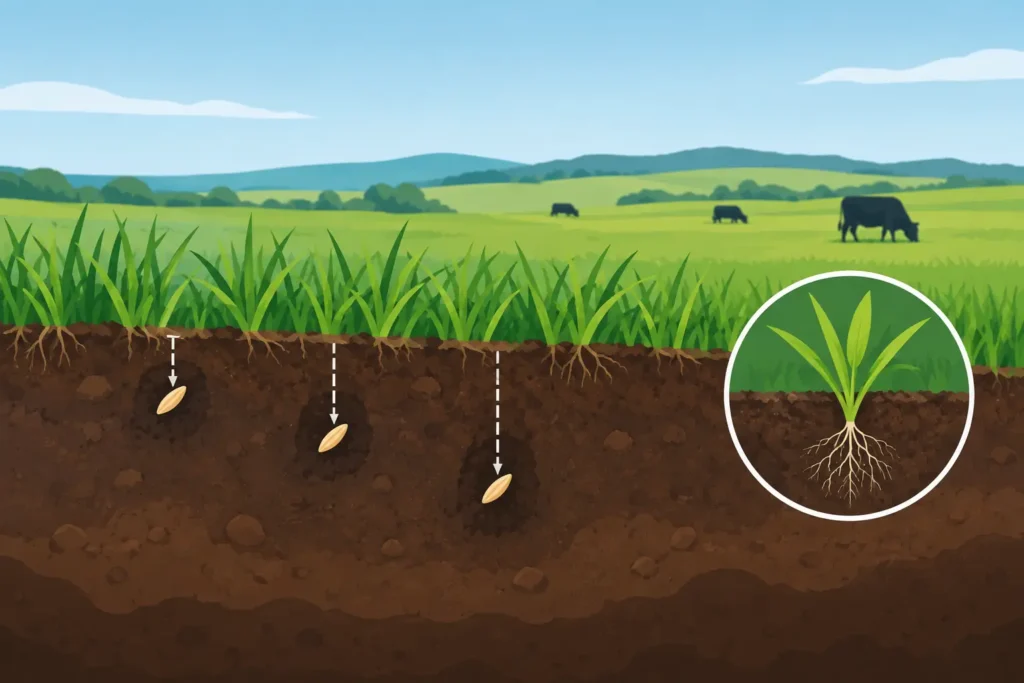
A pasture can be seeded with the right species and still miss its establishment target if the seed is placed at the wrong depth. Pasture seed depth is a small setting with large consequences: too deep, and seedlings run out of energy before reaching daylight; too shallow, and seed can dry out, wash away, or become easy feed for birds.
For most pasture work, successful placement is less about chasing one exact number and more about matching seed size, soil moisture, soil texture, and the equipment in use. The goal is simple: place seed in firm soil where it can absorb moisture quickly and emerge without fighting through unnecessary soil.
Why Pasture Seed Depth Controls Establishment
Seeds carry a limited energy reserve. Large seeds such as peas or cereal grains can push through more soil than small-seeded grasses and legumes. Many common pasture species, including smooth bromegrass, timothy, orchardgrass, fescues, clovers, and alfalfa, are small-seeded. They generally belong close to the surface.
A practical target for many pasture grass and legume mixes is about 1/4 to 1/2 inch deep in a firm seedbed. In dry, sandy ground, placement may move toward 1/2 to 3/4 inch where moisture is more dependable. Going deeper than that is often a gamble for fine seed. Seedlings may emerge slowly and unevenly, or fail before they reach the surface.
Planting too shallow has its own risks. Seed resting on loose soil or heavy residue may have poor seed-to-soil contact. It can take in moisture after a rain, then lose it quickly during wind or heat. On sloping ground, shallow seed is also more vulnerable to movement from runoff.
The best emergence usually comes from shallow placement followed by firm packing. Firm soil brings the seed into contact with moisture while leaving a short, manageable path to the surface. That is why a properly adjusted drill and packer can make more difference than adding more seed to the acre.
Seed Size Sets the Starting Point
When a mix contains several species, use the smallest important seed in the blend to guide depth. A drill set for a companion cereal crop can easily bury clover, alfalfa, or fine fescue too deeply. If a nurse crop is part of the plan, consider separate passes or equipment settings that protect the smaller-seeded component.
Most pasture mixes require a practical compromise. The aim is not identical depth for every seed, which is rarely possible in field conditions. It is to establish the core species consistently and avoid placing a meaningful portion of the blend beyond its emergence range.
Match Depth to Soil and Field Conditions
A stated drill setting is only a starting point. Actual seed depth changes across a field with soil texture, residue, wheel tracks, uneven tillage, and moisture conditions. A setting that places seed at 1/2 inch in a level loam may leave it nearly exposed on a dry ridge or bury it too deep in soft worked soil.
In heavier clay or clay-loam soils, stay on the shallow side when adequate moisture is present. These soils can crust after intense rain, and small seedlings may struggle to break through a sealed surface. Good surface preparation and firming are particularly valuable here.
Sandy soils dry faster near the surface, so slightly deeper placement may be justified when the seed zone is dry. Still, depth is not a substitute for moisture. If moisture sits well below the safe emergence depth for the species being planted, waiting for suitable conditions may produce a better stand than placing fine seed too deep.
Residue changes the equation as well. No-till and reduced-tillage systems can conserve moisture and protect soil, but residue can interfere with seed placement when openers do not cut cleanly or closing wheels fail to firm the slot. Check behind the drill, not just at the monitor. Open several rows in representative parts of the field and inspect where seed actually landed.
Setting Pasture Seed Depth With Common Equipment
A drill is often the most reliable choice for pasture establishment because it can place seed at a consistent shallow depth and press soil around the seed. The key is calibration in real field conditions. A drill that looks properly adjusted in the yard can behave differently once it encounters loose ground, residue, or changing soil moisture.
Before committing to the full field, seed a short test strip. Stop, carefully uncover seed in multiple rows, and measure its placement. Inspect both the seed trench and the closing action. If the trench remains open, the seed can dry out even if the measured depth looks correct.
Broadcast seeding can work well on accessible ground, especially when followed by harrowing, cultipacking, or rolling. It requires attention to surface firmness. Broadcast seed should generally remain very near the surface and be pressed into the soil rather than incorporated aggressively. A common failure is working broadcast seed too deeply with a heavy harrow or multiple passes.
For frost seeding, seed is intentionally placed at or near the surface. Freeze-thaw cycles can help work seed into the soil, but results depend on exposed soil, timing, slope, and species selection. It is a useful management tool in the right situation, not a replacement for proper seedbed preparation where a new pasture stand is needed.
Do Not Confuse a Fine Seedbed With a Loose Seedbed
A seedbed can look smooth and still be too soft. Loose, fluffy soil creates an uneven planting depth because drill openers sink and seed is covered inconsistently. It also loses moisture quickly around the seed zone.
A well-prepared pasture seedbed should be level, free of large clods, and firm enough that a boot heel leaves a shallow impression. That firmness supports accurate shallow placement and better capillary movement of moisture to the seed. Packing before and after seeding may be warranted on heavily worked ground.
Field Checks That Prevent Expensive Re-Seeding
The most useful depth decisions happen before the entire field is planted. A few simple checks can reveal whether the equipment and seedbed are working together:
- Dig behind the drill in low areas, slopes, ridges, and different soil textures.
- Check depth across several openers, not just one row.
- Confirm the seed slot is closed and the soil is firm around the seed.
- Watch for seed sitting in residue, sidewall smearing, or seed placed in dry soil.
- Recheck after a change in field conditions, drill speed, or packing pressure.
These checks take little time compared with repairing a thin, uneven stand. They also help separate a depth problem from other establishment issues such as poor seed-to-soil contact, inadequate moisture, crusting, or early weed competition.
Depth Is Only One Part of a Productive Pasture
Correct depth gives seed a fair start, but it cannot overcome every limitation. Soil test results, fertility, pH, weed pressure, planting date, grazing management, and species selection all influence long-term pasture performance. A shallow-planted seed in a firm, moist seedbed still needs enough time to establish roots before heavy traffic or grazing.
For mixed pastures, the right blend should match the production goal and site. A hay field, rotational grazing pasture, saline area, wet swale, and reclaimed corridor may all call for different species and different establishment approaches. The depth target remains a practical foundation, but the site determines how that target is applied.
Proterra Seeds works with producers and land managers who need seed solutions suited to demanding conditions, from forage production to reclamation. When the species, seedbed, and placement work together, a shallow, well-firmed seed zone gives a pasture the best chance to emerge evenly and persist for years.