
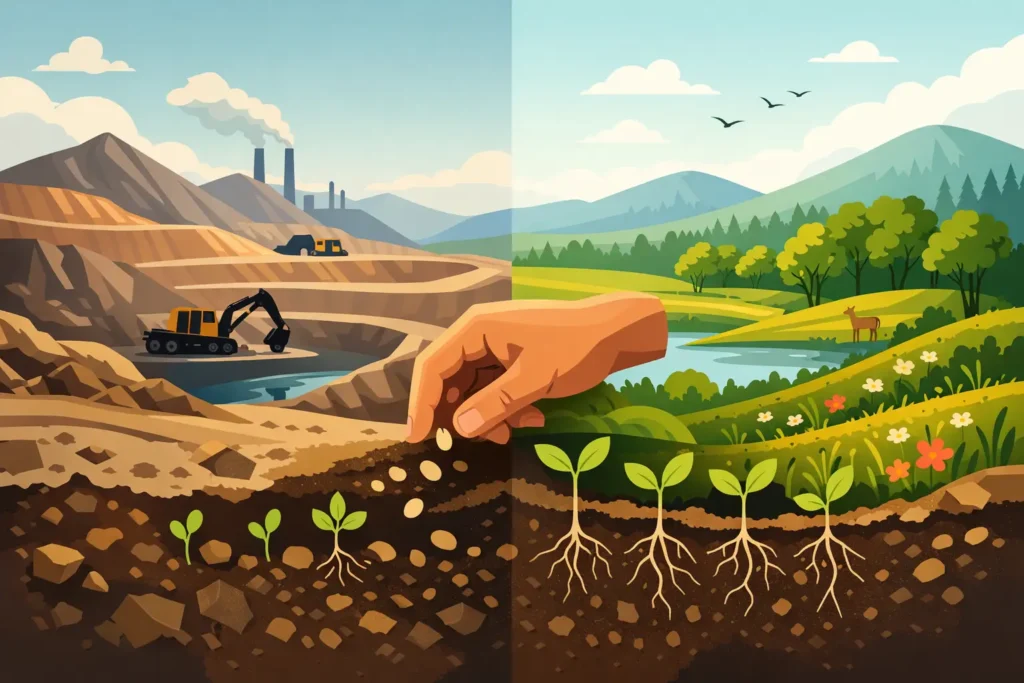
A successful reclamation site does not begin with a seed bag. It begins with an honest reading of the ground: what was removed, what remains, where water moves, how the slope behaves, and what the land needs to become over time. The right mine reclamation seed supports that process by establishing cover where soils are exposed, helping control erosion, and building a plant community suited to the site’s final land use.
For mine operators, contractors, and land managers, seed selection is one of the most visible decisions in reclamation. Poor establishment can leave bare areas, invite weeds, increase sediment movement, and create costly follow-up work. A well-designed blend gives a disturbed site a stronger start, but only when the species, application method, soil conditions, and timing all work together.
Why Mine Reclamation Seed Needs a Site-Specific Approach
Mine disturbances are rarely uniform. One area may have compacted haul-road material, another may have stockpiled topsoil, while a slope below may receive runoff and sediment after every major rain event. A single standard mix can establish well in one portion of the site and struggle badly in another.
That is why reclamation seed should be selected around site conditions rather than simply chosen for a general green appearance. The most dependable blends account for soil texture, available topsoil, salinity, moisture regime, slope, aspect, elevation, and planned land use. A mix intended for a dry, exposed upland will not necessarily be appropriate for a low area that holds moisture or a reclaimed pasture that needs to support grazing later.
The goal also matters. Some sites need quick temporary cover to stabilize soil during construction or before final grading. Others require a long-lived native plant community, productive forage, wildlife habitat, or a durable grass stand for industrial land closure. These are different jobs, and they call for different species combinations.
What a Strong Reclamation Blend Is Designed to Do
A properly built mine reclamation blend balances short-term establishment with long-term persistence. Fast-starting grasses can provide early ground cover and reduce erosion risk. Longer-lived grasses, legumes, shrubs, or native forbs may take more time to establish, but they contribute to the lasting function and diversity of the reclaimed landscape.
This balance is where many projects succeed or fail. A blend made entirely of aggressive, quick-growing species can create early visual cover but may limit the establishment of slower-growing plants. On the other hand, a highly diverse native blend may fit the final ecological objective but need careful site preparation, favorable timing, and patience during establishment.
Seed mixes may be designed to support several practical outcomes:
- Soil stabilization on slopes, stockpiles, and exposed ground
- Early vegetation cover to limit erosion and sediment movement
- Long-term grassland, forest-edge, pasture, or native habitat objectives
- Pollinator and biodiversity value where project plans call for it
- Forage production on reclaimed agricultural land
- Better resilience through species with different rooting depths and growth habits
The best approach depends on the reclamation plan, the site’s limitations, and how the land will be managed after release or closure.
Start With the Soil, Not the Species List
Before selecting seed, assess the growing medium. Seed cannot correct every soil problem on its own. Compaction, poor infiltration, low organic matter, salt-affected zones, acidity or alkalinity, and limited topsoil depth can all restrict establishment.
Soil testing provides useful direction for fertility and amendment decisions, but field observations matter just as much. Look for crusting after rain, rills on slopes, standing water, uneven topsoil placement, and evidence that subsoil has been brought to the surface. These details often explain why a blend performs differently across the same project area.
Where compaction is severe, loosening or ripping may be needed before seeding so roots can move into the profile. On slopes, roughening the surface across the slope can slow runoff and create small protected areas where seed and moisture can hold. In dry conditions, preserving every available inch of moisture can make a greater difference than adding more seed.
Topsoil handling is also critical. Salvaged topsoil can supply organic matter, nutrients, microorganisms, and an existing seed bank. However, it needs to be placed evenly and protected from erosion. Deep, uneven deposits or poorly graded stockpiled material may create variable establishment that no single blend can fully overcome.
Match Species to Moisture, Exposure, and End Land Use
The strongest mine reclamation seed blends use species with defined roles. Some establish quickly, some stabilize soil with dense fibrous roots, and some persist through dry periods or variable weather. Legumes may add diversity and contribute nitrogen over time, but they are not the right fit for every site or final land-use target.
For dry, exposed ground, drought tolerance and strong early rooting are often priorities. Areas with better moisture may support a broader range of grasses and forbs. Low spots should be assessed carefully because persistent wetness, temporary flooding, or saline seepage can quickly eliminate species that perform well on nearby uplands.
Native species can be appropriate where restoration plans call for regional plant communities and long-term biodiversity. They often require more precise timing, proper seed placement, and weed management during the establishment period. Introduced grasses or forage species can be a practical choice for sites intended for hay, pasture, or rapid soil stabilization, provided they align with project approvals and long-term management goals.
There is no universal rule that native is always best or that fast cover is always the priority. The right choice comes from the approved reclamation objective and the realities of the site. A dependable supplier should be able to discuss those trade-offs clearly rather than push a one-size-fits-all blend.
Seeding Method Affects Establishment as Much as the Blend
Even the right seed mix can underperform if it is applied poorly. Seed-to-soil contact, depth, and moisture access determine whether seedlings emerge and survive. Many reclamation grasses and forbs should be placed shallowly. Seed buried too deep may never emerge, while seed left exposed on a smooth, dry surface can be lost to wind, runoff, or wildlife.
Drill seeding is often effective on accessible ground because it places seed at a controlled depth and improves contact with the soil. Broadcast seeding can be useful on rough terrain, steep slopes, or areas where equipment access is limited, but it generally needs rolling, harrowing, tracking, or another approach to improve seed coverage and contact.
Hydroseeding may help cover large or difficult slopes, particularly where a mulch layer is needed for erosion protection. Its performance still depends on proper surface preparation, seed selection, moisture, and application conditions. It is not a substitute for correcting poor soil conditions or unstable slopes.
Timing should reflect local climate, soil moisture, species requirements, and the risk of erosion. Dormant seeding can work well for some projects when seed is expected to remain in place through winter and germinate under spring moisture. Spring and late-summer seeding windows can also be effective, but the ideal window changes with elevation, rainfall patterns, and the species in the mix.
Plan for the Establishment Period
Reclamation does not end after the seeder leaves the site. The first one to three growing seasons are when the project reveals whether the design is working. Regular inspections help identify bare areas, erosion channels, weeds, washouts, and moisture-related failures early enough to respond.
Weed pressure deserves particular attention. Disturbed land creates opportunity for unwanted annuals and invasive species, especially where soil has been moved or imported. A dense, well-matched stand can help reduce open space for weeds, but early monitoring and site-appropriate control measures are still needed.
Avoid judging success only by how green the site looks in the first few weeks. Some long-lived species establish slowly, and a young reclamation stand can appear uneven while roots are developing below ground. Evaluations should consider plant density, species presence, cover, erosion control, site variability, and the intended end land use.
When reseeding is required, identify the cause before applying more seed. If failure came from surface crusting, compaction, poor drainage, drought, or seed placement, repeating the same application without correcting the issue may produce the same result.
Build the Blend Around the Land You Are Returning
Mine reclamation is a practical restoration effort. The work must stand up to weather, meet land-use requirements, protect soil, and continue improving after the first flush of growth fades. Seed is a major part of that outcome, but it performs best as one piece of a complete reclamation plan.
Proterra Seeds works with project teams across Western Canada to develop seed solutions around real site conditions, whether the priority is erosion control, native restoration, long-term cover, or reclaimed forage. The most reliable results come from asking the right questions early, selecting species for the actual ground, and giving the new stand the management attention it needs to take hold.