
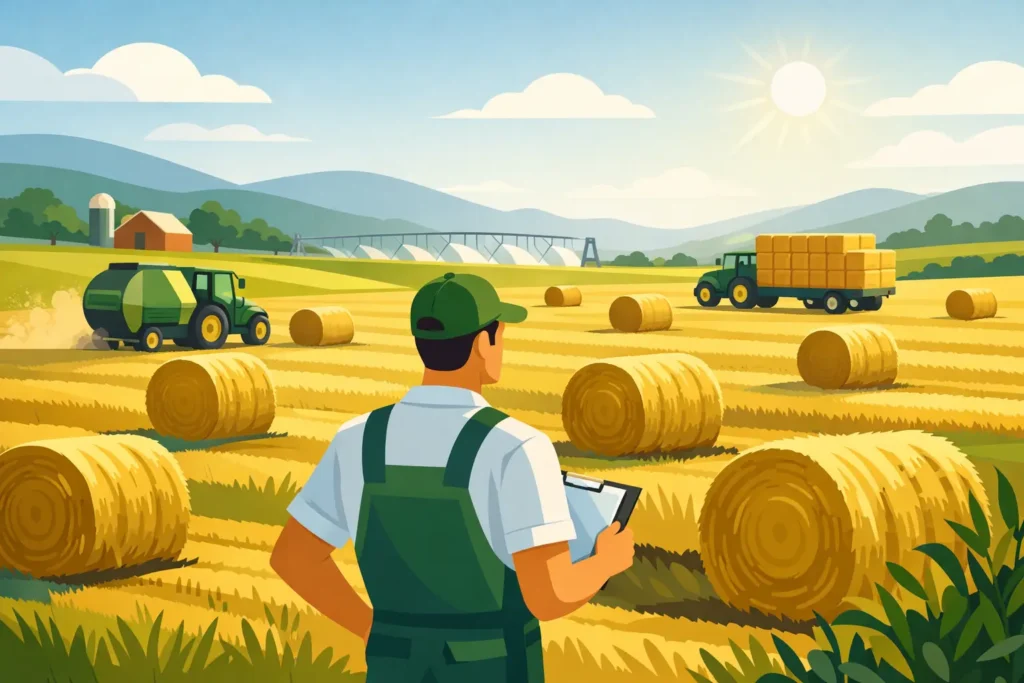
A hay field can look green and still leave a lot of feed in the field. Thin stands, uneven fertility, late cutting, and poorly matched species all reduce tonnage or feed value, often before the problem is obvious from the road. Knowing how to improve hay yield starts with treating the stand as a production system, not simply a crop that gets cut when the weather allows.
For hay and pasture producers, the best gains usually come from correcting a few limiting factors in the right order. More fertilizer will not fix poor drainage. A high-yielding variety will not perform as intended if it is seeded into an unsuitable field. The goal is dependable dry matter production, strong stand persistence, and forage that fits the livestock ration.
Start With Soil Conditions That Support Production
Soil fertility and pH set the ceiling for hay yield. A soil test is the practical first step because it replaces guesswork with field-specific information. Sample established hay fields regularly, especially where yields have declined, manure has been applied unevenly, or different parts of the field perform noticeably differently.
Nitrogen, phosphorus, potassium, sulfur, and pH all affect forage growth, but their importance depends on the crop. Grass hay generally responds strongly to nitrogen. Alfalfa and other legumes produce much of their own nitrogen when nodulation is working, but they require adequate phosphorus, potassium, sulfur, and appropriate pH to remain productive. Applying nitrogen to a healthy alfalfa stand is rarely the first answer and can encourage grasses at the expense of legumes.
Potassium deserves close attention in high-producing hay fields. Every cutting removes substantial amounts of potassium, and low levels can reduce regrowth, winter survival, and stand longevity. On fields receiving manure, test rather than assume fertility is adequate. Manure can supply valuable nutrients, but nutrient distribution across a field is often uneven.
Drainage and compaction also deserve attention. Hay roots need air as well as moisture. Areas that stay saturated after rain or snowmelt can lose plants, delay spring growth, and invite weed pressure. Compacted headlands and traffic lanes may benefit from changes in traffic patterns, drainage work, or renovation when conditions allow.
Match the Stand to the Field and End Use
Seed choice has a direct effect on how much hay a field can produce over several years. The highest-yielding species on paper is not necessarily the best fit for a drought-prone quarter, a poorly drained low spot, or a field intended for intensive multi-cut management.
Alfalfa can deliver high yield and protein on well-drained soils with good fertility and proper management. It is a strong option for dairy-quality forage, beef rations requiring higher protein, and hay operations that can manage timely cutting. However, it is less forgiving of prolonged flooding, severe soil acidity, and repeated traffic damage.
Grasses such as orchardgrass, meadow bromegrass, timothy, tall fescue, and ryegrass each bring different strengths. Some are better suited to hay fields that need persistence and drought tolerance. Others establish quickly or offer excellent quality under intensive management. Blending compatible grasses with alfalfa or another legume can spread risk, improve seasonal production, and create a more balanced forage product.
The right mix depends on soil texture, moisture regime, expected cutting schedule, winter conditions, livestock needs, and how long the stand is expected to last. A custom blend can be especially useful where fields include variable soils or where producers need a specific balance of yield, feed quality, and persistence. Proterra Seeds works with Western Canadian growing conditions where those field-to-field differences often determine establishment success.
Improve Establishment Before Chasing More Tonnage
New seedings are an opportunity to build yield potential for years. Poor establishment creates a weak stand that requires early intervention or replacement, regardless of the quality of the seed used.
Start with a firm, level seedbed. Small-seeded forage crops should be placed shallowly and pressed into good seed-to-soil contact. Seeding too deep is one of the most common ways to reduce emergence. In most situations, forage seed should be placed about one-quarter to one-half inch deep, with adjustments for soil texture and moisture conditions.
Seeding timing matters as much as depth. Spring seeding can work well when moisture is available and weed competition can be controlled. Late-summer seeding may also be effective where there is enough time for seedlings to establish before hard frost and winter stress. The best window depends on local moisture patterns and the species being seeded.
Avoid over-seeding rates simply to compensate for poor conditions. Excessively dense seedings can create early competition, reduce individual plant development, and make it harder for legumes to persist in a mixed stand. Use a rate suited to the species, blend, and intended stand life, then focus on placement, packing, and early weed control.
Manage Fertility for Every Cutting
Hay removes nutrients every time it leaves the field. A fertility plan should reflect annual yield goals and the number of cuttings, not just a one-time application in spring. Split applications can be useful for grass stands where nitrogen is needed through the season, particularly on fields managed for two or more cuts.
For established grass hay, nitrogen timing should support growth without creating unnecessary risk. Early spring applications can drive first-cut production, while post-harvest applications may support regrowth if moisture is available. Applying nitrogen ahead of a long dry period may not produce the return expected, and high rates can increase the risk of lodging or nitrate concerns under stressful conditions.
For alfalfa and alfalfa-grass mixtures, prioritize soil-test-based phosphorus, potassium, sulfur, and lime needs. Healthy nodulation should also be checked in young stands. If alfalfa plants are pale, weak, or lack active pink nodules on their roots, the issue may be inoculation, soil conditions, nutrient balance, or plant health rather than a simple nitrogen shortage.
Cut at the Right Stage, Not Just the First Open Weather Window
Harvest timing is where yield and quality must be managed together. Waiting longer generally adds dry matter yield, but stems become more fibrous and digestibility declines. Cutting very early protects quality but can reduce total tonnage and weaken stand reserves if done repeatedly.
For alfalfa, many producers target early bloom or bud-stage harvest depending on feed requirements, cutting interval, and stand health. For grass hay, heading stage is a key quality threshold. Once grass heads emerge and mature, forage quality can fall quickly even as tonnage rises.
The best cutting schedule depends on the forage market or feeding program. Dairy-quality hay often requires earlier cuts than beef cow hay. A field intended for high-producing livestock may justify tighter harvest timing and more intensive fertility management. A field supplying lower-demand rations may be managed for more tonnage and a slightly later cut.
Leave adequate stubble height to protect crowns, support regrowth, and reduce soil contamination in the windrow. Avoid cutting stressed stands too close during hot, dry conditions. For perennial forage, preserving stand health is often worth more than gaining a small amount of immediate yield.
Protect Regrowth After Harvest
Hay yield is not determined only by first cut. Strong regrowth often separates productive fields from fields that fade after early summer. After cutting, plants need leaf area, moisture, nutrients, and enough rest to rebuild root reserves.
Traffic can be a major source of hidden yield loss. Repeated wheel passes damage crowns, compact soil, and reduce regrowth, particularly in alfalfa. Keep equipment traffic efficient, avoid unnecessary passes, and stay off fields when soils are soft enough to rut or compact.
Moisture management matters as well. Where irrigation is available, apply water to support regrowth and nutrient uptake without creating saturated conditions. On dryland acres, species selection, residue cover, cutting height, and harvest timing become even more important because there is less room to recover from drought stress.
Watch Stand Density and Renovate Before It Fails
Yield decline is often gradual. Walk fields in spring and after each cutting to assess plant density, bare areas, weed pressure, winter injury, and the grass-legume balance. A stand may still produce a crop while no longer producing enough to justify its inputs.
Interseeding can help in some grass stands, but it is not always the answer. Adding seed to a severely thin or weedy field may produce uneven results because established plants and weeds compete with seedlings. Alfalfa autotoxicity also limits the success of reseeding alfalfa into a recent alfalfa stand. In those cases, rotation or full renovation may produce a better long-term result.
Use yield records to identify fields that need attention. Bale counts, bale weights, cutting dates, and visual field notes provide useful information when compared over several seasons. A field that consistently underperforms may have a drainage issue, nutrient imbalance, pest concern, aging stand, or species mismatch that deserves a targeted response.
Better hay yield is built through steady decisions: test the soil, match the seed to the site, harvest with a purpose, and protect the stand between cuts. The field will usually tell you where the next improvement belongs if you take the time to measure what it is producing.