
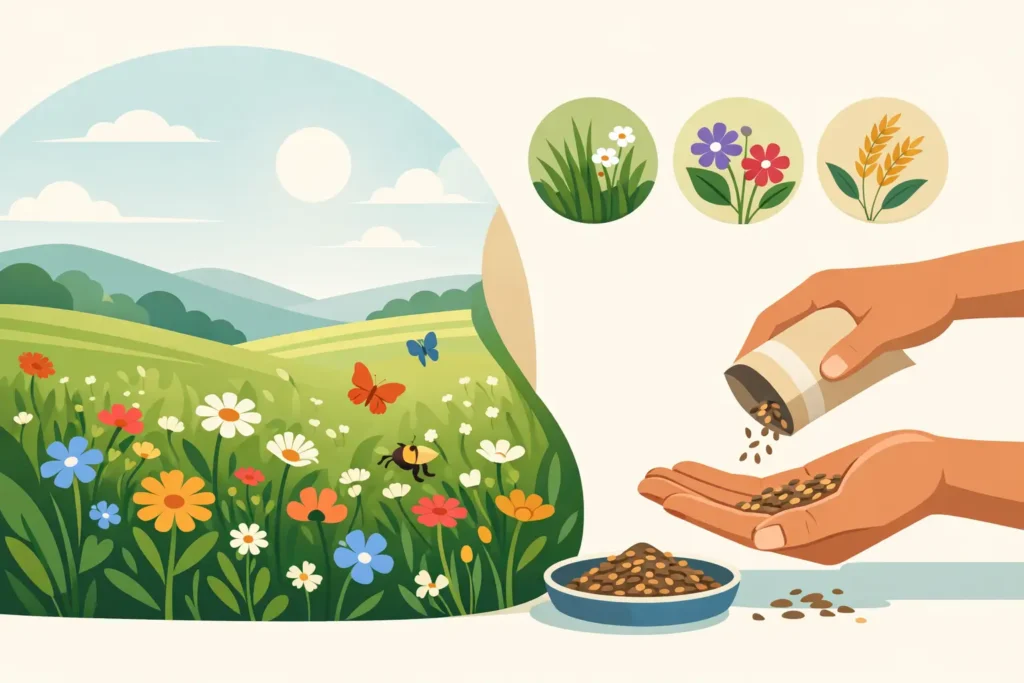
A wildflower restoration seed mix can look great on paper and still fail in the field. That usually comes down to one issue: the mix was not built for the site, the goals, or the establishment window. On reclamation ground, roadsides, utility corridors, and municipal projects, success depends less on appearance in a seed tag and more on how those species handle real soil, moisture, competition, and maintenance.
For commercial buyers and land managers, that distinction matters. A restoration mix is not the same as a pollinator blend designed for a decorative planting, and it is not just a grab bag of flowering species. The right mix supports vegetation cover, ecological function, and long-term persistence while fitting the realities of disturbed land.
What a wildflower restoration seed mix is meant to do
In restoration work, wildflowers are part of a system. They add species diversity, improve habitat value, and help move a disturbed site toward a more stable plant community. On some projects, they also support public-facing goals by improving visual quality along roadways, commercial sites, or community spaces. But appearance alone is not the benchmark.
A good mix needs to establish within the limits of the site. That may mean drought tolerance on a south-facing slope, resilience on low-fertility soils, or compatibility with grasses used for erosion control. In many cases, wildflowers are included to strengthen ecological performance over time, not to dominate the site in year one.
That is where buyers sometimes run into trouble. If expectations are based on a dense, colorful display in the first season, a restoration mix may seem underwhelming early on. Many perennial native and adapted wildflowers spend their first year building roots. The real value shows up in persistence, species layering, and improved stand stability over multiple seasons.
Site conditions should drive the mix
The first question is not which flowers look best. It is what the site can support.
Soil texture, topsoil depth, salinity, pH, slope position, and moisture patterns all shape species selection. A dry, coarse-textured site in southern Alberta calls for a different approach than a cooler, moisture-holding location in northern British Columbia or Saskatchewan. Disturbed industrial ground often adds another layer of complexity because compaction, low organic matter, and uneven seedbed conditions can limit establishment.
That is why broad, one-size-fits-all blends often underperform. A wildflower restoration seed mix should reflect the site’s growing environment and the intended end use. If the goal is ecological reclamation, species need to fit the reference conditions and coexist with companion grasses or other restoration species. If the goal is a municipal naturalized area, the mix may need a balance of habitat function, durability, and visual appeal.
The timing of seeding matters too. Spring, dormant fall, and late-season seeding each create different opportunities and risks. Some species benefit from natural stratification and emerge more reliably after winter exposure. Others perform better with warmer soils and more predictable early-season moisture. There is no universal best window. It depends on the region, the seedbed, and how much competition the new stand will face.
Why species balance matters more than species count
It is easy to assume that more species automatically means a better restoration mix. In practice, balance matters more than the number on the label.
A mix overloaded with aggressive or fast-establishing species can crowd out slower, longer-lived plants before the stand has a chance to develop. On the other hand, a blend made up mostly of species with slow early growth may leave the site too open, which increases erosion risk and gives weeds room to move in.
Strong restoration mixes usually include species that play different roles. Some establish quickly and provide early cover. Others fill in more gradually and contribute long-term diversity. Bloom timing should also be spread across the season where possible, especially if habitat value is part of the objective. That creates a more functional planting than a mix that peaks for a short window and then fades.
This is also where grass-to-wildflower balance needs careful attention. In many restoration applications, wildflowers are not seeded alone. They are paired with grasses or other stabilizing species. If the grass component is too aggressive, the flowers may never gain traction. If the stand lacks enough structure, the site may not hold the soil or compete well against undesirable species. The right balance depends on slope, erosion pressure, maintenance expectations, and final land use.
Establishment challenges that affect results
Even the right mix can struggle if establishment conditions are poor. Seed-to-soil contact is one of the biggest factors. On rough or loosely prepared ground, small-seeded wildflowers can get buried too deep or left exposed. Either problem reduces emergence.
Weed pressure is another common issue. Restoration sites are rarely clean. Disturbance often brings a flush of annual weeds, and those species can outpace young wildflower seedlings quickly. That does not always mean the project is failing, but it does mean early monitoring matters. Some sites need a phased approach to weed management before and after seeding.
Fertility can also work against restoration goals. On turf or forage projects, higher fertility may help drive growth. In wildflower restoration, too much available fertility can favor aggressive species and weeds over a balanced native or adapted stand. More input is not always better.
Moisture is the final variable that can override everything else. In Western Canadian conditions, dry periods after seeding are common, and not every site has the option of supplemental irrigation. That makes species selection, seeding timing, and realistic expectations even more important. A durable mix is one that can handle variability, not just ideal conditions.
When custom blending makes sense
Standard blends can work for straightforward sites, but many restoration projects are not straightforward. Utility corridors, well sites, stormwater edges, commercial developments, and municipal natural areas often have very specific constraints. That is where custom development adds value.
A custom mix allows buyers to build around site limitations and project targets instead of forcing the site to fit a preset formula. That may mean adjusting for dryland performance, increasing species suited to difficult soils, or aligning with a reclamation plan that calls for certain functional groups. It may also mean selecting species that can tolerate low-maintenance conditions over time.
For contractors and project managers, this matters because establishment success affects more than vegetation. It affects timelines, compliance, appearance, and whether a site needs costly rework. A seed mix should reduce uncertainty, not add to it.
What to ask before you buy a restoration mix
Before selecting a mix, it helps to be clear on a few practical points. Start with the site conditions you actually have, not the ones you wish you had. Then define the primary goal. Is the project focused on erosion control, biodiversity uplift, habitat improvement, visual naturalization, or a combination of those outcomes?
From there, ask how the mix will behave in the first three years, not just the first three months. Will it provide enough early cover? How aggressive is the companion species component? Is it suited to the moisture regime and soil profile? Does the project include mowing, weed control, or other maintenance that could affect flowering species during establishment?
These questions often reveal whether a generic blend is sufficient or whether a more tailored approach is needed. For many buyers, that conversation is where project risk starts to drop.
A practical view of long-term success
The best restoration stands rarely look finished in the first season. They develop. Some species appear early, some later, and some respond only after the site settles and competition shifts. That is normal.
What matters is whether the mix is moving the site in the right direction: stable ground cover, improving diversity, manageable weed pressure, and species that persist under local conditions. In that sense, a wildflower restoration seed mix should be judged by function first and bloom second.
At Proterra Seeds, that is the mindset behind good seed planning across reclamation and land restoration work in Western Canada. The strongest results usually come from matching species to the site, being honest about establishment limits, and building mixes that can perform beyond year one.
If you are planning a restoration project, the best next step is usually not asking which mix is most colorful. It is asking which mix still makes sense after the first dry spell, the first weed flush, and the second growing season.