
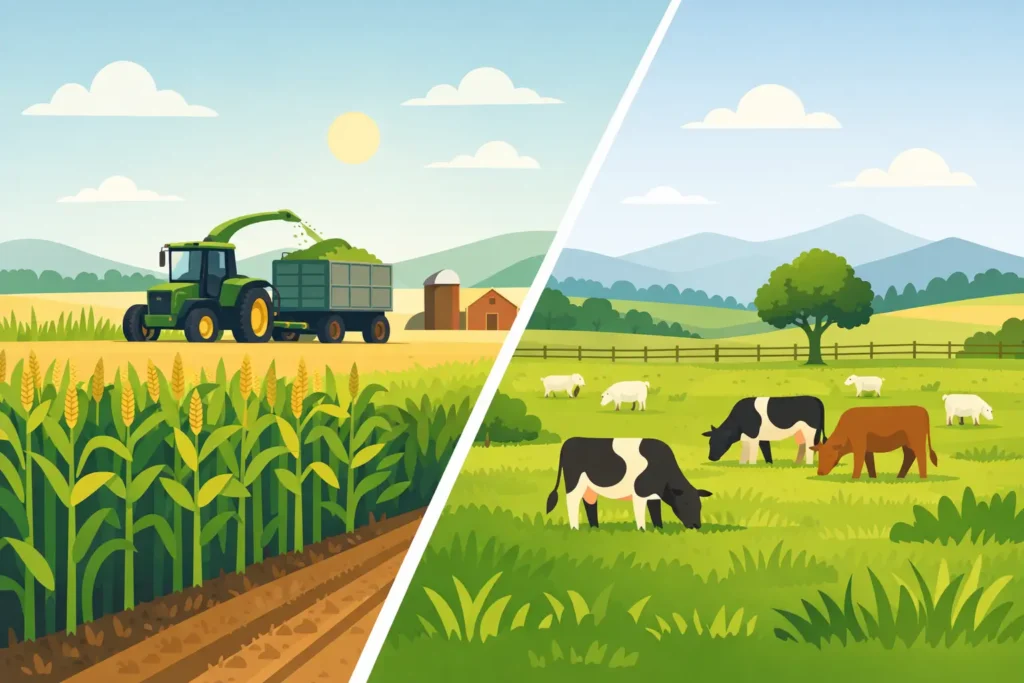
A pasture that is thin after winter, a hay field coming out of an old stand, or acres opened up after an annual crop can all create the same question: annual forage vs perennial pasture? The right answer depends less on which option is “better” and more on what the field needs to do this season and over the next several years.
Annual forage gives producers speed, flexibility, and a chance to respond to a short-term feed gap. Perennial pasture is built for persistence, repeat grazing, and long-term ground cover. Both can be productive parts of a forage program when the crop, field conditions, and management plan are aligned.
Annual Forage vs Perennial Pasture: The Core Difference
Annual forages complete their life cycle in one growing season. Depending on the species and planting window, they may be used for grazing, greenfeed, silage, swath grazing, or hay. Common annual forage options include oats, barley, triticale, millet, sorghum-sudangrass, brassicas, peas, and annual ryegrass.
Perennial pastures are designed to establish once and produce for multiple years. They commonly include productive grasses, legumes, or a tailored blend of both. Orchardgrass, meadow bromegrass, smooth bromegrass, timothy, fescues, alfalfa, and clovers can each play a role, but their suitability varies with moisture, soil conditions, intended use, and grazing pressure.
The practical distinction is timing. An annual crop can fill a near-term forage need quickly, while a perennial stand requires more patience at establishment but can provide years of grazing or hay production when managed well.
When Annual Forage Makes Sense
Annual forage is often the practical choice when feed is needed within the current growing season. A producer may need more grazing after a dry year, replacement feed after winterkill, or a crop that fits between other rotations. Annuals can also provide a useful bridge while a permanent pasture is being planned or while a damaged field is being repaired.
They offer considerable management flexibility. A cereal forage planted early can provide greenfeed or silage, while a warm-season annual may offer summer growth when cool-season perennial pastures slow down. Late-season annuals can support fall grazing, extend the grazing season, and reduce pressure on stored feed supplies.
Annuals also give growers an opportunity to address field-specific concerns before committing to a longer-lived stand. For example, a producer may use an annual forage year to manage residue, improve field trafficability, work organic matter into the system, or evaluate drainage and weed pressure. This can make the eventual perennial establishment more reliable.
That flexibility comes with a trade-off. Annual forage requires seedbed preparation, planting, and establishment every year it is grown. It also has a narrower margin for error when weather delays seeding or limits emergence. Feed value and yield can be excellent, but harvest timing or grazing management must be closely matched to the crop stage.
Where Perennial Pasture Delivers Value
Perennial pasture is usually the better fit where livestock will graze the same acres year after year. Once established, a well-designed stand provides a dependable forage base, protects soil from erosion, and reduces the annual disturbance associated with reseeding. A persistent root system can improve soil structure and help the site make better use of rainfall over time.
For fields prone to erosion, rolling ground, pasture paddocks, and land that is not well suited to annual cropping, perennials often offer the most durable answer. A blend built around grasses and legumes suited to the site can provide season-long cover while supporting forage production and, where legumes are included, contributing nitrogen to the system.
The long-term benefit depends on establishment and management. Young perennial stands need adequate moisture, good seed-to-soil contact, appropriate planting depth, and competition control. They also need time to develop roots before heavy grazing. Starting with the right species mix matters because no single grass or legume performs equally well across every soil type, grazing system, or moisture zone.
Perennial pasture also demands disciplined grazing. Repeated close grazing weakens plants, reduces root reserves, and creates openings for weeds. Rotational grazing, rest periods, and leaving adequate residual growth are central to keeping a stand productive. A pasture blend cannot compensate for chronic overgrazing.
Consider the Field Before Choosing the Seed
The field often makes the decision clearer than the crop name does. Start with the intended use. If the acres are needed for immediate feed, annual forage may be the stronger fit. If the goal is to establish a long-term grazing platform or stabilize vulnerable soil, perennial pasture usually deserves priority.
Soil moisture and drainage should also shape the decision. Some annuals perform well under dryland conditions and others need dependable heat or moisture to justify the investment. Perennial species vary widely as well. A low, moisture-holding area may call for a different blend than a lighter, drought-prone upland field.
Pasture history is equally useful. A declining perennial stand may not need full renovation if the desirable plants are still present and management is the main limitation. In other cases, extensive weed invasion, bare ground, poor species composition, or winter damage may justify terminating the stand and using an annual forage before reseeding to perennials.
Producers should also account for livestock class and feeding method. Cow-calf pairs, backgrounding cattle, horses, sheep, and dairy replacement animals have different forage quality requirements. A grazing crop that works well for mature beef cows may not be the right choice for high-gain cattle. Hay, silage, stockpiled grazing, and swath grazing each place different demands on species selection and harvest timing.
Establishment Is Where Both Systems Win or Lose
A strong annual forage crop begins with a clean, firm seedbed, timely planting, and a species selection that matches the calendar. Seeding too late can reduce yield potential, particularly when a cool-season crop needs early growth or when a warm-season crop needs enough heat to develop. Fertility should be based on soil test results and realistic yield expectations rather than a blanket approach.
Perennial establishment asks for even more attention to detail because the stand is expected to remain productive for years. Small seeds should be placed shallowly and firmly into moisture. A field with heavy residue, poor seed-to-soil contact, or aggressive weeds can quickly undermine establishment. Companion crops can be useful in selected situations, but they can also compete with young seedlings if they are not managed carefully.
In both cases, seed quality and blend design matter. A mix should be selected for its role, not simply because it contains many species. The best blend is the one with species that complement each other under the site conditions and management plan. For Western Canadian operations, that means considering winter hardiness, drought tolerance, soil zone, grazing intensity, and the length of the growing season.
A Two-Step Strategy Can Be the Best Fit
Annual forage and perennial pasture do not have to be competing choices. Many successful forage plans use both. An annual can provide feed while a perennial field is being rested, renovated, or established elsewhere. It can also give a producer a transition year to correct field issues before putting long-term seed into the ground.
For example, a worn-out pasture may be taken out of production, planted to an annual forage for one season, then seeded back to a perennial mix when weed pressure and seedbed conditions are better controlled. Conversely, a productive perennial pasture may remain the foundation of the grazing program while annual acres provide extra feed during dry periods or periods of higher stocking demand.
This approach spreads risk. Perennials offer persistence and lower reseeding frequency, while annuals offer agility when weather, herd size, or feed inventories change. The right balance will differ between farms and can change from year to year.
Plan for the Next Use of the Field
Choosing between annual forage and perennial pasture should start with a clear production horizon. Ask whether the field needs to produce feed in 60 to 90 days, support grazing for the next five years, protect fragile soil, or do several of those jobs in sequence. That answer will guide species selection, establishment timing, and management expectations.
A seed plan works best when it is built around the field’s limitations as honestly as its potential. Matching the crop to the site, then managing the stand according to its purpose, gives both annuals and perennials the opportunity to deliver dependable feed and healthier ground.