
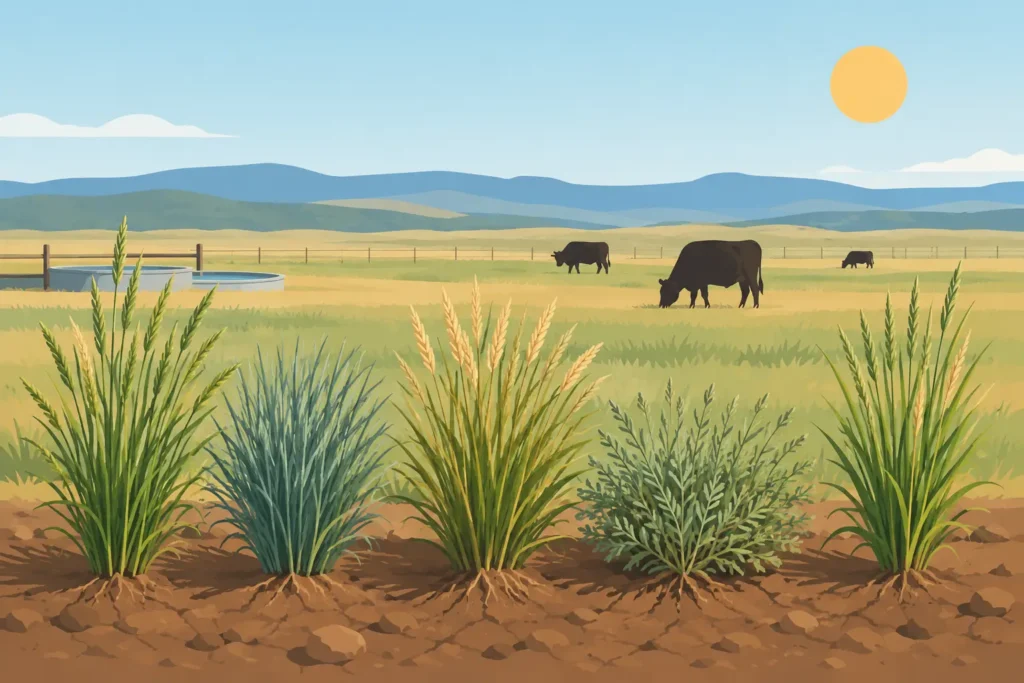
A dry summer exposes weak species quickly. On a roadside slope, pasture field, well pad, or commercial landscape, thin cover can mean erosion, weed pressure, and costly follow-up work. For anyone asking which grasses tolerate drought, the useful answer is not one species name. It is a decision based on soil, moisture pattern, intended land use, and how much time the stand has to establish.
Drought-tolerant grasses are not drought-proof grasses. Even the best-adapted species need enough moisture to germinate, root, and compete during establishment. Once established, however, the right grass can remain productive or recover well through dry periods that would thin less-suited turf or forage species.
What Makes a Grass Drought Tolerant?
Drought tolerance comes from several traits working together. Deep or extensive roots allow a plant to access moisture farther down the soil profile. Narrow leaves, waxy surfaces, and low growth habits can reduce water loss. Some species also slow their growth during heat and drought, then green up when rainfall returns.
Growth season matters as much as plant structure. Cool-season grasses make most of their growth in spring and fall, when temperatures are moderate and moisture is often more available. Warm-season grasses begin growing later, but generally handle summer heat and dry conditions better once they are established.
Site conditions can change the outcome. A grass that performs well on a deep loam may struggle on compacted clay, shallow gravel, saline soil, or a south-facing slope. For reclamation and infrastructure work, surface stability and early cover may be just as important as long-term drought survival. That is why a single-species recommendation is rarely the strongest plan.
Which Grasses Tolerate Drought Best?
The following grasses are commonly considered for dry sites across the Great Plains, western rangeland, and continental climates. Their fit depends on the project objective and local adaptation.
Crested Wheatgrass
Crested wheatgrass is a dependable cool-season option for dryland pasture, disturbed ground, and soil stabilization. It establishes relatively quickly, tolerates low precipitation, and offers early spring growth. Its persistence has made it a common choice where reliable cover is the priority.
The trade-off is ecological. Crested wheatgrass can be very competitive and is generally not the first choice where restoring a diverse native plant community is the primary goal. It is often better suited to utility corridors, dry pasture settings, and sites where durable grass cover is needed quickly.
Western Wheatgrass
Western wheatgrass is a native, sod-forming cool-season grass with good drought tolerance after establishment. Its spreading rhizomes help hold soil together, making it valuable for stabilization and reclamation. It can also tolerate moderately saline or alkaline conditions better than many common turf and forage grasses.
It is not usually the fastest species out of the ground, particularly in dry seedbeds. On erosion-prone sites, it often performs best as part of a blend that includes species with quicker early establishment.
Slender Wheatgrass
Slender wheatgrass is often used as an early-establishing component in native and reclamation mixes. It handles variable soils, provides initial cover, and can tolerate moderately dry conditions. It is particularly useful when the goal is to protect soil while slower, longer-lived species become established.
It should not carry the whole long-term plan by itself. Slender wheatgrass is typically shorter lived than species such as western wheatgrass or blue grama, so its role is often to support early site recovery rather than dominate the mature stand.
Blue Grama
Blue grama is one of the stronger choices for hot, dry sites. This native warm-season grass has a low growth habit, fine texture, and excellent ability to persist with limited rainfall. Its dense basal growth can help protect soil on exposed slopes and low-maintenance landscape areas.
Blue grama starts slowly in cool spring weather, and seedling establishment can be uneven where weed competition is high. It is a long-game species. Proper seedbed preparation, appropriate planting timing, and realistic expectations in the first season are important.
Sideoats Grama
Sideoats grama is a native warm-season bunchgrass known for drought tolerance and adaptability to well-drained soils. It contributes height and structure to native restoration plantings while providing forage value and wildlife habitat. It works well in mixes for dry uplands, rights-of-way, and restoration sites that need more diversity than a simple grass cover.
Like other warm-season grasses, it benefits from warm soil at planting. A cold, early spring seeding may not provide the rapid response expected from a cool-season species.
Little Bluestem and Big Bluestem
Little bluestem performs well on dry, well-drained upland soils and brings strong late-season color, structure, and habitat value to native plantings. Its fibrous root system helps protect soil, while its drought response is usually better than that of many cool-season turf grasses.
Big bluestem has an even deeper root system and can be highly drought tolerant once mature, but it is better suited to deeper soils with enough seasonal moisture to support its larger growth habit. On very shallow, severely dry ground, little bluestem, blue grama, or sideoats grama may be the more reliable fit.
Sheep Fescue, Hard Fescue, and Other Fine Fescues
Fine fescues are valuable where a low-input, low-maintenance turf appearance is needed. Sheep fescue and hard fescue can tolerate dry, lean soils better than many high-maintenance lawn grasses. Their fine texture and lower fertility needs make them useful on commercial landscapes, roadside areas, and certain restoration applications.
They do not offer the same heat tolerance as the best warm-season species. In areas with prolonged hot summers, fine fescues may go dormant, thin out, or need support from companion grasses better suited to heat and traffic.
Tall Fescue
Tall fescue can be drought tolerant because of its deep root system, especially compared with Kentucky bluegrass or perennial ryegrass. It is commonly considered for durable turf, sports areas, and landscapes where some irrigation may be available but water use needs to be reduced.
Performance varies widely by variety and site. Tall fescue is not automatically the right choice for every dryland project, particularly where native restoration goals, very low rainfall, or saline soils are part of the equation.
Match the Grass to the Job, Not Just the Weather
A drought-tolerant pasture stand needs different traits than a drought-tolerant reclamation mix. For pasture, producers may prioritize spring growth, regrowth after grazing, feed value, and persistence under hoof traffic. Crested wheatgrass, western wheatgrass, and selected warm-season species can all have a role, depending on the grazing system and moisture zone.
For reclamation, the target may be rapid surface protection followed by long-term vegetation diversity. A blend can combine a quicker establishing species such as slender wheatgrass with persistent sod-formers and warm-season native grasses. Where the land-use objective includes pollinator habitat or native ecosystem recovery, grasses should also be balanced with locally appropriate forbs and legumes.
For commercial turf and landscapes, appearance, mowing height, wear tolerance, and irrigation capacity matter. Fine fescues and tall fescue may fit low-input turf applications, while blue grama can be a strong option for naturalized areas that will not receive regular irrigation.
Soil Conditions Can Override a Species Recommendation
Dryness is only one stress. Before selecting seed, assess the soil texture, topsoil depth, slope, compaction, salinity, and drainage. Coarse, sandy ground sheds water quickly but warms early. Heavy clay can hold moisture deeper in the profile, yet crusting and compaction may limit emergence. A seed mix that works on one may fail on the other.
Saline or alkaline soils require another level of screening. Western wheatgrass may be useful in moderately saline settings, but severely affected sites often need a more specialized approach. The same is true for steep slopes, recently graded surfaces, and sites with limited topsoil. Establishment planning should account for the physical condition of the ground, not simply annual rainfall totals.
Establishment Is the First Test of Drought Tolerance
The most drought-adapted grass cannot compensate for poor seed-to-soil contact or unmanaged weeds. Prepare a firm seedbed, place seed at the correct shallow depth, and seed during a window that matches the species in the mix. Cool-season grasses generally benefit from cool, moist planting conditions. Warm-season grasses need warmer soils to germinate and develop steadily.
Avoid judging a perennial stand too early. Many native warm-season grasses invest heavily below ground in the first year. A site may look modest above ground while roots are developing the foundation for later drought tolerance. Mowing, grazing, or weed control should be timed to protect young seedlings rather than remove their limited leaf area during a dry spell.
For projects across demanding western climates, the strongest answer is usually a purpose-built blend rather than a single drought-tolerant grass. Proterra Seeds works with land managers, contractors, and producers to match species to soil limitations, establishment timing, and the long-term use of the site. The goal is not simply green cover after rain. It is a stand that holds ground, recovers from stress, and performs when conditions are less forgiving.
When rainfall is uncertain, choose species for the site you have, prepare the ground carefully, and give the stand time to develop the root system that makes drought tolerance possible.