
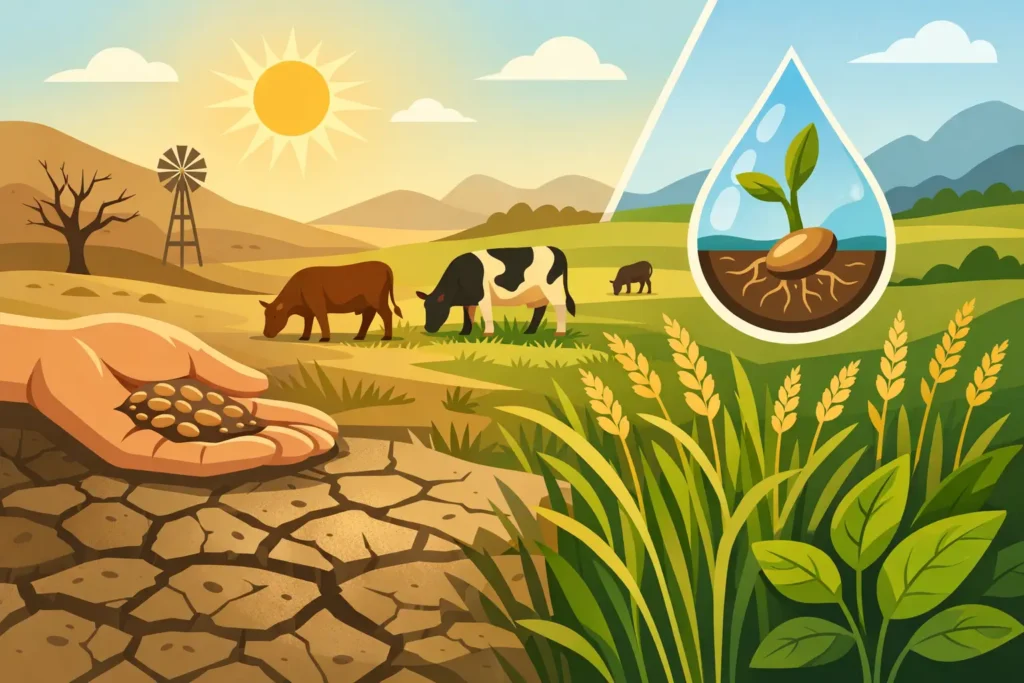
One dry June can change the whole math of a pasture. Stands that looked strong in spring can thin fast, production can stall, and every grazing decision gets tighter. That is why drought tolerant pasture seed matters – not as a marketing phrase, but as a practical tool for building pasture that can stay productive longer when moisture turns short.
For producers and land managers, the goal is rarely to find a single miracle species. The better approach is to match the seed mix to the site, the soil, and the way that pasture will be used. Drought tolerance is real, but it is never separate from rooting depth, grazing pressure, fertility, establishment timing, and the length of the dry period you are trying to manage.
What drought tolerant pasture seed really means
A drought-tolerant pasture is not a pasture that never slows down in dry weather. It is a pasture built from species that can use limited moisture more efficiently, recover better after stress, and persist longer under repeated dry cycles. That distinction matters. Some species stay green longer. Others go dormant and come back well when moisture returns. Others produce less total volume in ideal years but hold up better when conditions get tough.
In practical terms, drought tolerance usually comes from a mix of traits. Deep or fibrous root systems help plants reach and hold moisture. Good summer persistence helps maintain stand density. Strong regrowth after grazing can support feed stability across a variable season. These are not identical strengths, which is why seed selection should be based on the field in front of you, not just a generic species list.
Start with the site before you choose a mix
The same drought tolerant pasture seed blend will not perform the same way on sandy ground, heavy clay, and saline patches. Moisture stress shows up differently depending on soil texture, organic matter, slope, and how quickly the field dries after a rain.
Lighter soils usually lose moisture faster, so species with strong root development and summer persistence tend to be a better fit. On heavier soils, water may be present deeper in the profile, but compaction and slow establishment can still limit performance. Fields with variable topography may need a blend that can handle both drier knolls and lower areas without the stand becoming uneven over time.
This is also where grazing management enters the picture. A rotational system with recovery time supports a wider range of species than a pasture that sees constant pressure. If a stand will be grazed hard and often, persistence becomes just as important as yield.
Species that often fit dry pasture conditions
There is no single best answer for every operation, but a few forage types are regularly considered when dryland performance is a priority.
Tall fescue and meadow brome for persistence
Tall fescue is often valued for its deep root system and ability to stay productive under heat and moisture stress. It can be a strong choice where long-term persistence matters, especially on ground that dries hard in summer. The trade-off is that it needs good establishment management and should be selected carefully based on endophyte considerations and intended livestock use.
Meadow brome is not always the first species people mention for drought, but it has real value in Western forage systems because of its regrowth and grazing compatibility. It can hold up well in mixed stands where the goal is dependable seasonal production rather than maximum early flush.
Orchardgrass and smooth brome for balanced performance
Orchardgrass can perform well in dryland systems when fertility and grazing management are right. It establishes relatively quickly and offers strong forage quality, but it can lose persistence under continuous overgrazing. That makes it useful, but not forgiving.
Smooth brome remains a dependable option in many pasture settings. It is well known, broadly adapted, and capable of solid production. Its weakness is that management can make or break the stand. If it is repeatedly grazed too short, it can thin out faster than expected, especially during dry periods.
Alfalfa and sainfoin for deeper rooting and feed value
Legumes are often part of the drought conversation for good reason. Alfalfa brings deep rooting and strong feed quality, which can improve both production and protein in a pasture mix. It is especially useful where soils are suited to it and drainage is adequate. The caution is that it does not fit every grazing system equally well, particularly where close, frequent grazing is expected.
Sainfoin can be worth considering in the right setting as well. It offers quality forage and useful compatibility in mixed stands. Like many good species, it is not a universal fit. Soil conditions, stand goals, and management all influence whether it deserves a place in the blend.
Why mixed stands usually outperform single-species thinking
On dry acres, diversity is often a form of insurance. One species may handle early season stress well, another may contribute better midsummer growth, and another may improve forage quality or nitrogen dynamics. A mixed stand spreads risk across weather patterns and soil variation.
That does not mean every pasture needs a long list of ingredients. In fact, overcomplicated mixes can create their own problems if species compete unevenly or mature at very different rates. The point is to build a blend where the components complement each other. A good dryland pasture mix is less about how many species are included and more about whether they belong together.
Establishment matters as much as the seed itself
Even the best drought-tolerant blend can disappoint if establishment goes sideways. Dry conditions expose every weakness in seedbed preparation, seeding depth, and timing.
Firm seed-to-soil contact is essential. Most pasture species should be seeded shallow, and many failures start with placing seed too deep in search of moisture. If the forecast is marginal, patience can be the better call. Waiting for a realistic moisture window often beats seeding into dust and hoping for the best.
Fertility also deserves attention, but with some restraint. A pasture seeded for drought resilience should not be pushed into soft, flashy growth that fades under stress. Balanced fertility supports root development and stand establishment better than chasing top-end growth in the first season.
Management can improve or erase drought tolerance
A stand may be genetically suited to dry conditions and still underperform if it is grazed without recovery. Residual height matters because leaf area drives regrowth and root reserves support survival. When pastures are repeatedly grazed too short during heat and moisture stress, drought tolerance drops fast.
Rest periods should lengthen as conditions get drier. That is not always easy in a tight forage year, but it is often the difference between a stand that rebounds and one that keeps sliding backward. In dry years, protecting plant crowns and root reserves is a feed strategy, not just a pasture health principle.
It also helps to think beyond one season. Pasture renovation and reseeding are expensive in time and effort, so the best return usually comes from choosing a mix that fits the site and then managing it for persistence. That is especially true across Western Canada, where moisture patterns can swing sharply from one year to the next.
When custom blending makes more sense
Standard mixes can work well on straightforward acres, but many pastures are not straightforward. Variable soils, reclamation histories, saline edges, hay-to-graze transitions, and specific livestock goals can all change the right answer.
That is where a custom approach becomes useful. Instead of asking for the most drought tolerant pasture seed in general, it is better to ask which blend fits your field, your moisture pattern, and your grazing plan. A custom mix can account for persistence, forage quality, establishment speed, and the practical realities of how the land will actually be used.
For producers and land managers who work in dry or variable conditions, that kind of fit matters more than a generic claim on a tag. Proterra Seeds works with customers who need that level of practical matching because pasture success is rarely about one trait alone.
A better question than what is the toughest seed
The better question is this: what stand is most likely to keep working on your acres when moisture gets short? Sometimes that means including deeper-rooted grasses. Sometimes it means adding legumes for quality and drought response. Sometimes it means simplifying the mix so establishment is cleaner and management is easier.
Drought puts every pasture under pressure, but it also reveals which seed decisions were built for real field conditions. If you choose with the site in mind and manage for recovery, dry weather does not have to define the whole season.