
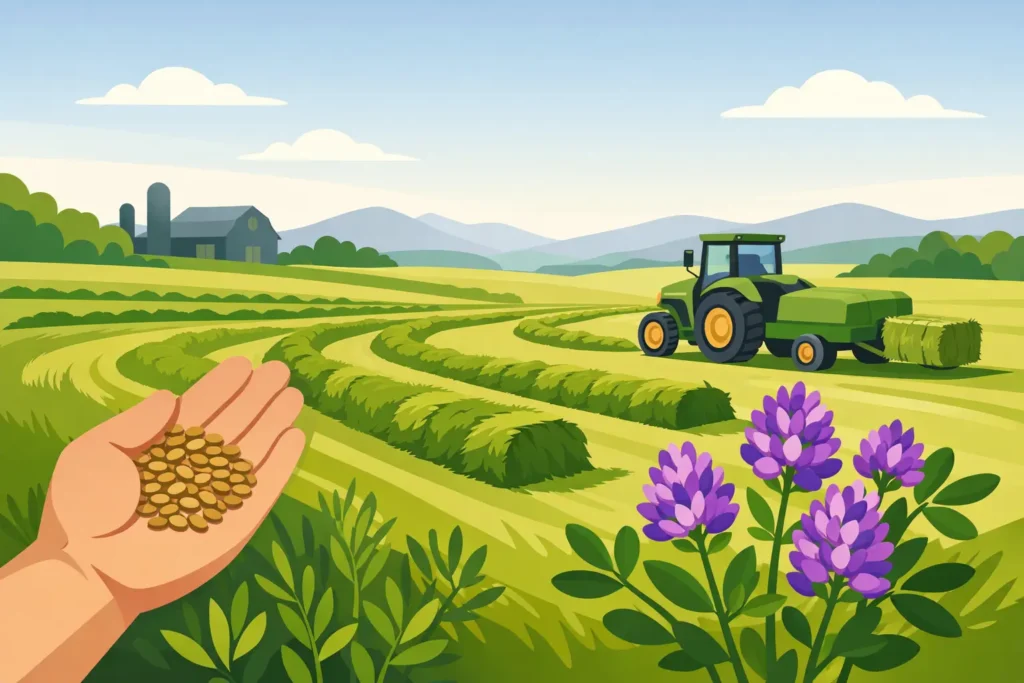
A good hay stand usually starts paying for itself long before the first cutting – or it starts showing problems just as fast. Thin establishment, winter injury, weed pressure, and uneven regrowth often trace back to one early decision: choosing the right alfalfa seed for hay.
For hay producers, that choice is not just about picking a familiar variety name. It is about matching dormancy, disease resistance, soil fit, and management goals to the field in front of you. In Western growing conditions especially, where weather swings and field variability can be hard on stands, the right seed choice can make the difference between a productive multi-year stand and an early reseeding job.
What matters most when choosing alfalfa seed for hay
The best alfalfa seed is not always the highest-yielding option on paper. Yield matters, but it has to come with persistence. A stand that produces well in year one and then drops off after winter is rarely the best long-term decision.
Start with your real objective. If you need top-end dairy-quality forage and plan to manage intensively, you may lean toward varieties bred for aggressive production and fast regrowth. If your priority is dependable tonnage over several years with fewer surprises, persistence and stress tolerance should carry more weight. For many operations, the right answer sits somewhere in the middle.
Stand life also matters more than some buyers expect. A variety that holds density and recovers well after cutting can improve annual yield without requiring extra acres. On mixed farms, that reliability often matters as much as peak performance.
Dormancy and winter survival are not small details
When buyers compare alfalfa seed for hay, fall dormancy and winter survival should be near the top of the list. These ratings help indicate how a variety will behave through the season and how well it is likely to handle colder conditions.
Less dormant varieties typically offer faster growth and stronger yield potential in longer growing seasons. More dormant types generally bring better winter hardiness and stand persistence. There is always a trade-off. Pushing for maximum growth without enough winter tolerance can leave a stand exposed, especially in areas where open winters, freeze-thaw cycles, or limited snow cover are common.
That is why regional fit matters. A hay field in central Alberta does not face the same pressure as one in milder pockets of British Columbia, and a field with exposed topography may winter differently than one with better snow catch. Seed selection should reflect those real-world differences, not just brochure averages.
Disease resistance protects yield you never want to lose
Disease resistance is easy to overlook because it does not always show up as an obvious advantage on day one. Over time, though, it helps preserve plant density, root health, and regrowth.
Look closely at resistance packages for common alfalfa diseases such as phytophthora root rot, aphanomyces, bacterial wilt, fusarium wilt, and verticillium wilt where relevant. Not every field needs the same package, but most hay acres benefit from broad protection. Wet ground, heavy soils, irrigation, or repeated stress can all increase the value of stronger resistance.
There is no perfect variety for every farm. Still, choosing seed with a solid disease profile gives the stand a better chance to stay productive when conditions turn less than ideal. That is usually a smart place to invest your decision-making effort.
Soil conditions should guide variety choice
Alfalfa performs best in well-drained soils with good fertility and a suitable pH. That part is well known. What matters in practice is how honestly the field gets assessed before seeding.
A field with drainage limitations, salinity concerns, variable texture, or compaction issues may still work for alfalfa, but seed selection and stand expectations should match those conditions. In tougher acres, persistence traits and seedling vigor often deserve more attention than raw yield potential.
Soil pH is especially important. Alfalfa does not like acidic conditions, and poor pH can reduce nodulation, establishment, and long-term productivity. Fertility also needs to be addressed early, particularly phosphorus, potassium, and sulfur where deficiencies exist. Good seed cannot overcome a field that is not prepared to support it.
This is one reason experienced growers often treat seed choice and field prep as the same conversation. They are closely tied, and separating them usually leads to weaker outcomes.
Pure alfalfa or a hay mix?
Not every hay field should be seeded to straight alfalfa. In some operations, a pure stand makes sense because it supports a specific feed target, harvest schedule, or market requirement. In others, pairing alfalfa with a grass is the better fit.
A mixed hay stand can improve traffic tolerance, adjust fiber levels, widen adaptation across soil zones, and help spread production risk. Grass can also improve drying and handling in some systems. On the other hand, mixtures complicate management. Fertility, cutting timing, and stand longevity can become a balancing act because the species do not mature or respond the same way.
If the goal is high-protein forage with strong legume content, pure alfalfa may be the cleaner approach. If the field is more variable or the forage program benefits from a legume-grass balance, a custom mix can be the better tool. The right answer depends on how the hay will be used and how the field will be managed over time.
Seed coating, inoculation, and seed quality
When comparing alfalfa seed for hay fields, buyers should understand what is actually in the bag. Seed coatings can serve a purpose, particularly where they support inoculation or seed flow, but they also affect how much pure live seed is being planted. That matters when calculating seeding rates.
Inoculation is another important detail. Alfalfa depends on the right rhizobia bacteria for nitrogen fixation, and that relationship needs to be in place from the start. On fields without recent alfalfa history, effective inoculation is especially important.
Seed quality goes beyond the label headline. Germination, purity, and freedom from troublesome weeds all matter. So does consistency. A dependable seed supplier should be able to help growers understand the fit of a variety, not just hand over a bag and move on.
Management plans should shape the seed decision
The best variety on paper can still underperform if it is seeded into the wrong management system. Before choosing seed, it helps to be clear on how the field will actually be handled.
If harvest intervals will be aggressive, regrowth and traffic tolerance matter more. If the field may see some grazing, that changes the discussion again because standard hay-type alfalfa is not always the best match for grazing pressure. If the stand is intended to remain productive for several years, persistence becomes more important than short-term yield spikes.
Seeding timing matters too. Spring and late summer seedings carry different risks around moisture, weed competition, and establishment before winter. Variety selection should support the timing window, not ignore it.
This is where practical planning pays off. Matching the seed to the intended cutting schedule, fertility program, and field conditions usually leads to fewer surprises after establishment.
Common mistakes when selecting alfalfa seed for hay
One common mistake is choosing based only on yield claims. Strong yield numbers matter, but they need context. A variety that performs well under one set of conditions may not be the best fit somewhere colder, wetter, or more variable.
Another mistake is underestimating winter survival. Producers sometimes chase more aggressive growth without fully accounting for stand longevity. That can work in the right geography and management system, but it can also shorten the productive life of the stand.
A third issue is overlooking field variability. One farm can have several very different soil environments, and one seed choice may not be ideal for every acre. That is where a more tailored recommendation can make a real difference.
At Proterra Seeds, that practical fit matters. Matching seed decisions to field realities is what helps hay stands establish cleanly and stay productive.
The best seed is the one that fits the field
There is no universal best alfalfa seed for hay. There is only the best fit for your soil, climate, harvest plan, and stand-life goals. Strong selections usually share the same basics: proven adaptation, solid disease resistance, dependable winter survival, and the yield potential to make the acres work.
A hay stand asks for a lot from the start. It has to establish quickly, compete well, handle cutting pressure, and come back strong after winter. When the seed matches the field and the management plan, those acres have a much better chance to deliver steady forage year after year.
If you are choosing seed for a new hay field, the smartest move is usually the simplest one – be clear about what the field needs to do, and choose for that job first.