
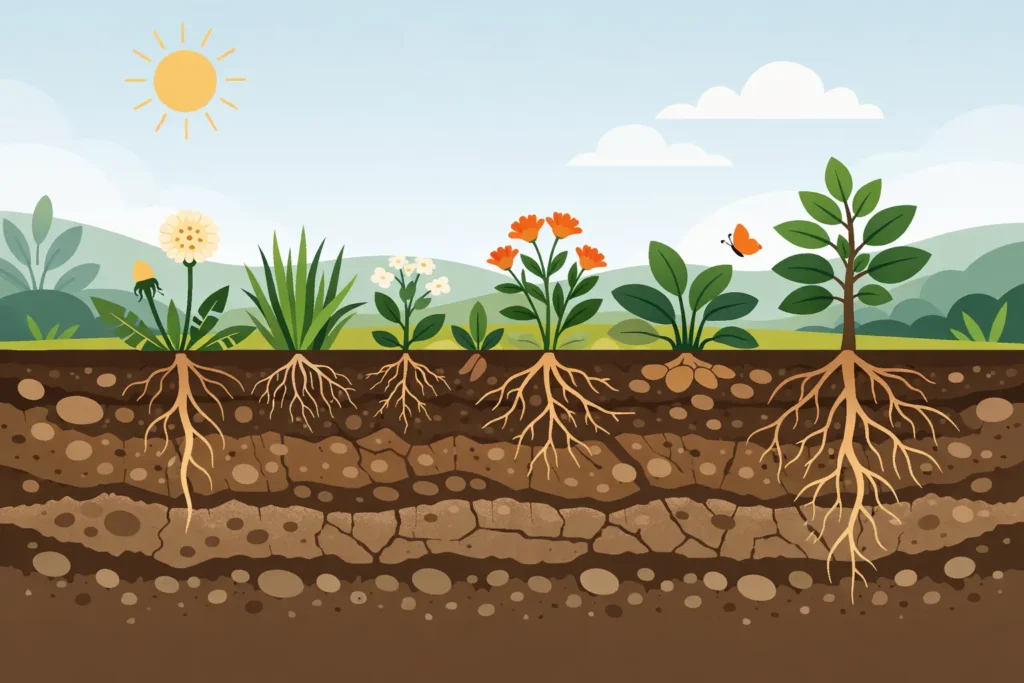
A site can have a good seed mix, timely rain, and proper seeding depth, then still establish poorly because equipment traffic has squeezed the air and pore space out of the soil. When clients ask what grows on compacted soil, the practical answer is: certain tough grasses and site-adapted species can establish, but no plant selection fully replaces fixing severe compaction.
Compacted ground limits root penetration, water movement, oxygen, and nutrient cycling. It can also create a difficult split condition – dry and hard near the surface after a few warm days, then saturated after rain because water cannot move down through the profile. The right vegetation depends on whether the objective is erosion control, reclamation, durable turf, forage, or a long-term native plant community.
What grows on compacted soil depends on the site
Plant tolerance is only one part of the decision. First, identify where the compaction sits and what is causing it. A thin surface crust following construction is different from a dense layer 4 to 12 inches below grade created by repeated hauling, grading, or livestock traffic. The second condition can stop roots at the same depth across a site, even when the surface appears loose.
Drainage also changes the recommendation. A compacted roadside shoulder that sheds water needs different species than a low area that ponds after every storm. Salinity, topsoil depth, slope, soil texture, and the intended maintenance level matter as well. For reclamation work, the seed mix should also reflect the surrounding land use and long-term restoration target.
The following plants are often useful components of mixes for firm, disturbed, or traffic-affected soils. Their suitability still depends on local conditions and seedbed preparation.
Grasses that handle firm, disturbed ground
1. Western wheatgrass
Western wheatgrass is a strong candidate for dry to moderately moist sites with heavy or compacted soils. Its rhizomatous growth habit helps it spread and provide long-term soil cover once established. It is commonly valued for stabilization, reclamation, and pasture settings where persistence matters more than a quick cosmetic result.
It is not a cure for a severely compacted layer, especially where water stands for extended periods. But on clay-based sites with moderate compaction, it can be a dependable part of a longer-lived mix.
2. Thickspike wheatgrass
Thickspike wheatgrass is another rhizomatous grass that tolerates drought, wind exposure, and coarse or disturbed soils. It is particularly useful where surface stability is the priority, such as slopes, utility corridors, and areas with limited topsoil.
Compared with species selected mainly for lush growth, thickspike wheatgrass is built for persistence under leaner conditions. It may not create a uniform, fine-textured turf appearance, but it can contribute meaningful erosion control and ground cover.
3. Slender wheatgrass
Slender wheatgrass establishes relatively quickly and is widely used as an early component in reclamation and restoration mixes. It tolerates a broad range of soil conditions, including disturbed ground, and provides early cover while slower perennial species develop.
Its trade-off is longevity. It is often less persistent than rhizomatous wheatgrasses, so it works best as part of a blend rather than as the only species expected to carry a site for years.
4. Canada wildrye
Canada wildrye is a useful native bunchgrass for many disturbed sites, including areas with heavier soils or partial shade. It can establish in challenging ground and adds height, structure, and diversity to native restoration mixes.
As a bunchgrass, it will not knit the soil together in the same way as a spreading rhizomatous grass. Pairing it with other grasses and appropriate forbs usually produces better long-term coverage and ecological function.
5. Green needlegrass
Green needlegrass is a native perennial grass suited to drier grassland conditions and fine-textured soils. It is known for durability and can be a valuable long-term species where the goal is a naturalized or native plant community.
It is slower to establish than many short-lived cover species. That makes seedbed preparation and early weed management especially important when it is included in a reclamation mix.
6. Tufted hairgrass
Where compaction is paired with poor drainage, tufted hairgrass can be a better fit than dry-site wheatgrasses. It tolerates moist soils and periodic wet conditions, making it useful for swales, low areas, and sites where infiltration has been reduced.
It should not be used simply because a site is compacted. On dry, exposed ground, it may struggle while drought-tolerant grasses perform better.
7. Tall fescue for managed turf areas
For managed landscapes and some commercial turf applications, turf-type tall fescue is often chosen for its deep rooting potential, wear tolerance, and ability to perform on a range of soils. It can be a practical option where the target is a durable green surface rather than a native restoration outcome.
Tall fescue still benefits from aeration and a properly prepared root zone. It is more forgiving than some turf species, not indifferent to hardpan or poor drainage.
8. Perennial ryegrass as a quick cover component
Perennial ryegrass can provide fast germination and early cover on some disturbed sites. That can be useful where short-term erosion control is urgent and the site will receive ongoing management. However, it is not usually the best stand-alone answer for compacted ground, dryland reclamation, or low-maintenance areas.
Use it carefully in a mix. Its fast early growth can compete with slower native or long-lived perennial species if seeding rates are not balanced.
Why seed selection alone is not enough
A plant can only root where the soil allows it. If a shovel, soil probe, or excavator test shows a dense layer below the surface, mechanical loosening may be needed before seeding. Deep ripping, subsoiling, or other decompaction work should be matched to soil moisture and site conditions. Working clay soil when it is too wet can smear and worsen the problem rather than solve it.
After loosening, avoid immediately re-compacting the area with unnecessary equipment passes. On industrial and construction sites, that often requires planning traffic routes before final grading and keeping finished areas protected from repeated travel.
Adding suitable topsoil, compost, or other approved organic amendments may improve aggregate stability and water movement, particularly where the surface has been stripped or heavily disturbed. Amendments are not automatically necessary, and they should fit the project specifications and reclamation objectives. The goal is a seedbed with enough contact for germination, enough pore space for roots, and a surface that resists erosion.
Match the mix to the establishment goal
For fast stabilization, a blend may include a quick-establishing grass with persistent rhizomatous species. For native reclamation, the mix may need a broader combination of regionally appropriate grasses, sedges, and forbs, with short-lived cover species used at restrained rates. For forage, species selection must also consider grazing plans, fertility, moisture, and the desired feed value.
A single-species approach can look simple on paper, but diverse mixes often manage risk better. One species may tolerate drought, another wet periods, and another provide early cover. Diversity also supports more complete soil coverage over time, which helps limit erosion and weed pressure.
Seeding timing matters. Cool-season grasses generally establish best when soil moisture is available and temperatures are moderate. Dormant seeding can be effective on some reclamation projects, but it requires careful planning around site exposure, seed placement, and the risk of erosion or runoff before spring emergence.
Watch for signs that compaction is still limiting growth
Even a well-designed mix can reveal a soil problem after emergence. Look for shallow roots that turn sideways, standing water in wheel tracks, uneven plant height along equipment routes, or vegetation that dries out quickly despite recent rain. These patterns often point to restricted rooting rather than poor seed quality.
Do not assume more fertilizer will solve weak establishment. On compacted ground, nutrients may be present but inaccessible because roots are shallow and oxygen is limited. Correcting the physical condition of the soil is usually more valuable than adding inputs without a diagnosis.
The most dependable result comes from treating compaction as a site-management issue first and a seed-selection issue second. Choose species that fit the moisture regime, land use, and restoration target, then give them a soil profile they can actually root into. That approach produces cover that holds, persists, and performs when the site is under real pressure.