
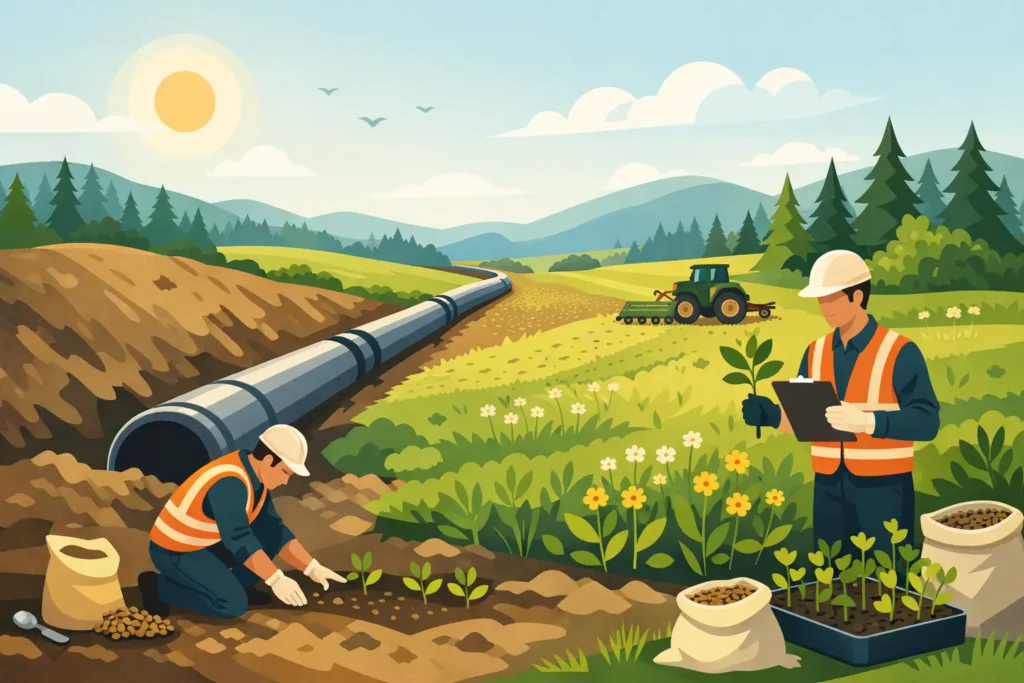
A pipeline right-of-way can look stabilized after one growing season and still fall short years later. In pipeline reclamation Alberta projects, the real test is whether vegetation holds soil, fits the surrounding landscape, tolerates management pressures, and persists after the contractor has left the site. Seed selection plays a central role in that outcome.
For project operators and reclamation contractors, the objective is rarely just to produce green cover. A successful revegetation plan must account for the land use that follows construction, the site’s moisture and soil conditions, erosion risk, adjacent plant communities, and the expectations attached to the project. That calls for a seed program built around the site, not a standard mix applied from one corridor to the next.
Start With the Reclamation Target
Before choosing species, define what the right-of-way needs to become. Agricultural land, native prairie, forested transition areas, wet ground, and industrial corridors can all require very different approaches. A mix that establishes quickly on cultivated land may not be appropriate beside intact native grassland. Likewise, a native-focused blend may need a different establishment strategy than a short-term erosion-control treatment.
The reclamation target should reflect the approved land-use plan, surrounding vegetation, and the landowner’s practical needs. On agricultural properties, restoring productive capability may be a priority. On native or environmentally sensitive sites, the emphasis may be on rebuilding a plant community that is compatible with the surrounding area. Some projects need both – dependable early cover to protect the soil, followed by longer-lived perennial species that carry the site forward.
This distinction matters because short-term visual success can be misleading. Fast-growing species may provide valuable initial protection, but they can also compete with slower-establishing perennials if they are included without a clear purpose. The right balance depends on the seedbed, timing, expected moisture, and the desired long-term vegetation.
Pipeline Reclamation Alberta Sites Need Local Fit
Alberta corridors can cross dry prairie, rolling parkland, cultivated fields, saline areas, wet depressions, and boreal transition zones within the same project footprint. Elevation, exposure, topsoil handling, compaction, and the availability of moisture can change quickly. A seed blend should respond to those site differences rather than treating the entire route as one uniform acre.
Species adapted to local precipitation patterns and soils are more likely to establish and persist. On dry, exposed ground, drought tolerance and rooting depth may carry more weight than rapid top growth. On moist or poorly drained sites, species must tolerate periodic saturation without losing their ability to compete. Where soils are saline or otherwise challenging, a conventional upland mix may create weak, uneven establishment.
Regional adaptation is also about timing. Spring, dormant, and late-season seeding windows each bring different risks. Spring seeding can benefit from early moisture, but weed pressure can be substantial. Dormant seeding may suit certain native species and scheduling needs, although seed must remain in place through winter conditions and germinate at the right time. There is no universal best window. The best approach is the one that matches site access, soil preparation, species biology, and the project’s risk tolerance.
Soil Preparation Is Part of the Seed Plan
Even the right seed blend cannot compensate for a poor seedbed. Compacted surfaces, rough grading, crusted soil, poor seed-to-soil contact, and improperly replaced topsoil can limit establishment before a seed has a chance to perform.
A practical seedbed is firm enough to support equipment and prevent excessive drying, while still providing enough surface condition for seed placement and contact. Seed depth matters as well. Many native grasses, legumes, and small-seeded broadleaf species should not be buried deeply. Uneven placement can produce patchy stands that leave exposed soil between stronger areas.
On steep slopes, drainage features, or highly erodible soils, erosion-control measures may need to work alongside seeding. Mulch, tackifiers, blankets, or other site-appropriate practices can reduce surface movement while vegetation develops. These measures are not substitutes for a well-designed mix, but they can protect the investment during the establishment period.
Build Blends Around Function, Not a Species Checklist
Effective reclamation blends generally combine species with complementary roles. Some establish early and help stabilize soil. Others develop deeper root systems, fill in over time, support biodiversity, or tolerate the conditions expected on a specific portion of the corridor. The goal is not simply to add more species. It is to include species that can realistically contribute under the site conditions.
Grasses often provide the foundation for cover, root mass, and erosion control. Legumes can contribute diversity and, where appropriate, support nitrogen cycling, though their use must fit the project objective and surrounding ecosystem. Native forbs can add ecological value and improve compatibility with natural plant communities, but they may establish more slowly and need careful attention to competition and seeding methods.
A blend should also account for the limits of individual species. A species known for fast establishment may have limited persistence. Another may persist for years but emerge slowly or perform poorly in compacted soil. The right mix manages those trade-offs deliberately.
Seed quality is equally important. Clean, high-quality seed with reliable germination helps project teams calculate seeding rates accurately and reduces uncertainty in the field. When a mix includes native species, appropriate source considerations and realistic availability planning can also affect both performance and scheduling.
Separate Problem Areas Before Seeding
Long pipeline corridors often contain small areas that need a different treatment from the main right-of-way. Treating those areas separately can prevent one difficult section from weakening the overall reclamation result.
Common examples include saline patches, low areas with prolonged moisture, steep side slopes, shaded forest edges, compacted workspaces, and locations where topsoil quality differs from the surrounding corridor. These areas may require a site-specific blend, altered preparation, erosion-control support, or a different seeding window.
This is where field observations are especially valuable. Maps and preconstruction plans provide a starting point, but conditions after stripping, grading, replacement, and cleanup can be different from what was anticipated. A quick review before seeding can identify changes in drainage, surface condition, and soil texture that warrant adjustment.
Plan for Establishment Beyond the First Pass
Reclamation does not end when the drill, broadcast seeder, or hydroseeder leaves the site. Monitoring is how teams determine whether vegetation is meeting the intended objective and where corrective action may be needed.
Early assessments should look beyond overall greenness. Check for bare ground, uneven emergence, erosion channels, aggressive weeds, poor establishment on slopes, and differences between soil zones. A dense flush of annual growth may look promising, but it does not necessarily indicate that the desired perennial stand is developing underneath.
Maintenance decisions should follow the site and project requirements. In some situations, mowing or weed management can reduce competition and help desirable seedlings establish. In others, disturbance at the wrong time can create more problems than it solves. Reseeding may be appropriate for localized failures, but it should be paired with an honest diagnosis of why the first attempt underperformed. If compaction, drainage, seedbed condition, or species mismatch caused the issue, repeating the same approach is unlikely to deliver a different result.
Documentation Supports Better Decisions
Keeping records of blend composition, seeding dates, weather conditions, site preparation, application methods, and follow-up observations gives project teams a useful baseline. It also helps identify patterns across a corridor or from one project to the next.
For contractors managing multiple sites, this information can improve future blend design and field planning. For landowners and operators, it creates a clearer picture of how the site is progressing and what actions, if any, are needed to support long-term recovery.
Choose a Seed Partner That Understands the Corridor
Pipeline work moves quickly, but reclamation decisions can affect the land for years. A seed supplier should be able to discuss the purpose of the mix, site conditions, species trade-offs, application timing, and establishment risks in practical terms. The best recommendation is rarely the most complicated one. It is the one that fits the land, the project requirements, and the available field window.
Proterra Seeds works with reclamation professionals across Western Canada to develop performance-driven seed solutions for disturbed land. That regional perspective matters when a project faces dry conditions, variable soils, demanding schedules, or the need to restore a corridor to a specific land use.
Good pipeline reclamation is built well before seeding day. When the target vegetation, soil condition, site variability, and long-term management plan are considered together, the resulting stand has a better chance to protect the ground and remain useful long after construction is complete.