
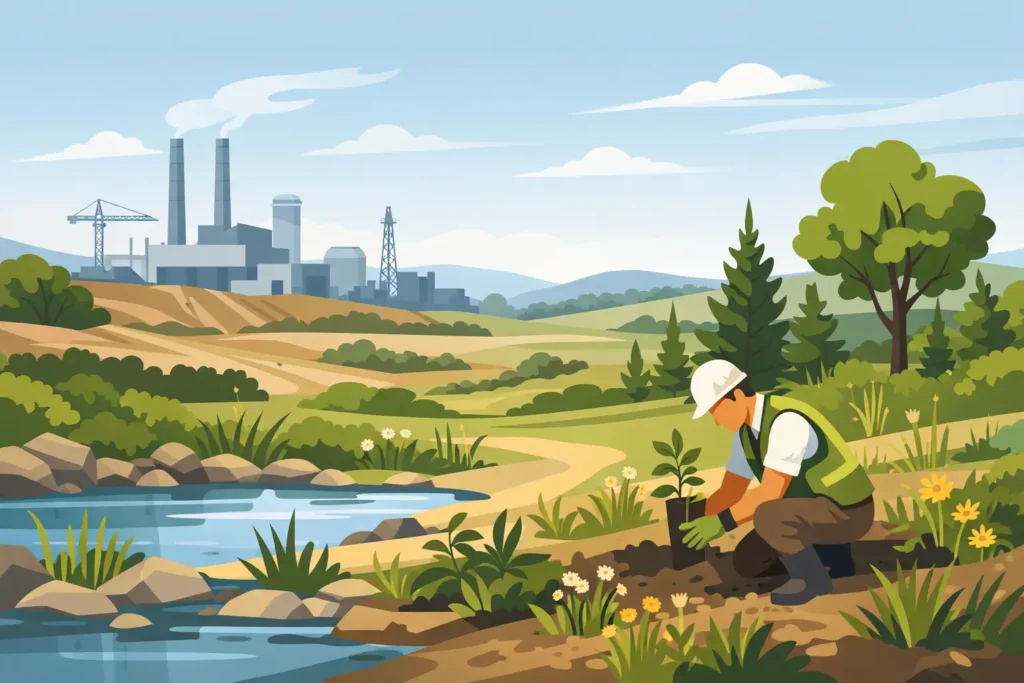
A seeded site can look green within weeks and still be headed for failure. On industrial ground, early cover is only one measure of success. Industrial site revegetation has to stabilize soil, fit the surrounding landscape, tolerate the site’s constraints, and persist after the equipment has left. That calls for more than selecting a standard reclamation mix.
For project operators, contractors, and land managers, the best revegetation plan begins with a practical question: what does this land need to become? The answer may be native grassland, a compatible plant community around a facility, productive agricultural ground, or durable cover along a transportation or utility corridor. Each outcome requires a different approach to seed selection, site preparation, and follow-up.
What Industrial Site Revegetation Must Accomplish
Disturbed industrial sites rarely offer ideal growing conditions. Grading can leave compacted surfaces. Topsoil may be thin, unevenly replaced, or mixed with subsoil. Slopes, wind exposure, saline conditions, poor drainage, and heavy traffic can all limit establishment. In many locations, the surrounding vegetation also creates a clear ecological benchmark for what belongs on the site.
A successful program works on several fronts at once. It provides enough early cover to reduce erosion, develops roots that help hold the soil in place, and establishes species that can survive beyond the first growing season. Where biodiversity restoration is a project goal, it should also create room for a broader, site-appropriate plant community over time.
These goals can pull in different directions. A quick-establishing cover crop may protect bare soil well, but it is not automatically the right long-term species. A highly diverse native mix may better reflect the local ecosystem, yet it can establish more slowly and require more careful weed management. The right balance depends on the site, the reclamation objective, and the level of maintenance available after seeding.
Start With the Ground You Have
Seed cannot correct every site limitation. Before a mix is developed, review how the ground was handled and what conditions plants will actually face. Soil texture, organic matter, pH, salinity, compaction, drainage, slope, and available topsoil all affect which species are likely to perform.
Compaction deserves particular attention on laydown areas, access routes, and heavily traveled portions of a project. Seed placed into a firm seedbed is desirable. Seed placed into a dense, sealed surface with limited pore space is another matter entirely. If roots cannot move through the soil or water cannot infiltrate, even high-quality seed has limited opportunity to establish.
Topsoil placement matters just as much as total volume. Uneven depths can create patchy growth, while rough grading can concentrate runoff and wash seed from slopes. A prepared surface should support good seed-to-soil contact without burying small seed too deeply. On difficult ground, the seeding method and the sequence of soil handling operations may matter as much as the species list.
Soil testing is useful when site conditions are uncertain or when there is a history of salinity, poor growth, or industrial disturbance. Results should guide decisions rather than automatically trigger broad amendments. Applying fertilizer where it is not needed can favor annual weeds or produce fast top growth without solving a deeper rooting problem. The goal is a functioning plant community, not a short-lived flush of green.
Match the Mix to the Final Land Use
A seed blend should reflect the land’s intended future use and the conditions that will remain after reclamation. For a native or naturalized restoration area, the mix may prioritize perennial grasses, forbs, and species with proven adaptation to the region. For a corridor or engineered slope, rapid cover, root strength, and tolerance of mowing or periodic access may carry more weight.
Agricultural reclamation has its own requirements. If land will return to forage or crop production, species selection needs to consider soil productivity, grazing or haying plans, and the transition back into active management. A restoration blend designed for long-term ecological diversity is not necessarily the best fit for a field that needs dependable forage performance.
Local adaptation is especially valuable in Western Canada and other northern, cool-season growing regions. Long winters, short establishment windows, dry periods, late frosts, and variable rainfall can expose weaknesses in a generic mix. A custom blend allows the seed plan to account for elevation, moisture regime, soil limitations, and the desired plant community instead of forcing every site into the same formula.
Timing and Seeding Method Affect Establishment
Good seed placed at the wrong time can still struggle. Spring seeding often provides moisture and a full growing season, but it can coincide with strong annual weed pressure. Dormant seeding can work well for some projects, particularly where conditions support natural stratification and early germination, but seed must be placed when it will remain in position through winter and spring runoff.
Summer seeding can be successful when moisture is available and the species are suited to the timing, but it carries greater risk during hot, dry stretches. There is no universal best date. The practical choice depends on local weather patterns, site readiness, equipment availability, erosion risk, and whether the project can support maintenance if conditions turn unfavorable.
Broadcast, drill, and hydraulic applications each have a place. Drilling generally improves seed placement and seed-to-soil contact on accessible, prepared ground. Broadcast seeding can be effective on uneven terrain when followed by proper packing or incorporation. Hydraulic methods can help cover steep or difficult slopes, especially when erosion-control materials are needed, though the seed mix and application rate still need to match the site.
Small-seeded species are easily buried too deep, while larger seeds may need more consistent placement. This is one reason a blend should be designed with the intended application method in mind. A mix that flows and distributes properly through the chosen equipment is more likely to produce even coverage across the site.
Manage the First Two Growing Seasons
Revegetation is not finished on seeding day. The first growing season reveals whether the plan matches reality. Monitor establishment early enough to identify erosion, washouts, weed pressure, poor germination, or sections affected by traffic. Waiting until the end of the season can turn a manageable correction into a more expensive repair.
Weed control should be based on what is present and how it is affecting desired seedlings. Mowing may be appropriate where annual weeds are shading young perennials, but mowing height and timing matter. Herbicide decisions require equal care because newly established broadleaf species can be vulnerable. In some cases, a temporary nurse crop helps suppress erosion and moderate conditions; in others, it competes too strongly with slower-growing perennials.
Expect establishment to be uneven at first, particularly in diverse restoration seedings. Some species emerge quickly, while others take longer to establish or may not appear until the second season. The useful question is not whether every species is visible immediately. It is whether the site is gaining stable cover, desired species are progressing, and problem areas are being addressed before they expand.
Measure More Than Green Cover
Percent cover is valuable, but it should not be the only indicator used to judge performance. A site dominated by aggressive annuals can appear successful from a distance while offering little long-term stability. Track the presence and vigor of desired species, bare-ground areas, erosion features, weed pressure, and differences between slopes, soil zones, or seeded sections.
Photo points and consistent field notes make year-over-year changes easier to see. They also help contractors and land managers distinguish between a normal establishment lag and a real problem with soil conditions, species fit, or application quality. Clear records support practical decisions about overseeding, targeted repairs, or a change in maintenance approach.
Proterra Seeds approaches these projects with the understanding that seed is one part of a larger land-restoration system. The strongest results come from aligning the blend with the site conditions, the seeding method, and the long-term objective from the beginning.
The best time to solve a revegetation problem is before seed reaches the ground. A clear site assessment, a mix built for the actual conditions, and early follow-up give industrial land the better chance to become stable, useful, and resilient for years to come.