
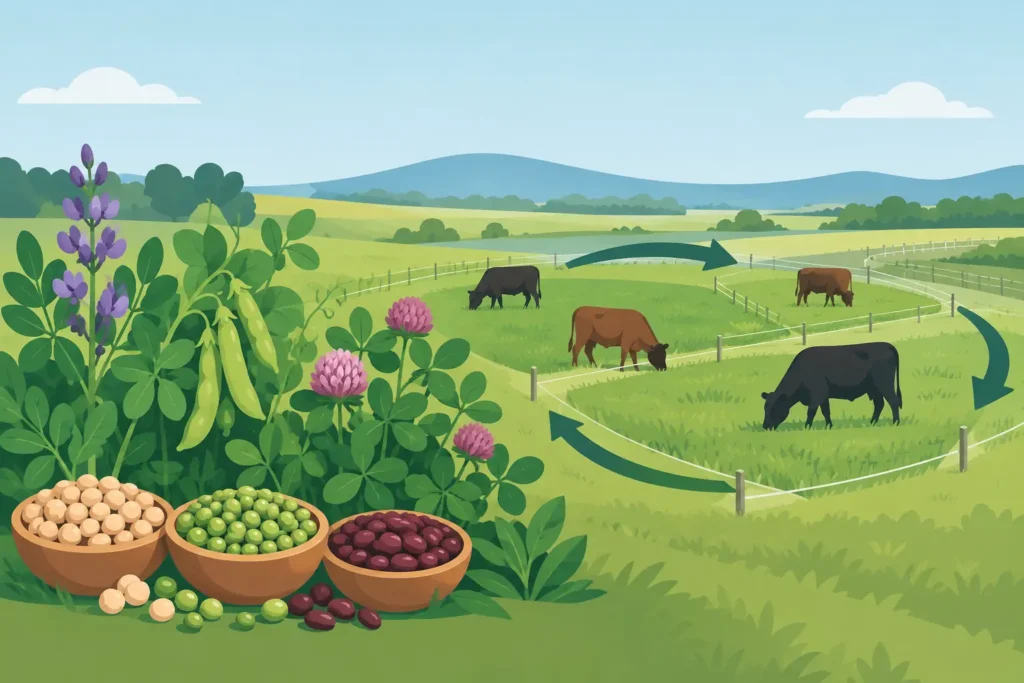
A pasture can look green and productive while still leaving livestock short on protein during peak demand. Adding the best legumes for rotational grazing can change that equation by improving forage quality, extending seasonal production, and supplying biologically fixed nitrogen to the stand. The right choice, however, depends on your soil, moisture pattern, grazing intensity, and ability to manage bloat risk.
For many grazing operations, a grass-legume mix is more dependable than a pure legume pasture. Grasses provide fiber, help moderate the rate of legume intake, and protect the stand under hoof traffic. Legumes contribute protein, energy, and nitrogen. The objective is not simply to select the highest-yielding species on paper. It is to build a pasture that establishes well, recovers after grazing, and stays productive for the years you expect it to serve.
What Makes a Legume Work in Rotational Grazing?
Rotational grazing gives legumes an advantage when rest periods are planned around plant recovery. Most productive forage legumes need time to rebuild leaf area and root reserves after defoliation. If animals return too soon, even an otherwise well-adapted stand will thin out.
The best fit usually comes down to five practical questions. How well drained is the field? Does it stay dry through summer or hold moisture in spring? Is the soil acidic, saline, or alkaline? How closely will the pasture be grazed? And can the livestock manager reduce the chance of bloat through species selection and grazing practices?
Legumes also vary in how they spread. Some, such as alfalfa, are productive crown-forming plants but can lose plants under repeated close grazing. Others, including white clover, spread by stolons and can fill small gaps in a managed pasture. Deep-rooted species can carry production later into dry weather, while shallow-rooted clovers often perform best where moisture is more reliable.
Best Legumes for Rotational Grazing by Site and Goal
Alfalfa: High Production for Well-Managed Pastures
Alfalfa remains one of the strongest options where high forage yield, drought tolerance, and feed quality are priorities. Its deep root system helps it access moisture below the surface, making it especially valuable in productive pasture systems with well-drained soils and periodic summer dryness.
The trade-off is management. Alfalfa can create a significant bloat risk when grazed at lush, vegetative stages, particularly as a dominant component of the stand. It also does not respond well to repeated, very close grazing. Use adequate rest periods, avoid turning hungry animals directly onto a pure or legume-heavy alfalfa stand, and maintain enough residual to support regrowth. Including compatible grasses is often the practical choice for grazing durability and risk management.
For rotational systems, grazing-tolerant alfalfa varieties are worth considering where the field will be used primarily as pasture rather than mechanically harvested forage. Variety selection should reflect local winter conditions, disease pressure, and soil drainage.
Birdsfoot Trefoil: A Strong Choice Where Bloat Matters
Birdsfoot trefoil is often one of the most useful legumes for cattle pasture because it contains condensed tannins that substantially reduce bloat potential compared with alfalfa or many clovers. It produces high-quality forage and works well in mixed stands with grasses.
It is not a direct replacement for alfalfa on every field. Birdsfoot trefoil can be slower to establish and may be less competitive during the seeding year. It also benefits from careful early weed control and a grazing plan that does not repeatedly scalp the stand. Once established, it can be a valuable fit for producers who want a productive legume pasture with a wider margin of safety for cattle.
Birdsfoot trefoil generally favors moderately well-drained soils and consistent moisture. It can tolerate somewhat poorer drainage than alfalfa, but it is not a solution for sites that remain saturated. In a pasture blend, it is particularly useful where long-term grazing use and reduced bloat risk are more important than maximum short-term yield.
Sainfoin: Quality Forage for Dry, Well-Drained Ground
Sainfoin is another non-bloating legume with strong appeal for cattle grazing. Like birdsfoot trefoil, it contains tannins that help reduce bloat risk. It is palatable, high in quality, and well suited to dryland environments with deep, well-drained soils.
Its limitation is persistence under aggressive grazing. Sainfoin does not tolerate frequent close defoliation or heavy hoof pressure as well as some other pasture legumes. It is best used where paddocks can receive meaningful rest and grazing can be timed before plants are repeatedly pushed to the ground. It is generally more dependable in lower-rainfall areas than on wet, poorly drained sites.
Sainfoin can complement grasses and other legumes in a blend, but its role should be matched to the field. It makes more sense on drier slopes and well-drained soils than in a high-traffic sacrifice area or a pasture that will be grazed continuously.
Cicer Milkvetch: Persistence for Cold and Dry Conditions
Cicer milkvetch is a durable perennial legume that deserves attention in challenging grazing environments. It is known for winter hardiness, drought tolerance once established, and a relatively low bloat risk. For regions with cold winters, variable precipitation, and long-term pasture goals, it can be a practical component in a grazing mix.
Establishment is the main consideration. Cicer milkvetch can be slow in the seedling stage, and it may take time to show its full value. A field with heavy early weed competition or intense grazing pressure during establishment is not ideal. When given time to develop, it can persist well and provide quality forage through a long grazing season.
This species fits best with a patient management approach. It is a good option for permanent pasture, rangeland improvement, and dryland grazing fields where stand longevity matters more than rapid first-year production.
Red Clover: Fast Establishment and Shorter-Term Value
Red clover establishes quickly, produces quality forage, and can bring useful nitrogen to grass pastures. It is often a strong choice for short-rotation pastures, hay-pasture systems, or fields that need a productive legume while a longer-term stand develops.
Its weakness is persistence. Red clover is usually shorter lived than alfalfa, cicer milkvetch, or well-managed birdsfoot trefoil, especially under repeated grazing. It also carries bloat risk and should be managed accordingly. In many systems, red clover is best viewed as a two- to three-year contributor rather than the foundation of a long-lived pasture.
Where soil moisture is adequate and a quick, high-quality response is needed, red clover can be an effective partner with orchardgrass, meadow bromegrass, or other compatible pasture grasses.
White Clover: Best for Moist, Closely Managed Pastures
White clover is well suited to fertile, moist pasture settings and rotational systems where grazing is frequent but not excessively severe. Its low-growing, spreading habit allows it to recover from grazing and occupy open spaces in the sod. That makes it useful in permanent grass pastures where improving forage quality and nitrogen supply is the goal.
It is less suited to extended drought than deep-rooted alfalfa. White clover can also decline on dry, low-fertility ground or under prolonged hot conditions without moisture. Bloat remains a consideration, particularly when white clover becomes a large share of the available forage.
For intensively managed paddocks with reliable moisture, white clover can be one of the most persistent grazing legumes. In drier fields, it is usually better included as a smaller part of a broader mix rather than relied on as the primary legume.
Managing Bloat Without Giving Up Legume Benefits
Bloat risk should shape the pasture plan, but it does not mean legumes must be avoided. Risk is highest when hungry cattle enter a pasture with abundant lush legumes, especially after rapid growth or a weather change. Pure stands of alfalfa and clover require more caution than balanced grass-legume mixtures.
Start livestock on dry hay or grass pasture before moving them onto legume-rich paddocks. Avoid abrupt changes in feed, provide consistent access to water and minerals, and monitor animals closely when conditions favor rapid, leafy legume growth. Rotations should also prevent animals from selectively grazing only the most tender legume growth while leaving grass behind.
Species choice matters. Birdsfoot trefoil, sainfoin, and cicer milkvetch offer a lower-risk path for operations where bloat is a major concern. Alfalfa and clovers can still be highly productive choices, but they demand stronger grazing discipline and an appropriate grass component.
Build the Mix Around the Field, Not a Single Species
The most reliable grazing blend usually contains more than one answer. A well-drained field with summer moisture stress may benefit from alfalfa or cicer milkvetch paired with drought-tolerant grasses. A moist, productive pasture may support white clover with persistent sod-forming grasses. A cattle operation seeking lower bloat risk may favor birdsfoot trefoil or sainfoin where the soil and rest schedule fit.
Seeding decisions should also account for fertility, pH, drainage, salinity, expected stocking density, and whether the stand will occasionally be cut for hay. Legumes need the correct rhizobium inoculant to fix nitrogen effectively, and young stands need protection from grazing until roots are developed and plants are firmly anchored.
A custom pasture blend can balance these competing demands rather than forcing one species to do every job. Proterra Seeds works with producers to match forage species to local soils, moisture conditions, and pasture use so the finished stand is built for performance beyond the first growing season.
The best pasture legume is the one that gives livestock quality feed while still leaving enough plant behind to recover after every rotation. Start with the field conditions, plan the rest period honestly, and let the species mix do the work it was selected to do.