
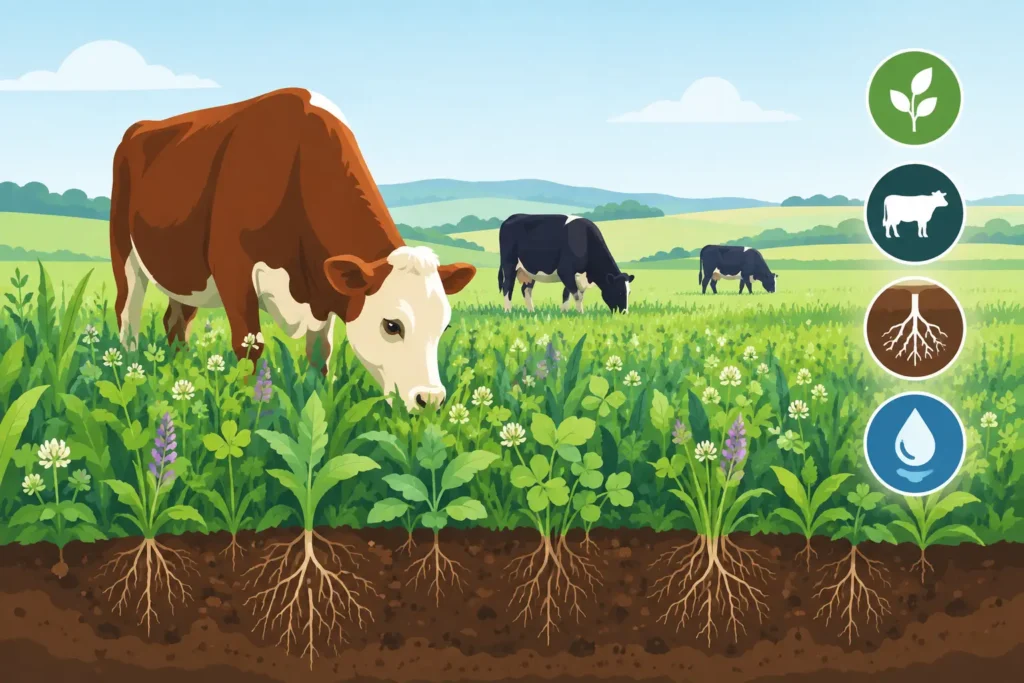
A cover crop can look outstanding from the cab and still disappoint once livestock enter the field. Strong grazing cover crop results are not measured by biomass alone. They come from turning that growth into usable feed while protecting soil cover, maintaining animal performance, and leaving the field in better condition for the next crop.
For producers, the goal is usually straightforward: extend the grazing season, reduce feed costs, and build soil function without creating a compaction, nutrition, or establishment problem. Achieving all three takes more than choosing a popular mix. Species selection, planting date, grazing timing, stocking density, and weather all carry real weight.
What Good Grazing Cover Crop Results Look Like
The best results are practical and visible. Livestock harvest a meaningful share of the forage, but enough residue remains to shield the soil from wind, rain, and temperature swings. The field is not rutted, compacted, or grazed down to bare ground. Manure and urine are distributed reasonably well, and the following crop has a workable seedbed rather than a problem to solve.
Feed value matters as well. A cover crop may produce a great deal of dry matter, but mature stems or an unbalanced mix can limit intake and animal performance. Brassicas and high-quality annual cereals can provide highly digestible grazing. Legumes can raise protein. Grasses add fiber and rooting strength. The right balance depends on whether the field is supporting dry cows, growing calves, replacement heifers, or another class of livestock with different nutritional requirements.
Good outcomes also depend on the production system. A late-summer grazing crop after silage or early cereal harvest has a different job than a full-season annual forage. A producer focused on fall grazing may prioritize cold tolerance, feed quality, and rapid regrowth. Someone using a cover crop ahead of a cash crop may put more emphasis on residue, roots, nutrient capture, and dependable spring planting conditions.
Start With the Field’s Main Job
Before choosing species, decide what the field needs most. Cover crops can be managed to support grazing, erosion control, compaction relief, nutrient scavenging, pollinator habitat, or soil organic matter. One mix can contribute to several goals, but every mix has trade-offs.
For example, a high-brassica blend can establish quickly and offer excellent fall feed, particularly when paired with oats, triticale, or rye. However, brassicas alone may not provide enough effective fiber for some rations, and they can leave less surface residue than a grass-heavy stand. A cereal-forward mix can build more biomass and hold soil well, but quality declines as plants mature.
Legumes can contribute protein and biological nitrogen fixation, yet they may establish more slowly or struggle when planted late into dry ground. In short growing seasons, a species that looks ideal on paper may not have enough time to deliver its intended benefit.
A practical mix starts with the likely planting window, available moisture, soil constraints, livestock class, and the planned termination or follow-up crop. Custom blends are often worthwhile because fields rarely have identical needs, even within the same operation.
Match Species to Timing and Moisture
Planting date is one of the biggest drivers of performance. Earlier planting generally allows more roots, more leaf area, and more grazing days. Delayed seeding can still produce valuable feed, but expectations need to change. Late-seeded crops may be better suited to light fall grazing, soil cover, or spring grazing rather than maximum fall tonnage.
Moisture is just as important. Small-seeded brassicas and legumes need good seed-to-soil contact and enough moisture for quick emergence. Larger-seeded cereals may be more forgiving, but they still cannot produce forage without rainfall or stored soil moisture. Seeding into dry soil and hoping for a timely rain is sometimes necessary, but it adds risk that should be reflected in the mix and grazing plan.
In prairie environments, cool nights can preserve quality in the fall, but an early frost can slow growth quickly. Species selection should account for local frost patterns and whether grazing will happen before freeze-up, after a killing frost, or in early spring.
Grazing Management Protects the Payoff
A well-established cover crop can lose much of its value in a few wet days if livestock stay too long. The most reliable approach is usually controlled grazing with enough animal density to encourage uniform use, followed by timely movement to the next allocation.
The right stocking rate depends on forage yield, utilization target, animal size, weather, and how much residue needs to remain. Rather than aiming to clean up every green plant, set a residual target before cattle enter the field. Leaving adequate leaf area and surface cover helps reduce erosion, supports soil biology, and limits damage when conditions turn wet.
Portable fencing and frequent moves are useful tools when they fit the operation. They can improve forage use and manure distribution while preventing livestock from repeatedly selecting the same preferred plants. That said, intensive rotation is not the only workable model. Larger paddocks can perform well when fields are dry, forage supply is adequate, and grazing duration is short enough to avoid repeated regrazing.
Water access is part of the grazing plan, not an afterthought. Animals will concentrate around water, mineral, shade, and entry points. If those locations are not managed carefully, they can become heavily trampled and nutrient-loaded. Moving attractants and planning access routes can spread pressure more evenly across the field.
Watch the Nutritional Risks
Cover crops can be highly nutritious, which is a benefit that requires management. Rapidly growing brassicas and cereal crops may be high in moisture and protein but low in effective fiber. Cattle may need access to dry hay, straw, or another fiber source to support rumen function and reduce digestive upsets.
Introduce livestock gradually, especially when moving from dry feed to lush forage. Monitor intake, manure consistency, behavior, and body condition. Feed testing is valuable when a crop will supply a significant portion of the ration, particularly for growing animals or pregnant cows with specific nutritional needs.
Nitrates are another consideration. Drought stress, frost, heavy manure application, or high available nitrogen can raise nitrate levels in annual crops. The risk varies by species and growing conditions. Testing suspect forage before grazing is a practical safeguard, not an unnecessary complication.
Brassica-heavy stands require additional attention because they can create dietary imbalances when they make up too much of the ration. Mixing brassicas with grasses and managing access time can help. The correct approach depends on the crop, the livestock, and available supplemental feed.
Soil Conditions Decide When to Pull Cattle Off
The soil often tells you more than the calendar. Hoof traffic on firm, dry ground can add organic matter, cycle nutrients, and incorporate residue with minimal concern. Hoof traffic on saturated clay or thawing soil can create compaction, pugging, and deep ruts that carry into the next season.
Do not wait for widespread damage before moving livestock. Check gate areas, low spots, water locations, and wheel tracks daily during wet periods. These are usually the first places to show trouble. If soil is deforming under hoof pressure, a sacrifice area, earlier move, or temporary removal may protect the rest of the field.
Winter grazing can reduce mud issues when soils are frozen, but it brings different management needs. Snow cover, wind exposure, feed access, manure concentration, and spring runoff all deserve attention. Bale grazing and stockpiled forage can fit well in some systems, but site selection matters if nutrients could move toward surface water during thaw.
Measure Results Beyond Pounds of Forage
A scale ticket or forage estimate is useful, but it does not tell the full story. Track how many grazing days the field provided, how much stored feed was replaced, how livestock performed, and what the field looked like afterward. Compare those observations with soil tests, infiltration, residue cover, and the establishment of the next crop.
Keeping simple field notes improves decisions over time. Record planting date, species, seeding rate, rainfall, first grazing date, cattle numbers, grazing duration, and any challenges. After two or three seasons, those notes often reveal patterns that are more valuable than a generic recommendation.
Proterra Seeds works with producers who need cover crop options suited to regional growing conditions and real livestock systems. The strongest grazing plan is not necessarily the most complex one. It is the one built around the field, the season, and a clear plan for when cattle enter and when they leave.
A cover crop should earn its place in the rotation. When grazing is managed with the same care as planting, the field can provide feed now while building a stronger foundation for the crop that follows.