
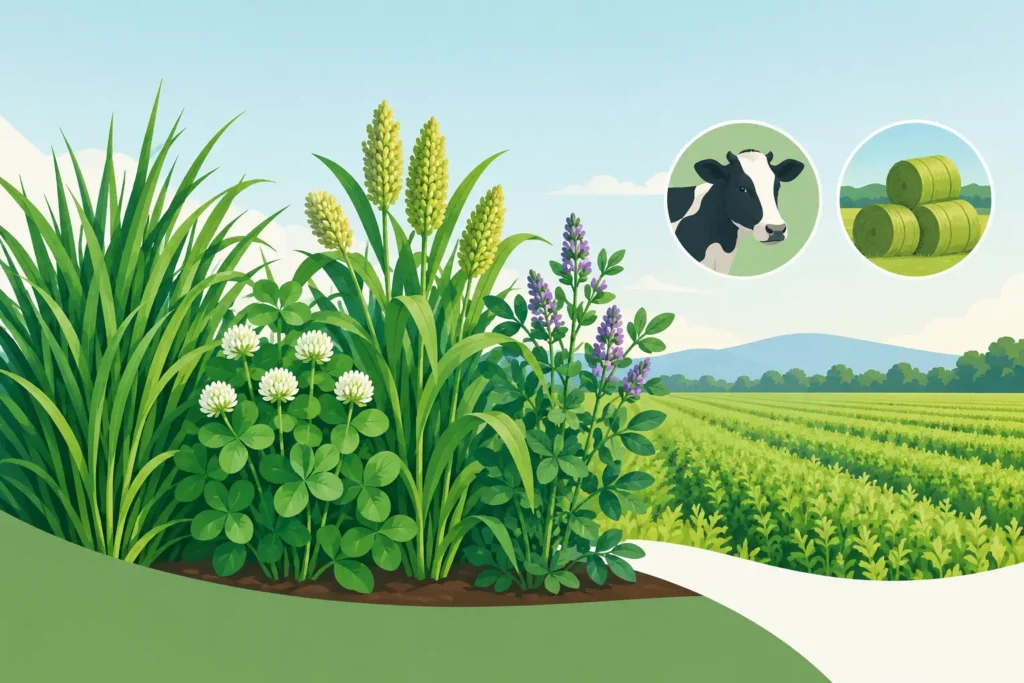
A forage stand can look excellent on the seed tag and still disappoint in the field. A dry spring, compacted headland, short growing season, saline patch, or grazing plan that changes midseason can quickly expose the limits of a poorly matched mix. The right forage crops are chosen for the land they will grow on and the job they need to do, not simply for the highest potential yield.
For livestock producers, the goal may be high-quality hay, dependable pasture, winter feed, or a short-season annual crop that fills a gap. For land managers, forage can also stabilize soil, improve organic matter, cover disturbed ground, and prepare a field for a longer-term rotation. Those goals can overlap, but they do not always require the same species or management approach.
Start With the Job the Forage Must Do
Before selecting a species or blend, define how the stand will be used. Hay fields need crops that cure well, regrow predictably, and fit available cutting equipment. Pastures need plants that tolerate hoof traffic and repeated defoliation. Annual forage systems often prioritize fast growth, flexible harvest timing, and a reliable source of feed when perennial stands are being established or renovated.
A field intended for grazing is not automatically a good candidate for a hay-focused mix. Alfalfa can provide excellent feed value and yield, for example, but it needs proper fertility, drainage, and grazing management to persist. A grass-heavy pasture blend may tolerate frequent use better, while a mixed stand can offer broader seasonal production and reduce risk when conditions turn against one species.
The best choice also depends on whether the stand is expected to last one season, several years, or much longer. Annual options can provide speed and flexibility. Perennial stands require more planning at establishment, but they can reduce reseeding costs and protect the soil over time when managed well.
Match Forage Crops to Site Conditions
Every field has limitations. The objective is not to find a crop with no weaknesses, but to select one whose strengths fit the site.
Moisture, Drainage, and Soil Texture
Alfalfa performs best on well-drained soils and does not tolerate prolonged wet feet. Where drainage is limited, certain grasses or species suited to wetter conditions may offer better establishment and stand longevity. On light, drought-prone ground, deep-rooted species can help maintain production when surface moisture disappears early.
Soil texture affects more than moisture. Sandy fields may require closer attention to fertility and establishment timing, while heavy soils can create compaction and drainage concerns. A soil test gives the clearest starting point for pH, nutrient levels, and amendments. It also prevents a common mistake: blaming the seed choice when the real problem is a nutrient deficiency or soil condition that was never addressed.
Salinity and Problem Areas
Saline areas should be treated as a management zone, not ignored because they represent only part of the field. Seedlings are especially vulnerable to salt stress, and a blend that performs well across most acres may fail in concentrated saline patches. Site-specific species selection can improve ground cover and help protect exposed soil, even when maximum yield is not realistic.
Low-lying areas, compacted access routes, and eroded slopes deserve the same attention. A uniform blend across a variable field may be simple to apply, but it is not always the most dependable approach. Separate blends or targeted seeding rates can make better use of challenging acres.
Climate and Growing Season
In regions with short growing seasons and wide temperature swings, establishment speed and winter survival matter as much as peak summer yield. Producers need species that can use available moisture, establish before weeds take over, and recover after cutting or grazing.
For Western Canadian operations, this often means balancing productivity with persistence. A forage crop that looks exceptional in a favorable year may not be the best foundation for a stand expected to handle dry periods, winter exposure, and repeated use. Local growing conditions should guide selection more than a generic recommendation from another region.
Build a Mix Around Feed Quality and Persistence
A single-species stand can be easier to manage and may fit a specific feed program. It can also carry more risk. A mixed forage stand often spreads that risk across species with different root systems, growth habits, and seasonal strengths.
Legumes such as alfalfa and clover can contribute protein, digestibility, and nitrogen fixation. Grasses can add fiber, improve drying conditions in hay, provide sod-forming soil protection, and stand up well under grazing. The right proportion depends on the intended use. A dairy-quality hay program may target a different balance than a beef cow-calf pasture or a reclamation-oriented forage planting.
Feed value should be considered alongside yield. High tonnage is valuable, but only when the harvested or grazed crop meets the nutritional needs of the animals consuming it. Mature forage can provide bulk while losing digestibility. Conversely, a high-quality stand that does not produce enough dry matter may not meet the operation’s feed requirements.
Harvest and grazing timing are part of this equation. Cutting too late can lower quality and reduce regrowth potential. Grazing too closely can weaken crowns and expose soil. A well-chosen blend still needs management that gives plants enough recovery time.
Establishment Is Where Performance Begins
Many forage failures begin before the seed enters the ground. Seed-to-soil contact, planting depth, weed competition, fertility, and moisture all influence whether a stand becomes productive or patchy.
A firm seedbed is especially important for small-seeded forage species. Seed placed too deep may emerge unevenly or not at all. Seed placed on a loose, dry surface can germinate and then fail before roots reach moisture. Packing before and after seeding, where appropriate, helps create the seedbed conditions that support uniform emergence.
Weed pressure should be evaluated honestly. Establishing a perennial forage stand into a field with aggressive annual weeds can reduce seedling survival and shorten the productive life of the stand. In some cases, a planned annual crop or cover crop phase can help address weeds and improve field conditions before the long-term forage seeding goes in.
Seeding timing also depends on moisture and the species selected. Spring seeding can work well when moisture is available, but it may coincide with strong weed pressure. Late-summer establishment can avoid some early-season competition, yet it leaves less time for seedlings to develop before winter. The practical answer is often field-specific: seed when soil conditions, moisture outlook, and management capacity give the new stand its best chance.
Annual Forages Can Fill Important Gaps
Annual forage crops are useful when feed is needed quickly, when perennial acres are being renovated, or when a crop rotation needs added flexibility. Cereals, annual ryegrass, brassicas, and other annual options can be selected for grazing, greenfeed, silage, baleage, or cover.
Their advantage is speed. Their trade-off is that they require regular reseeding and can be more sensitive to harvest timing. An annual forage planted for grazing may not be managed the same way as one intended for silage, and a mix designed for late-season grazing may not suit an early-cut greenfeed plan.
Annuals can also support soil-building goals. Root diversity, residue cover, and reduced periods of bare ground can benefit the field between cash crops or during a forage transition. Those benefits are strongest when the mix and termination plan are aligned with the next crop, available moisture, and equipment.
Work From Field Information, Not Assumptions
The most reliable forage decisions start with practical field information: a recent soil test, drainage observations, past crop history, weed pressure, intended use, and realistic management plans. This information makes it possible to choose species that are suited to the operation rather than relying on a one-size-fits-all blend.
Custom blending can be particularly useful when a farm has distinct soil zones, livestock classes with different nutritional requirements, or a need to combine production with erosion control. Proterra Seeds works with producers and land managers who need seed solutions built around real site conditions and long-term field performance.
A forage stand is a working asset. Give it a clear purpose, establish it carefully, and manage it according to how the plants recover. That approach gives every acre a better chance to provide dependable feed, stronger soil cover, and value that lasts beyond the first cutting.