
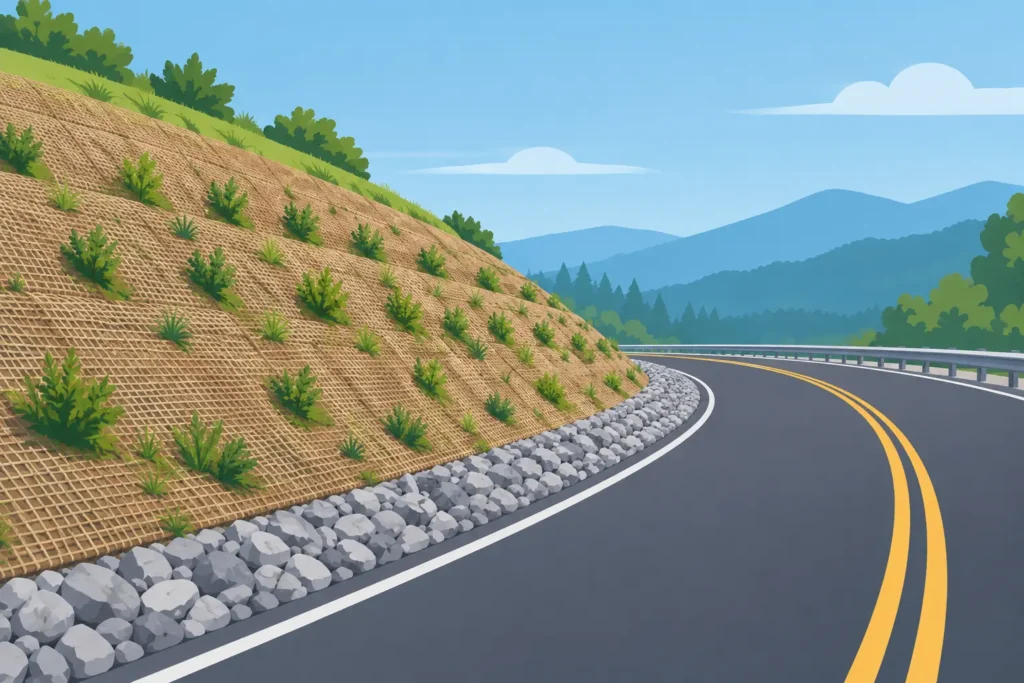
A roadside slope can look finished on the day equipment leaves, then lose soil after the first hard rain. Rills form at culvert outlets, seed shifts into low spots, and exposed shoulders begin shedding sediment onto the traveled surface. Effective erosion control for roadways starts before seeding, with an honest assessment of water, soil, slope, and the time of year the work must be completed.
For municipalities, contractors, developers, and industrial operators, the goal is not simply a green roadside. It is a stable vegetative cover that protects the grade, supports drainage, improves site appearance, and persists through traffic impacts, snow storage, drought, and repeated weather events. The right approach is site-specific because a dry shoulder, a steep cut slope, and a wet ditch do not fail for the same reasons.
Why Roadside Erosion Happens
Roadway construction changes how water moves across a site. Compacted subgrades shed water quickly. Cut slopes can expose low-organic-matter soil. Fill slopes may contain variable material with limited structure, while ditches concentrate runoff that once spread across a wider area. Even a well-designed drainage system can create erosion pressure where water enters, turns, or exits.
Vegetation is one of the most dependable long-term tools for managing that pressure. Above ground, leaf cover and residue reduce the force of raindrops and slow surface flow. Below ground, roots help bind soil, create channels for infiltration, and hold the surface together during wet periods. But vegetation needs time to establish. The most vulnerable period is often between final grading and the point when a planted cover has developed enough roots and canopy to do its job.
That is why a seed-only approach is not always enough. On low-risk areas with favorable soil and a suitable seeding window, properly selected seed may establish quickly. On steep, long, highly erodible, or high-flow areas, temporary erosion-control measures are often needed to protect the soil while permanent vegetation develops.
Start With the Site, Not the Seed Bag
The best seed blend cannot correct a drainage issue or establish reliably in poorly prepared soil. Before selecting species, review how the roadway section will handle water and what conditions the vegetation will face after construction.
Follow the Water Path
Identify where runoff begins, where it concentrates, and where it leaves the site. Pay close attention to culvert inlets and outlets, ditch transitions, toe-of-slope areas, bridge approaches, and locations where pavement runoff is discharged. A slope may appear stable across most of its length but fail repeatedly at one concentrated-flow point.
If water velocity is too high, vegetation alone may not be the right first line of defense. Grade changes, check structures, armoring, erosion-control blankets, or other engineered measures may be required. Seeded cover works best when it is part of a drainage plan, not a substitute for one.
Know the Soil You Are Planting Into
Roadside soils are frequently compacted, stripped of topsoil, or composed of subsoil with limited organic matter. These conditions reduce infiltration and make germination less predictable. Seed placed on a smooth, hard surface is also vulnerable to washing away before roots form.
Where possible, loosen the upper surface without creating deep channels that direct runoff. Salvaged or imported topsoil can improve establishment when it is placed and handled properly, but it should be evaluated for weeds, texture, and fertility. On some sites, a modest fertilizer application based on soil conditions supports early growth. Overapplying nutrients, however, can encourage weak, lush growth or create water-quality concerns near sensitive drainage areas.
Consider Slope, Aspect, and Maintenance Access
Steeper slopes need more attention to seed placement and temporary protection. South- and west-facing slopes can dry rapidly in hot weather, while north-facing slopes may remain cool and wet longer in spring. Ditches may hold moisture for extended periods, especially after snowmelt or heavy storms.
Maintenance access matters as well. A roadside system should be selected with mowing, visibility, snow management, and future repairs in mind. A blend that grows tall and aggressively may stabilize soil, but it can be a poor fit near intersections, signs, or areas requiring clear sightlines.
Choosing Seed for Erosion Control for Roadways
A roadway seed mix should be built around function. Fast establishment is valuable, but it is only one part of the picture. The mix also needs root development, tolerance of local moisture conditions, persistence after mowing or disturbance, and a practical appearance for the setting.
For many roadside projects, a blend of quick-establishing grasses and longer-lived perennial species provides a useful balance. Short-lived nurse species can help cover exposed soil early, while persistent grasses build a stable root system over time. On appropriate sites, native or regionally adapted species can add long-term resilience and support restoration objectives, though they may establish more slowly and require careful timing and weed management.
Ditch bottoms and wet swales need species that tolerate periodic saturation. Dry shoulders and upper slopes need species that can handle heat, reduced moisture, and compacted conditions. On reclamation or naturalized corridors, a more diverse mix may be appropriate. In maintained urban rights-of-way, lower-growing turf-type species may better suit appearance and mowing needs.
There is no single “roadside mix” that performs equally well everywhere. A blend suited to a moist, cool corridor can struggle on a dry exposed slope, while a drought-tolerant mix may thin out in a seasonally wet ditch. Matching the seed mix to the site is what turns a seeding specification into a working erosion-control measure.
Installation Determines Establishment
Seed needs good contact with the soil, consistent placement depth, and protection from movement. Broadcasting onto rough, prepared soil can work on accessible areas when followed by packing or rolling. Drill seeding may provide more consistent depth and seed-to-soil contact on suitable slopes. Hydroseeding can be useful for difficult access, broad slopes, or sites where mulch is needed to protect the seedbed, but it still depends on proper surface preparation and moisture.
Avoid burying small seed too deeply. Many grasses and native species establish best near the surface, where emerging seedlings can reach light without exhausting their stored energy. A firm seedbed is generally more effective than a loose, fluffy one. The soil should be stable enough to hold seed in place while still allowing roots to penetrate.
Mulch, tackifiers, blankets, and bonded fiber matrices can reduce erosion during establishment. Their value depends on slope length, expected runoff, wind exposure, soil type, and installation quality. A blanket that is poorly keyed into the slope or not properly secured can channel water underneath it. Likewise, mulch that is too heavy can limit emergence. Temporary protection should fit the site rather than be applied as a standard detail everywhere.
Timing and Early Maintenance Matter
The most favorable seeding period depends on climate and species selection. Spring seeding can take advantage of moisture, but it may compete with fast-growing annual weeds. Late-summer or early-fall seeding can work well where there is enough time for establishment before winter. Dormant seeding may be an option for some species and regions, but it carries the risk of seed movement or uneven germination if winter and spring conditions are harsh.
Inspect seeded areas after significant rain events, particularly during the first season. Look for sediment deposits, small rills, bare strips, failed drainage transitions, and washed-out seed. Early repair is usually straightforward. Waiting until a rill becomes a gully can turn a minor correction into regrading and reseeding work.
Weed pressure should be managed with the long-term planting in mind. Fast annual weeds can shade seedlings and compete for moisture, but aggressive intervention can also damage new desirable plants. Mowing, where appropriate, may reduce weed seed set and maintain visibility without stressing young plants. The right timing depends on the species present and the maturity of the seeded stand.
Build Roadside Stability for the Long Term
Successful roadside vegetation is rarely about one product or one pass with a seeder. It comes from matching drainage design, soil preparation, seed selection, installation method, and follow-up inspection to the conditions on the ground. That is especially true across variable Western landscapes, where moisture, soil texture, and seasonal weather can change quickly from one project area to the next.
Proterra Seeds works with contractors, land managers, and project operators who need seed mixes suited to real site conditions, from maintained roadside turf to reclamation-focused corridor plantings. The practical question is not which mix is most familiar. It is which combination of species and establishment methods will keep soil where it belongs after the next storm.
When planning a roadway project, treat the first growing season as part of the construction schedule. A well-prepared seedbed, a purpose-built mix, and timely inspections give new vegetation the opportunity to become the durable protection the roadway needs.