
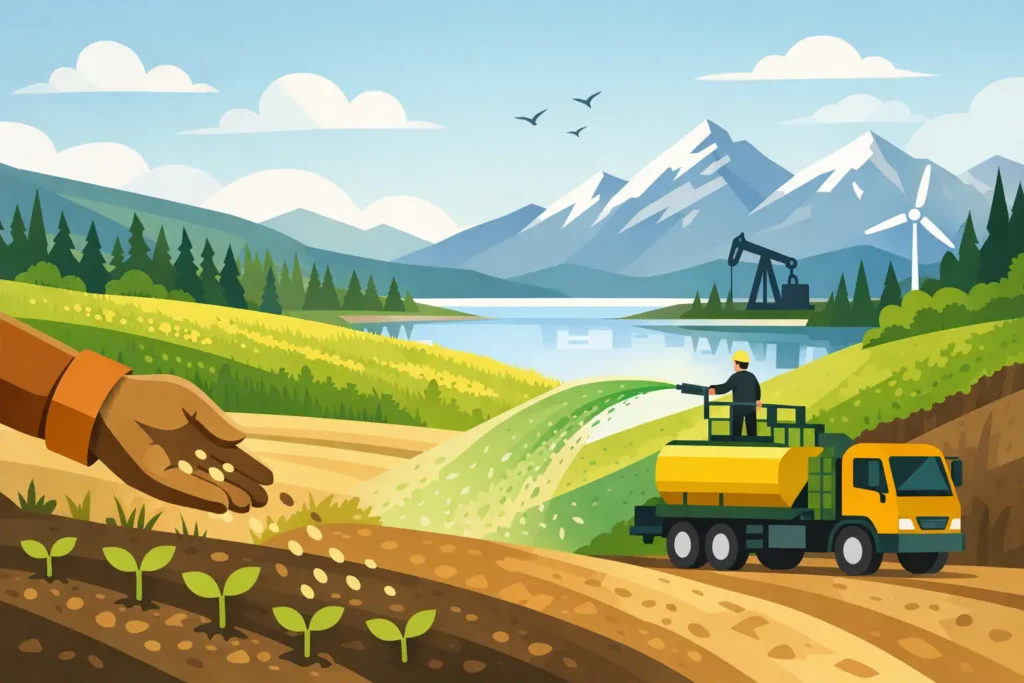
A reclaimed site can look green within weeks and still fall short years later. Thin cover, invasive pressure, poor species persistence, and erosion often point back to decisions made before the drill ever entered the field. Successful western Canada reclamation seeding starts with a practical understanding of the site, the disturbance, and what the land needs to become over the long term.
For pipeline corridors, well sites, utility projects, renewable energy developments, borrow areas, and road construction, seeding is not simply the final construction task. It is the establishment phase that determines whether soil remains stable, desired vegetation returns, and the site can move toward its intended end land use.
Start With the Reclamation Outcome
A seed blend should be built around the reclamation objective, not selected because it worked on a different project. A roadside slope, native grassland, forest transition zone, cultivated field, and grazing pasture may all require different species, application rates, and establishment approaches.
The first question is straightforward: what should this land support after reclamation? On some projects, the goal is a stable perennial cover that controls erosion and allows access for maintenance. On others, the requirement may be restoration of native plant communities, return to agricultural production, wildlife habitat, or a transition toward natural regeneration.
That end use affects every downstream choice. Fast-establishing grasses can be valuable where exposed soil needs quick protection, but a highly competitive mix may not be the right fit where slower native species need room to establish. Likewise, an agricultural reclamation blend may prioritize forage value and persistence while a habitat-focused project may call for more diverse grasses, legumes, and wildflowers.
A good reclamation plan balances immediate ground cover with the vegetation the site needs to carry in three, five, or ten years. Those goals sometimes pull in different directions, which is why a one-size-fits-all mix rarely delivers the best result.
Read the Site Before Selecting Seed
Across Alberta, British Columbia, and Saskatchewan, conditions can change quickly from one project area to the next. Elevation, moisture, soil texture, salinity, slope position, existing vegetation, and topsoil handling all influence what can establish successfully.
Soil condition matters as much as seed selection
Compaction is a common issue on disturbed land. Even a well-designed seed blend can struggle when roots cannot move through dense soil, water ponds on the surface, or surface crusting prevents seedlings from emerging. Ripping, loosening, or other soil conditioning may be needed before seeding, particularly on heavily traveled work areas.
Topsoil should also be assessed for depth, structure, and weed pressure. Where salvaged topsoil has been mixed, stockpiled for an extended period, or spread unevenly, its performance may differ across the site. This does not automatically mean the project will fail, but it does mean the blend and establishment plan should account for variable conditions.
Saline or sodic areas need special attention. Species that perform well on productive upland soils may not persist where salts limit germination and root development. Wet ground, drought-prone knolls, shaded edges, and coarse subsoils can create similar challenges. In many cases, separating a site into management zones produces better results than applying one blend everywhere.
Match species to the local environment
Regional adaptation is not a marketing detail. It is a practical measure of whether a stand can survive winter, recover after dry periods, compete with weeds, and persist under the expected land use. Species selection should reflect the project’s eco-region as well as its intended function.
For example, moisture-demanding species may establish strongly in a favorable first season but decline on a dry, exposed slope. A mix intended for a northern location may also need a different balance of grasses and legumes than one planned for a warmer, drier agricultural area. Native species can be an important part of ecological restoration, but they often require realistic expectations around timing, site preparation, and early-season appearance.
Seed Mix Design Is About Function
The strongest reclamation blends use species that perform complementary jobs. Some establish quickly to reduce erosion. Others develop deeper root systems that help stabilize soil over time. Legumes may contribute nitrogen and diversity where appropriate, while longer-lived grasses support persistence and cover.
The goal is not to include as many species as possible. Excessive complexity can make a blend harder to establish and manage, especially where certain species dominate under favorable conditions. A well-built mix uses the right number of species for the site, with rates that reflect each species’ role.
Consider the following functions when planning a blend:
- early cover for erosion control and surface protection
- long-term perennial persistence
- tolerance for drought, wetness, salinity, or low fertility
- compatibility with native restoration or agricultural end use
- biodiversity objectives and desired habitat value
The balance changes by project. A steep, freshly graded slope may need immediate stabilization as the first priority. A former cultivated field being restored to perennial cover may allow for a more gradual establishment approach. On a pipeline right-of-way, the mix also needs to suit ongoing access and maintenance requirements.
Timing and Seeding Method Affect Establishment
There is no single ideal seeding window for every reclamation project. Spring seeding can take advantage of moisture and a full growing season, but it can also coincide with heavy weed emergence. Late summer or dormant seeding may fit construction schedules and reduce some operational pressure, yet success depends on local weather, soil conditions, and species dormancy requirements.
The key is to seed into a firm, prepared seedbed with good seed-to-soil contact. Many reclamation species are small-seeded and should not be planted too deeply. If seed is buried beyond its effective emergence depth, establishment can be uneven even when germination quality is high.
Drill seeding is often preferred where site conditions allow because it can place seed more consistently and improve contact with the soil. Broadcast applications may be practical on rough terrain, steep slopes, or sites with limited equipment access, but they generally require careful packing or other methods to ensure seed is not left exposed on the surface.
Hydroseeding can be useful for specific erosion-control applications, particularly where access is limited or slopes are difficult to treat. It should still be viewed as part of an overall site stabilization plan rather than a substitute for proper surface preparation.
Manage Competition in the First Growing Seasons
Reclamation seeding is most vulnerable before the desired stand has developed enough cover and roots to compete. Annual weeds, volunteer crops, and aggressive undesirable species can quickly use available moisture and nutrients, particularly on fertile topsoil or sites disturbed during wet conditions.
Early monitoring makes a difference. The purpose is not to expect a finished landscape immediately, but to identify whether the site is moving in the right direction. Uneven emergence, bare areas, washouts, weed dominance, and poor growth in specific soil zones are easier to address before they become widespread problems.
Control options depend on the project, land use, and species in the blend. Mowing may help reduce annual weed seed production in some situations, but timing and cutting height matter. Herbicide options must be evaluated carefully to avoid damaging desired seedlings. In certain cases, patience is also part of the plan, especially with native species that establish more slowly than annual cover crops or conventional turf grasses.
Measure Success Beyond a Green Surface
A site should be evaluated against its approved reclamation goals, not just whether vegetation is visible. Cover, density, species composition, plant health, erosion control, invasive species presence, and the condition of adjacent undisturbed land can all provide useful information.
A strong first-year stand is encouraging, but persistence is the more meaningful test. Does vegetation remain through dry periods? Are roots holding the soil? Are the intended species increasing rather than disappearing under weed pressure? Can the land support its planned agricultural, industrial, ecological, or public-use function?
Documentation also matters. Keeping records of seed blend composition, lot information, application rates, weather conditions, field preparation, and follow-up observations gives project teams a clear basis for making adjustments. It also helps identify what worked on similar sites in the future.
Western Canada Reclamation Seeding Requires a Site-Specific Plan
Western Canada reclamation seeding works best when the seed supplier, contractor, land manager, and project operator are working from the same practical objective. The seed mix should fit the land, but the land also needs to be prepared and managed in a way that gives that mix a fair chance to perform.
Proterra Seeds develops reclamation seed solutions around regional conditions and real project requirements, from fast establishment and erosion control to longer-term restoration and agricultural return. The right blend is only one part of the job, but it is a part that should be chosen with care.
When the goal is lasting reclamation, treat every site as its own growing environment. A careful decision before seeding can prevent years of corrective work after it.