
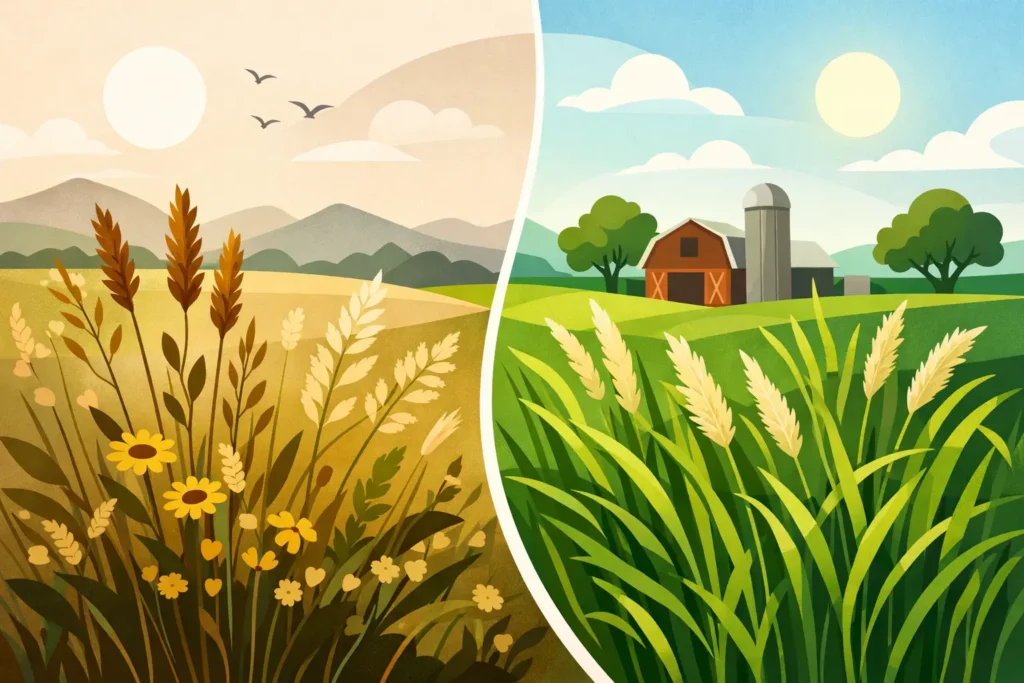
A reclaimed slope that needs cover before spring runoff has different priorities than a wellsite being returned to a native plant community. That is why the question of native seed or introduced grasses cannot be answered by species origin alone. The right choice starts with the land-use objective, the condition of the site, and what successful establishment needs to look like five, 10, or 20 years from now.
For land managers, contractors, municipalities, and producers, seed selection is a practical decision. It affects erosion control, weed pressure, maintenance requirements, habitat value, forage production, and the long-term stability of the site. Native and introduced species can both have a place in a well-planned seed program. The key is using each one where it performs best.
Native Seed or Introduced Grasses: Start With the End Goal
A seed mix should be built around the final use of the land, not around a simple preference for one seed category. If a project requires restoration of a native ecosystem, native species are usually central to the plan. They support regional biodiversity, align with many reclamation objectives, and can create a vegetation community that fits the surrounding landscape.
If the immediate need is dependable soil protection on a disturbed corridor, an introduced grass may be a better fit. Many introduced species establish quickly, provide dense ground cover, and tolerate repeated use or mowing. On agricultural ground, their value may be measured in yield, palatability, regrowth, and persistence under grazing.
The question is not whether native species are good or introduced grasses are bad. It is whether the species selected can meet the site’s required function without creating problems later. A short-term stabilization need, for example, may call for a different mix than a permanent right-of-way, a solar development, a pasture renovation, or a conservation-focused restoration project.
Where Native Species Deliver Their Best Value
Native seed is often the right foundation when the project goal is ecological restoration. Native grasses, forbs, and shrubs have evolved with regional climate patterns, soils, and local plant communities. Once established, properly selected species can provide durable cover while contributing to pollinator habitat, wildlife use, and a more natural vegetation structure.
For reclamation work, native species may be required by an approval, landowner agreement, or restoration plan. They can also be the preferred choice where the surrounding area is intact native habitat and the objective is to reduce visual and ecological contrast after disturbance. A diverse native mix can be especially valuable on sites where long-term biodiversity matters as much as vegetative cover.
Native seed does come with trade-offs. Some native species establish more slowly than common introduced grasses, particularly on dry, compacted, saline, or low-organic-matter soils. Seedlings can be vulnerable to weed competition during the first years, and establishment may depend heavily on proper seedbed preparation, timing, depth, and moisture.
That slower start is not a reason to rule out native species. It is a reason to plan for them realistically. A native restoration project may need weed management, careful site preparation, and monitoring beyond the first growing season. Results should be measured by appropriate species recruitment and long-term trajectory, not only by how green the site looks a few weeks after seeding.
When Introduced Grasses Are the Practical Choice
Introduced grasses are commonly used because they can establish reliably and perform a clear job. They may be selected for rapid soil stabilization, erosion control, traffic tolerance, forage production, or uniform turf coverage. On many disturbed sites, quick vegetative cover reduces the risk of soil loss and limits the open ground where weeds can gain a foothold.
For pasture and hay systems, introduced grasses can be productive, manageable, and well suited to a defined grazing or harvest program. Species selection should still account for moisture conditions, soil texture, fertility, drainage, grazing pressure, and the expected life of the stand. A productive forage mix is not necessarily the same mix that will succeed on a roadside embankment or industrial corridor.
There are limits to consider. An introduced grass that establishes aggressively may compete with desired native species if both are seeded at the same time and rate. It may also be unsuitable where a project requires a fully native plant community or where nearby sensitive habitat calls for added caution. This is why introduced species should be selected for their role, not used as a default answer for every disturbed acre.
Site Conditions Often Decide the Better Option
Even a strong seed mix will struggle if it does not match the ground it is being asked to cover. Before choosing species, evaluate the site’s available moisture, topsoil condition, compaction, salinity, slope, exposure, drainage, and expected disturbance after seeding. A south-facing cut slope, a wet swale, and a fertile pasture field may sit within the same project boundary, but they rarely need the same seed solution.
Timeline also matters. If a project needs erosion control immediately, a faster-establishing component may be necessary while longer-lived species develop. If the site will be mowed, grazed, driven across, or maintained regularly, the mix must tolerate that management. Where no active maintenance is planned, persistence and competitive balance become more significant.
Regional adaptation matters as well. Western Canadian sites can face short growing seasons, drought periods, variable spring moisture, wind exposure, and wide temperature swings. Seed that is suited to the region and selected for the specific site gives the project a better chance of establishing evenly and persisting through those conditions.
Blended Approaches Can Work When Managed Carefully
A choice between native seed and introduced grasses is not always an either-or decision. In some situations, a temporary cover crop or carefully controlled companion species can protect soil while slower native species establish. In others, different portions of a project may use different mixes based on their function. A high-traffic access area may need durable introduced turf, while adjacent undisturbed buffers are restored with native species.
The challenge is avoiding a mix that works against itself. A fast-growing species seeded too heavily can shade or outcompete slower seedlings. A mix with too few species may establish quickly but offer limited resilience if weather conditions shift. A highly diverse mix may better reflect restoration goals but require more patience and management during establishment.
This is where seed rates, species proportions, and timing matter as much as the species names on the bag. A well-designed blend accounts for which plants are expected to establish first, which will persist over time, and how the stand should function after the initial establishment period.
At Proterra Seeds, custom blend development begins with those practical questions: What is the site expected to do? What conditions are present? What level of cover, production, or restoration is required? Clear answers lead to better species selection and fewer surprises after seeding.
Establishment Practices Affect the Outcome
The best native or introduced mix cannot overcome poor installation. Seed-to-soil contact, appropriate seeding depth, a firm seedbed, and correct timing all influence germination and early survival. Small seeds, including many native grasses and forbs, should not be buried deeply. Uneven seed placement can leave thin areas that are vulnerable to erosion and weeds.
Manage expectations during the first season. Fast cover from an introduced grass may be visible quickly, while native stands often take longer to show their full composition. Monitor the site for erosion, weed pressure, bare ground, and unwanted species. Corrective action is usually more effective early than after a problem has spread across the project.
A good seed decision respects both the immediate job and the future of the land. Choose native species when restoration, biodiversity, and regional plant communities are the priority. Choose introduced grasses when rapid cover, forage performance, or durable managed vegetation is the primary need. When both goals matter, build the mix and management plan so each species has a clear role and the site has a better path to lasting success.