
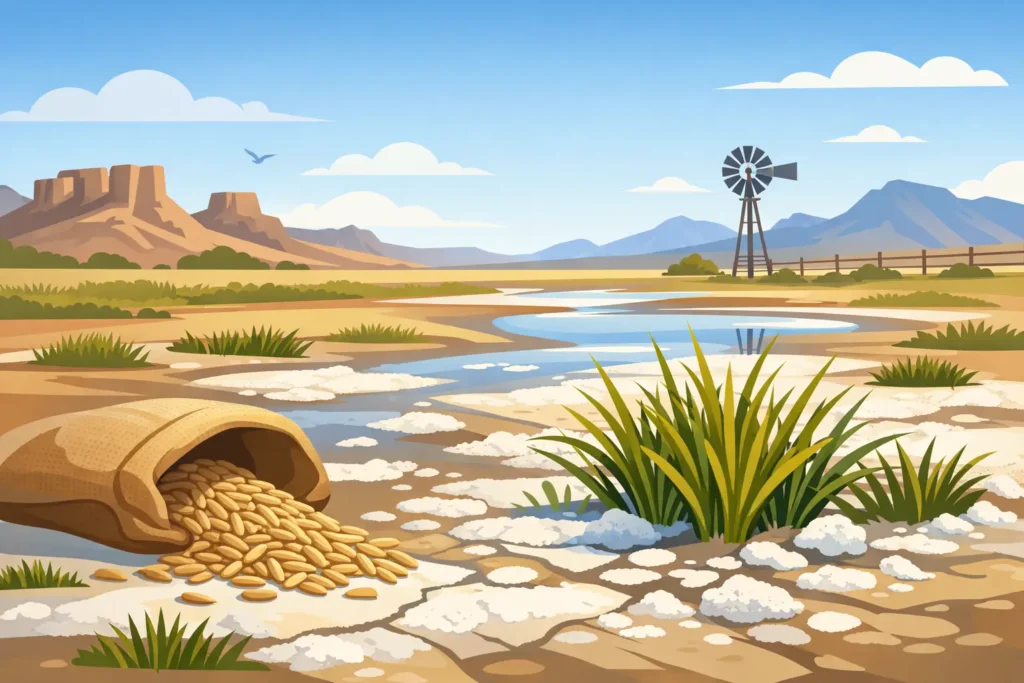
Salt-affected ground can turn an otherwise straightforward seeding job into a costly rework. The right saline soil grass seed can make the difference, but seed selection alone will not overcome poor drainage, concentrated salts, crusted soil, or a seeding window that does not fit the site. Successful establishment starts with understanding where the salt is coming from and choosing species that can persist under those conditions.
For reclamation contractors, municipalities, landowners, and agricultural operators, the goal is usually larger than getting green cover in the first season. A well-planned saline-site mix should stabilize soil, reduce erosion, compete with weeds, and remain productive or functional as the stand matures.
Why saline soils are hard to seed
Salinity limits a plant’s ability to take up water. Even when moisture is present in the soil, dissolved salts can make that water difficult for seedlings to access. Young plants are especially vulnerable because their root systems are shallow and have little margin for stress.
On many sites, salinity is paired with another establishment problem. Fine-textured soils may seal over after rain, low areas may remain wet in spring and dry hard later in the season, and poor drainage can keep salts moving toward the surface. Roadside ditches, disturbed industrial sites, irrigation-affected fields, and areas with shallow saline groundwater often show this pattern.
Not all salt-affected ground is the same. A site may have moderate salinity across a broad area, severe saline patches in depressions, or salt that appears only after dry weather. Sodic soils add another challenge: excessive sodium can damage soil structure, restricting infiltration and root growth. That distinction matters because a mix selected for salinity may still struggle if compaction, sodicity, or standing water is the main limiting factor.
Start with a site assessment, not a species list
The most dependable seed recommendation begins with a soil test and a field walk. Electrical conductivity, often reported as EC, provides a practical measure of soluble salts. Soil pH, sodium levels, texture, organic matter, and nutrient availability help complete the picture.
Sample separately when the field has visible zones. Testing a high, well-drained shoulder together with a white-crusted low spot can hide the conditions that will determine whether the project succeeds. Map wet areas, saline seep zones, wheel-track compaction, surface drainage paths, and sections that receive snow storage or runoff.
It also helps to define the job the vegetation needs to perform. A reclamation site may need long-term cover and diversity. A roadside project may prioritize quick soil stabilization and tolerance of traffic-related stress. A pasture may need usable forage without sacrificing persistence. These objectives call for different proportions of grasses, legumes, and broadleaf species.
Check the source of the salt
Seed cannot correct a continuing salt source. Before seeding, consider whether salts are being driven upward by shallow groundwater, carried in from adjacent runoff, concentrated by poor grading, or left at the surface after disturbance. Improving drainage, relieving compaction, reshaping a low area, or protecting a seep can be as valuable as changing the seed mix.
Where remediation is practical, soil amendments and incorporation can support recovery. However, amendments should follow test results and a realistic water-management plan. Adding material without addressing drainage may provide little benefit on a severely affected site.
Choosing saline soil grass seed by site function
Salt tolerance is not a single ranking that applies everywhere. A grass may tolerate salinity but fail under prolonged flooding, drought, shade, or heavy traffic. Species also vary in how quickly they establish and how well they compete during the first year.
For many Western sites, a mix built around salt-tolerant cool-season grasses provides the most reliable starting point. Alkaligrass is widely used where salinity is a primary concern and moisture can be variable. Tall wheatgrass is valued for its persistence, deep rooting, and ability to handle challenging saline or alkaline conditions. Slender wheatgrass can establish quickly and provide early cover, though it is generally shorter-lived than some long-term components.
Other species may be useful depending on the site. Streambank wheatgrass, western wheatgrass, and certain fescues can contribute durability and ground cover where conditions fit their strengths. On suitable reclamation projects, native species can add ecological value, but they should not be included simply because they are native. They still need to match the site’s salinity level, moisture regime, and establishment plan.
A single-species stand can be appropriate for a uniform, highly saline area with a specific functional goal. More often, a custom blend is the safer choice. It spreads risk across species with different rooting patterns, growth timing, and stress tolerances. If spring remains wet, summer turns dry, or salinity varies across the site, a well-designed mix is less likely to fail all at once.
Be careful with legumes
Legumes can improve forage quality and contribute nitrogen, but many are less salt tolerant than the grasses used on saline ground. Including a salt-sensitive legume in a severely affected area may create an attractive mix on paper without adding meaningful field performance.
Where forage is the objective and salinity is moderate rather than severe, a carefully selected legume component may still fit. The decision should be based on soil test results, intended grazing or hay use, and whether the area has enough moisture and fertility to support it. On the harshest patches, durable grass cover is often the more realistic target.
Seeding practices that protect establishment
Even the best saline soil grass seed needs good seed-to-soil contact. Seed into a firm, prepared surface that allows shallow placement and consistent depth. Small grass seed should not be buried deeply. On many sites, placing seed roughly one-quarter to one-half inch deep is appropriate, with adjustments for soil texture and equipment.
Avoid working saline soil when it is too wet. Smearing and compaction can reduce infiltration, create crusting, and make an already difficult site harder for seedlings. If the surface is loose after preparation, packing before and after seeding helps retain moisture and improves contact around the seed.
Timing depends on regional weather, site access, and available moisture. Dormant fall seeding can suit some reclamation projects, particularly where spring moisture will support germination. Spring seeding can also work well when the seedbed can be prepared properly and weeds are manageable. Dry summer seeding carries more risk unless reliable moisture is available.
Seeding rate should match the mix, site objective, and method. Extremely high rates do not solve salinity and can create unnecessary competition among seedlings. A rate that provides adequate cover while allowing persistent species to develop is more useful than simply putting more seed on the ground.
Manage the first season realistically
Salt-tolerant grasses are not instant cover. Germination may be uneven on a saline site because conditions can change over short distances. A weak-looking patch does not always mean the entire project has failed, especially during the first growing season.
Monitor emergence, weeds, crusting, and moisture after seeding. Address weed pressure before it overwhelms seedlings, using a method compatible with the species in the mix and the stage of establishment. Avoid unnecessary traffic across newly seeded ground, particularly when soils are wet or seedlings are small.
Where erosion is a concern, erosion-control practices may be needed alongside the seed mix. Surface protection can help hold soil and conserve moisture, but it must not smother seedlings or interfere with emergence. The right approach depends on slope, exposure, soil texture, and expected runoff.
For grazing or hay systems, defer use until plants are firmly rooted and the stand has had time to establish. Early grazing can remove the limited leaf area seedlings need to build roots, while hoof traffic can damage soft or wet saline soils. Patience in the establishment year often pays back in stand life.
Build for the site you have
A salt-tolerant mix should be designed around actual field conditions, not a generic label. Moderate salinity, severe saline depressions, reclaimed subsoil, roadside runoff, and forage acres each require different decisions about species, proportions, and management.
Proterra Seeds works with land managers across Western Canada to develop practical seed solutions for difficult ground, including reclamation, roadside, commercial landscape, and forage applications. The strongest results come from matching the mix to the soil test, the site’s moisture pattern, and the long-term use of the land.
When salt is part of the site, plan for persistence rather than a quick cosmetic fix. Good assessment, sound seedbed preparation, and species chosen for the real conditions give the stand its best chance to establish and keep working long after the first green growth appears.