
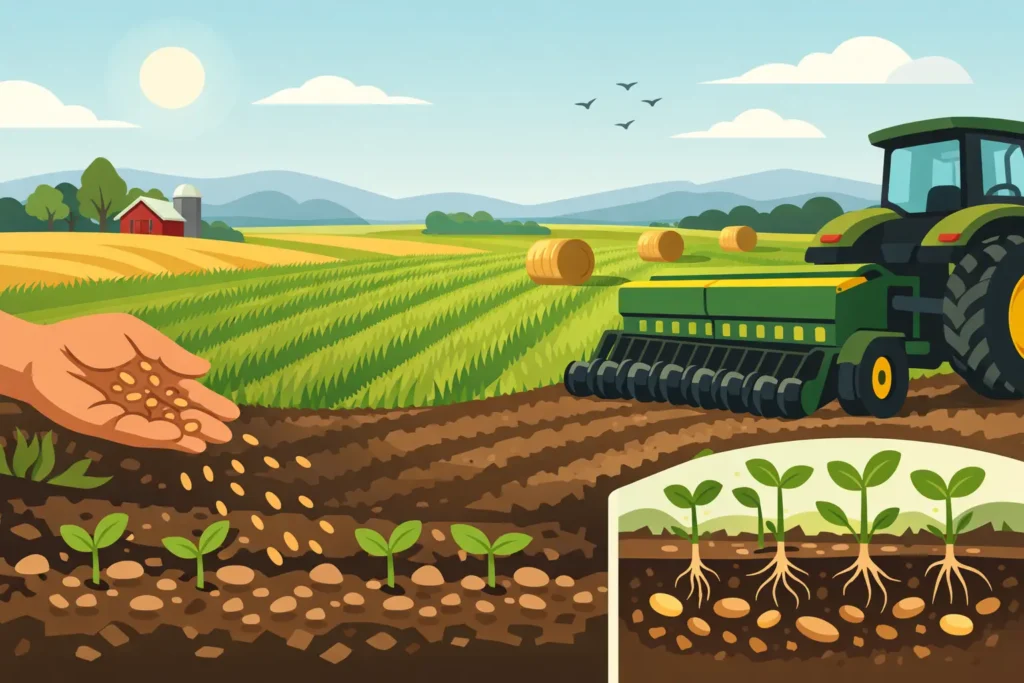
A thin hay stand can cost more than yield. Open ground invites weeds, weakens soil cover, and leaves expensive fertilizer working for plants that are no longer there. This hay field reseeding guide helps producers decide whether a field needs a light renovation, a full reseed, or a different management approach altogether.
Reseeding is not simply a matter of putting seed into the ground. The best result comes from matching the forage mix, seeding method, fertility program, and timing to the condition of the existing stand and the intended use of the hay. A field cut for dairy-quality feed has different priorities than one managed for beef cow-calf pairs, horse hay, or long-term soil protection.
Start With an Honest Stand Assessment
Walk the field before selecting a seed mix or booking equipment. A stand can look green from the road and still have too few productive plants to justify keeping. Check several representative areas rather than judging the field by its best corner.
Look at plant density, vigor, species balance, weed pressure, bare soil, drainage patterns, and damage from winterkill, drought, traffic, or insects. For alfalfa, evaluate crown health and count healthy plants, not just stems. Older alfalfa stands with declining crowns may not be good candidates for interseeding with more alfalfa because autotoxicity can limit new seedling establishment.
The decision usually falls into three practical paths. A productive stand with a few thin spots may only need fertility correction and improved cutting management. A moderately thin grass stand may respond well to overseeding. A field with widespread bare ground, persistent weeds, poor species composition, or major soil limitations often deserves termination and a complete reseed.
When Overseeding Makes Sense
Overseeding works best where the remaining forage is still worth preserving but gaps are large enough for seedlings to establish. Perennial grass hay fields can be good candidates, especially when desirable grasses remain present and weed competition is manageable.
The main trade-off is competition. Established plants have a root system and early-season advantage that seedlings do not. To improve the odds, seed early when soil moisture is available, use a method that places seed at the correct depth, and reduce competition through close grazing or an early harvest where appropriate. Do not scalp the field or damage crowns, but give new seedlings access to light.
When a Full Reseed Is the Better Investment
A full reseed gives you the chance to correct problems that patchwork renovation cannot solve. It is often the right route when more than a third of the field is bare or occupied by weeds, when the desired forage species are largely absent, or when compaction, fertility, salinity, drainage, and pH issues have been ignored for too long.
Terminating an existing stand requires planning. Perennial sod can be difficult to control, and tillage alone may spread some perennial weeds or leave living plants behind. The objective is a clean, firm seedbed with manageable weed pressure, not excessive tillage that dries the soil or creates a fluffy surface.
Hay Field Reseeding Guide: Build From the Soil Up
A soil test is the practical starting point for a successful reseed. It identifies nutrient needs before seed is in the ground and helps explain why the old stand failed. Test by management zone when fields vary noticeably in slope, soil type, productivity, or past manure application.
Pay particular attention to pH, phosphorus, potassium, sulfur, and available micronutrients where deficiencies are known. Legumes generally need higher soil fertility and suitable pH than many grasses. If the field is intended for alfalfa, correcting low pH before planting is far easier than trying to address it after the stand is established.
Soil physical condition matters just as much. Check for compacted layers with a shovel or probe, especially in headlands, feeding areas, and places repeatedly crossed when soils were wet. Correct compaction only when soil conditions allow effective work. Tillage performed too wet can create larger structural problems than it solves.
A good seedbed is firm, level, and free of large clods. Seed-to-soil contact is essential because most forage seed is small and cannot emerge from depth. A simple field check is useful: a boot heel should leave a shallow impression, not sink into loose soil.
Choose Species for the Field and the Feed Goal
Forage selection should begin with the site, then move to yield and quality targets. A high-performing mix on well-drained, fertile ground may fail on saline soil, a drought-prone hill, or a field with seasonal flooding. Seed mixtures are most effective when every species has a defined job.
Alfalfa is a strong option for high-protein hay and productive, well-drained soils. It can contribute nitrogen and excellent feed value, but it requires sound fertility, good drainage, and careful harvest management. Grass companions can improve stand structure, reduce drying time in some conditions, and create a more balanced forage package.
For cool-season grass systems, species selection depends on moisture, intended cutting schedule, winter conditions, and persistence goals. Orchardgrass can provide quality and regrowth under good management. Timothy is widely valued in hay markets but has different fertility and harvest timing needs. Smooth bromegrass and other persistent grasses can be useful where longevity and adaptability matter. On dry or challenging sites, drought tolerance and long-term ground cover may matter more than maximum peak yield.
Avoid adding species simply because they are familiar. A mix with too many components can make management harder when species mature at different times or respond differently to fertility and cutting intervals. A well-designed hay blend should establish evenly, fit the field’s limitations, and produce forage that works for the livestock operation.
Time Seeding Around Moisture and Competition
Spring and late summer are common reseeding windows, but neither is automatically right for every field. Spring seeding takes advantage of moisture and a full growing season, yet annual weeds can be aggressive. Late-summer seeding can reduce some weed pressure and allow seedlings to establish in cooler conditions, but it must occur early enough for plants to build roots and reserves before winter.
The ideal timing depends on local frost dates, expected rainfall, soil moisture, field elevation, and the species being planted. If conditions are dry and no meaningful moisture is forecast, waiting can protect both the seed investment and the field. Seed placed into dry soil may sit too long, emerge unevenly, or be lost to shallow germination after a small rain.
Seed depth is one of the most common establishment mistakes. Most small-seeded forage species should be placed shallowly, generally around one-quarter to one-half inch deep, depending on soil texture and moisture. Seed drilled too deeply often produces a thin, uneven stand even when the seed quality is excellent.
A drill with good depth control is usually the most reliable option for uniform placement. Broadcast seeding can work on suitable ground, but it needs follow-up packing to improve contact and should account for the higher risk of uneven depth. Calibrate equipment before entering the field, and verify actual seed placement by digging behind the drill.
Protect Seedlings During Their First Season
New forage seedlings need time to develop roots before they are asked to carry a harvest load. Watch emergence closely. Uneven emergence can point to residue issues, poor seed-to-soil contact, variable depth, crusting, or moisture differences across the field.
Weed management should be timely and practical. Some early weed growth may be tolerated if the forage is establishing well, while dense annual weeds can quickly shade seedlings and reduce stand survival. The right response depends on the weed species, crop stage, and whether the field was seeded to a grass, legume, or mixture. A mowing pass may help in certain situations, but it must be high enough to avoid cutting young forage plants too severely.
The first harvest should be based on plant development, not the calendar alone. Cutting too early can weaken root growth and reduce persistence. Waiting too long can allow weeds to set seed or forage quality to decline. Where establishment is uneven, it may be better to manage the field conservatively and give weaker areas more time.
Fertility also needs follow-through. A new stand has different nutrient demand than an established hay field, and nutrient removal begins with the first meaningful harvest. Use soil test results, expected yield, and the forage composition to build a program that supports production without overapplying nutrients.
Keep Reseeding Decisions Practical
The right reseeding plan is rarely the one with the most species or the most field passes. It is the plan that addresses the reason the old stand declined and establishes forage suited to the ground. A dependable hay field starts with a clear assessment, a firm seedbed, appropriate species, and patient first-year management.
If the field has variable soils, recurring winter injury, salinity, or a specific feed target, a custom forage blend can make the decision more precise. Proterra Seeds works with producers to match seed solutions to real field conditions, because strong establishment is built before the drill ever starts moving.