
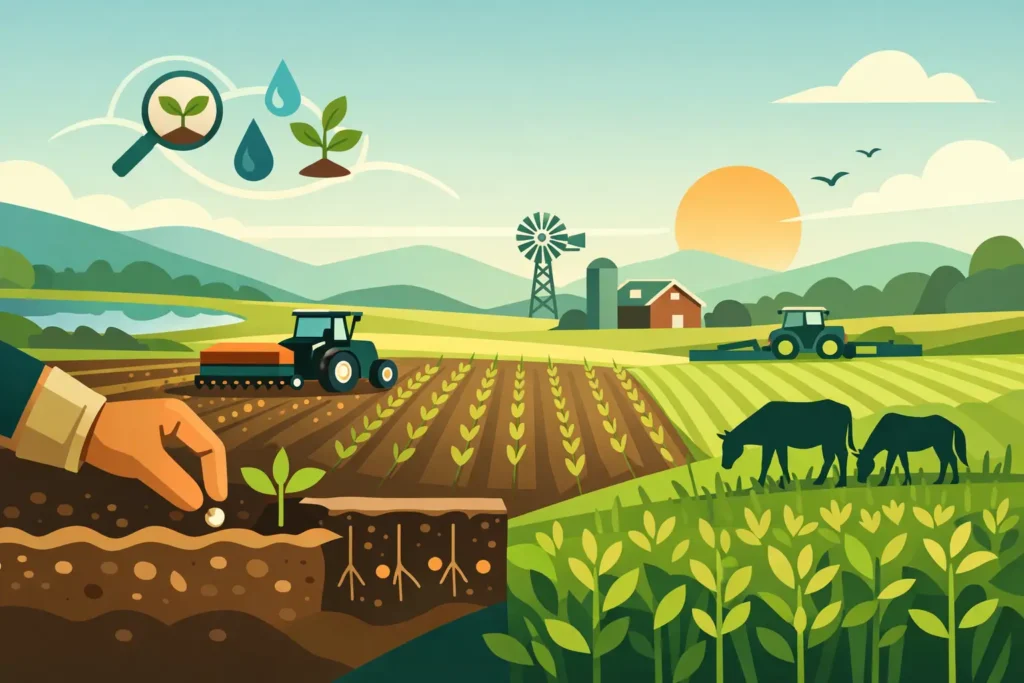
A forage stand usually succeeds or fails before the drill ever leaves the field. Seed choice matters, but so do soil conditions, timing, competition, moisture, and the way the seed is placed. That is why a good forage establishment guide starts with the full picture, not just a seeding rate. If the goal is long-term production, the first season needs to be managed with persistence in mind.
For hay, pasture, annual forage, or a mixed stand built for specific site conditions, establishment is the stage that sets yield potential, weed pressure, stand life, and recovery after stress. Across Western Canada and similar climates, the margin for error can be narrow. Cool springs, dry periods, variable soils, and short establishment windows all put pressure on every decision.
What a forage establishment guide should cover
A practical forage establishment guide needs to answer a few basic questions early. What is the stand meant to do? How long should it last? Will it be grazed, cut for feed, used as part of a reclamation plan, or expected to stabilize vulnerable ground while producing forage?
Those questions change the seed blend, the fertility strategy, and the level of risk a producer or land manager can accept. A high-yielding hay field, for example, may call for a different species balance than a pasture designed to handle grazing pressure and uneven moisture. A site with saline patches, compacted areas, or variable topsoil depth may need a more adaptable mix rather than a single-species approach.
The strongest plans are built around site realities instead of ideal conditions. That means paying close attention to drainage, texture, pH, previous crop history, residue levels, and likely weed pressure before seed is selected.
Start with the site, not the catalog
Forage establishment works best when the field or project area is assessed honestly. A clean, level field with good moisture-holding capacity offers very different opportunities than a disturbed site with erosion risk, poor structure, or inconsistent topsoil.
Soil testing is one of the most useful first steps because it helps separate a seed problem from a soil problem. If phosphorus is short, pH is limiting, or salinity is creeping in, those factors will affect emergence and early root development no matter how strong the blend looks on paper. On forage acres, early root growth often matters more than early top growth because persistence depends on what happens below ground.
Seedbed condition matters just as much. The goal is firm, uniform, and fine enough for good seed-to-soil contact without turning the surface powdery or prone to crusting. Small forage seed is unforgiving when it is buried too deep or left in loose ground that dries quickly. A rough seedbed can also lead to uneven emergence, which creates weak spots that weeds exploit.
Match species to use and environment
Species selection is where many establishment plans either gain resilience or build in future problems. A productive mix is not simply the one with the highest yield potential in a brochure. It is the one that fits moisture, soil, intended use, and management capacity.
Alfalfa can be a strong fit where drainage is good and fertility is managed, but it does not respond well to standing water or chronic compaction. Grasses may offer better ground cover, season-long competition against weeds, and grazing tolerance, but species differ widely in establishment speed and long-term persistence. Some annual forages can provide rapid feed production, but they are not a substitute for a perennial stand when the objective is multi-year output.
Blends often make sense because they spread risk. A well-built mix can combine fast establishment, seasonal production balance, and better adaptation to field variability. The trade-off is that mixed stands require more careful management. Cutting timing, fertility, and grazing pressure may favor one species over another, so the blend has to be built around the real management plan, not a best-case scenario.
For reclamation or disturbed land with forage value in mind, seed selection gets even more site-specific. Erosion control, rooting depth, traffic tolerance, and soil rebuilding may all matter alongside feed production.
Timing can make or break establishment
Seeding date is not just a calendar decision. It is a moisture and competition decision. In many areas, spring seeding gives the best chance to use stored soil moisture and moderate temperatures, but it can also line up with heavy annual weed pressure. Late seeding may avoid some early competition, yet it raises the risk of inadequate root development before heat or cold stress arrives.
There is no universal best date because conditions shift from year to year and from one region to another. In Alberta, Saskatchewan, and British Columbia, the right window can vary widely depending on elevation, moisture outlook, and field access. The better approach is to watch soil temperature, moisture conditions, and forecast patterns rather than forcing seed into poor conditions just because the schedule says it is time.
Dormant or late-season seeding may fit specific situations, but it requires a clear understanding of risk. If seed takes up moisture and starts to germinate too late, stand loss becomes more likely. That can be acceptable on some projects, but only when the decision is deliberate.
Seeding depth and placement matter more than many people think
Most forage seed should be placed shallow and consistently. Too deep is one of the most common establishment mistakes, especially in fluffy seedbeds or where operators are trying to chase moisture. Small seed has limited energy reserves. If it has to push too far to emerge, vigor drops quickly.
Uniform depth matters because uneven emergence creates an uneven stand. The plants that emerge first capture light, moisture, and nutrients, while later plants struggle to catch up. That thinning effect can start in the first few weeks and remain visible for years.
Press wheels, packers, and drill settings all have a role here. Good seed-to-soil contact helps moisture uptake, but overpacking can create crusting in some soils. Like most field decisions, the right setup depends on texture and moisture. There is no value in a textbook-perfect setting if it does not match the actual field.
Fertility and weed control should support establishment, not just yield
Early fertility decisions should be made with seedling safety and root development in mind. Phosphorus often supports early establishment, while aggressive nitrogen use can sometimes favor weeds or companion crops more than the forage seedlings themselves. The right program depends on species, soil test results, and whether the stand is pure, mixed, perennial, or annual.
Weed control should also be planned before seeding, not after weeds are already ahead. A field with known broadleaf or grassy weed pressure may need a different pre-seeding strategy, a cleaner break from the previous crop, or a revised timing plan. Once forage seedlings are in place, herbicide options can become more limited depending on species composition.
Companion crops can help with erosion control and early cover, but they are not automatically beneficial. If they compete too hard for light and moisture, they can reduce forage stand density. In drier regions or on lower-moisture sites, that trade-off needs careful thought.
First-year management is where stands are protected
A new stand should not be judged too quickly, but it also should not be ignored. The first season is the time to watch emergence uniformity, weed pressure, insect activity, and moisture stress. Thin patches may point to depth issues, residue problems, salinity, compaction, or simply changing soil conditions across the field.
Traffic should be minimized when soils are wet and seedlings are fragile. Grazing too early or cutting too aggressively can weaken root systems before the stand is anchored. At the same time, waiting too long to manage weeds or clipping a competitive nurse crop can cost stand density. Good establishment is active management, not just waiting for the field to fill in.
Patience matters, especially with perennial stands. Some species invest heavily in root growth during establishment and may not show their full production potential in the first year. That does not mean the stand is underperforming. It may simply be building the foundation needed for long-term persistence.
A forage establishment guide for long-term performance
The best forage establishment guide is not about chasing perfect conditions. It is about reducing preventable risk. That means matching species to the site, preparing a firm seedbed, placing seed correctly, managing fertility with care, and protecting young stands from avoidable competition and stress.
For buyers managing hay fields, pasture acres, municipal land, or reclaimed sites, the same principle holds true: establishment decisions should reflect how the stand will be used over time. A blend that looks efficient on paper can still fail if it does not fit the ground, the moisture pattern, or the management system behind it.
At Proterra Seeds, that practical fit matters because performance starts with using the right seed strategy for the land in front of you. When establishment is handled well, the stand has a fair chance to do its job for years, not just make a good first impression.