
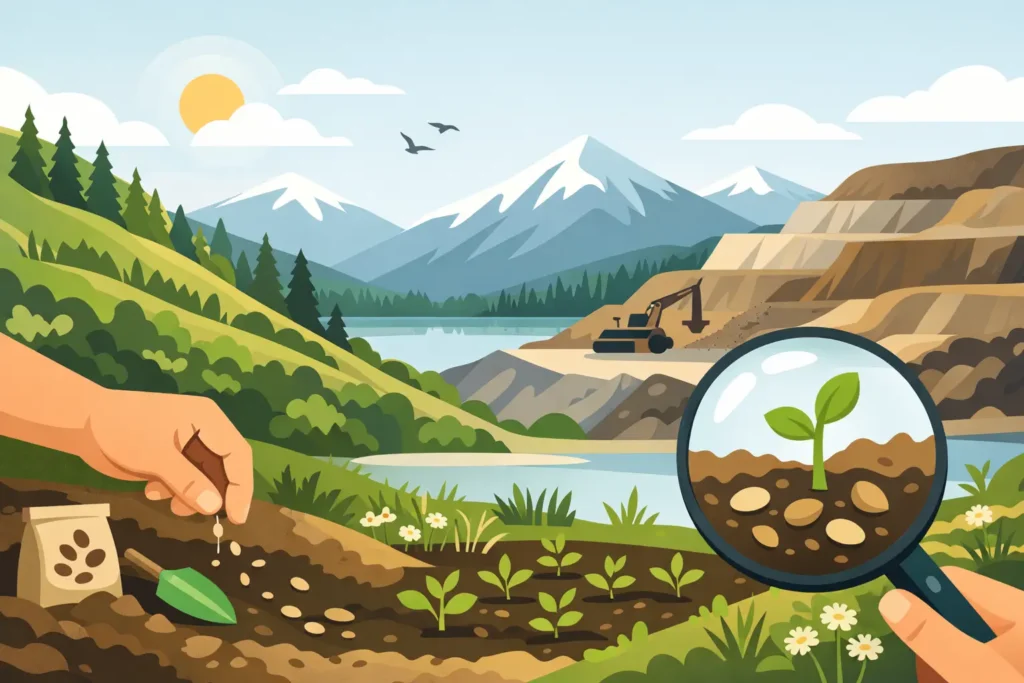
A successful British Columbia mine reclamation seed program starts well before a spreader reaches the site. A blend that establishes quickly on one reclaimed bench can struggle on another only a few kilometers away if elevation, soil handling, moisture, or exposure changes. The objective is not simply to make disturbed ground look green. It is to establish a vegetation community that holds soil, fits the approved land-use plan, and has a credible path toward long-term persistence.
For mine operators, contractors, and land managers, seed selection is one of the most practical decisions in the reclamation process. It affects erosion risk, follow-up maintenance, biodiversity outcomes, and the condition of the site years after construction or closure activities are complete.
What British Columbia Mine Reclamation Seed Must Do
Mine reclamation places seed in conditions that are rarely uniform. Salvaged topsoil may vary in depth and quality. Overburden, compacted surfaces, steep slopes, coarse substrates, and changing drainage patterns can all occur within one project area. The right seed mix needs to respond to those realities instead of assuming every acre has the same establishment potential.
Early cover is often a priority, especially where wind or water erosion could move soil before perennial vegetation develops. Fast-establishing species can provide that first layer of protection, but speed alone is not enough. If the blend is dominated by short-lived species, it may leave the site open again once those plants decline. A durable reclamation mix balances early establishment with species that can persist through local winters, summer dry periods, and competition over time.
The target community also matters. Some sites require a productive grass and legume cover for an agreed post-mining land use. Others call for native grasslands, forest-adjacent understory, wetland margins, or habitat-focused restoration. These objectives require different species, different seeding rates, and sometimes separate treatments across the same mine footprint.
Start With the Reclamation Objective, Not a Standard Mix
A standard mix can be useful as a starting point, but it should not replace site planning. Before selecting seed, define what the reclaimed area is expected to become and what conditions will shape establishment. The approved reclamation plan, permit conditions, land capability goals, and input from environmental professionals should guide the direction.
A practical seed plan considers elevation, precipitation pattern, aspect, soil texture, topsoil availability, salinity or pH concerns, and the likelihood of seasonal flooding or drought. South-facing slopes may need a different approach than cooler north-facing ground. A coarse, drought-prone rock pile cover may need species selected for stress tolerance, while a fine-textured area with reliable moisture may support a broader mix.
Timing changes the recommendation as well. Spring seeding can take advantage of moisture but may coincide with aggressive annual weeds. Dormant fall seeding can work well for certain native species and projects, yet it requires careful planning so seed remains in place through winter. Hydroseeding, drill seeding, broadcast application with incorporation, and erosion-control blankets each suit different terrain and soil conditions. Seed is only one part of the system, but it must be chosen with the application method in mind.
Separate Site Units When Conditions Change
One of the most common weaknesses in reclamation seeding is treating a varied site as one unit. If a project includes uplands, drainage swales, stockpile slopes, compacted laydown areas, and undisturbed edge transitions, a single blend may compromise performance everywhere.
Breaking the site into management zones allows the mix to do a more specific job. Upland zones can prioritize drought tolerance and stable perennial cover. Moist depressions may need species that tolerate periodic saturation. Transition areas near intact vegetation may be candidates for locally appropriate native species that support a more natural recovery pattern. This approach adds planning upfront, but it can reduce reseeding and improve long-term results.
Balancing Native Species With Establishment Performance
Native seed is often an important part of British Columbia mine reclamation seed planning, particularly where restoration goals call for regional ecological fit, habitat value, or connection to nearby plant communities. Native species can bring strong long-term value, but they do not all establish at the same speed or respond equally to disturbed soils.
That does not mean native seed is unsuitable for difficult sites. It means the blend and site preparation need to be realistic. Some native grasses establish steadily rather than rapidly. Native forbs may have specialized germination requirements, lower seed counts per pound, or greater sensitivity to seeding depth. On harsh sites, they may perform better when paired with carefully selected companion species, mulch, erosion control, and sound soil handling.
Introduced or agronomic species may have a role where rapid stabilization and dependable cover are the immediate priorities, provided they fit the project requirements. The trade-off is that highly competitive species can limit the establishment of slower-growing natives. In some cases, a phased strategy is more appropriate: stabilize the ground first, then introduce additional native diversity once the site is secure. In others, a diverse native-forward blend from the start is the better choice. The right answer depends on the reclamation target, site risk, and long-term management capacity.
Soil Preparation Determines Whether Seed Can Respond
Even the best-designed mix cannot compensate for poor seedbed conditions. Reclamation seed needs contact with soil, adequate but not excessive burial, and a surface that can retain enough moisture for germination. Smooth, compacted ground may shed water and leave seed exposed. Deeply loosened or rough ground can create favorable microsites, but excessive roughness may make application uneven or complicate follow-up work.
Topsoil handling deserves close attention. Salvaged soil can carry valuable organic matter, microbial activity, and an existing seed bank, but it can also contain weed seeds. Placement depth, timing, and stockpile duration affect how useful that material will be during revegetation. Where topsoil is limited, amendments, surface roughening, mulch, or erosion-control materials may be necessary to improve the chance of establishment.
Fertilizer decisions should be tied to soil testing and project objectives. More fertility is not automatically better. Excess nutrients can favor weeds or aggressive species, especially where native community development is the goal. On nutrient-poor substrates, targeted fertility may be necessary to get permanent cover started. A reclamation plan should account for both the first growing season and the vegetation community expected several years later.
Design for Erosion Control Without Sacrificing Persistence
Steep slopes and exposed materials create urgency. Seed may be needed quickly, but a rushed mix can create a short-lived green cover that does not solve the underlying stability problem. On erosion-prone areas, consider seed alongside slope length, runoff concentration, mulch type, tackifier use, blankets, and surface protection. A seed blend cannot hold a failing slope by itself.
Species with fibrous root systems can contribute to surface stability, while legumes may support nitrogen cycling where they are appropriate. Broadleaf species add diversity and habitat value, but they may not provide the same immediate ground cover as grasses. A well-built blend uses each group for a reason rather than adding species simply to make the label longer.
Monitoring is equally important. Germination counts, bare-ground observations, weed pressure, erosion features, and species composition tell the project team whether the site is moving toward its goal. A thin stand may need overseeding. A weed-dominated area may require a different intervention. Waiting until a site has deteriorated can turn a manageable correction into a costly rebuild.
Seed Quality and Documentation Matter on Regulated Sites
Mine reclamation projects require dependable records. Seed tags, lot information, purity, germination results, application rates, installation dates, weather conditions, and treatment maps help demonstrate what was applied and support later troubleshooting. They also make it easier to compare performance between zones and refine future prescriptions.
Species names should be reviewed carefully against project specifications and regulatory requirements. Common names can be confusing, and substitutions that appear similar on paper may have very different growth habits or ecological implications. When native provenance, certified seed, or specific species composition is required, those details should be settled before application day.
At Proterra Seeds, the practical focus is matching custom reclamation blends to the ground conditions and performance goals that Western Canadian projects face. That means asking the questions that affect establishment, rather than treating mine reclamation as a one-mix application.
Plan for the Second and Third Growing Seasons
The first green flush can be encouraging, but it is not the finish line. Some reclamation species establish slowly, and weather can strongly influence results from one year to the next. A site should be evaluated for cover, vigor, unwanted species, erosion, and movement toward the intended plant community over multiple growing seasons.
Build monitoring and contingency work into the original plan. Where practical, retain enough flexibility to overseed weak areas, add diversity later, or adjust weed management before desired vegetation loses ground. Good reclamation is measured by a site that keeps improving after the equipment has left, not just by a successful first-season photo.
The most reliable reclamation seed program is the one designed for the actual site in front of you. When the blend, soil preparation, application method, and follow-up plan all support the same land-use goal, reclaimed ground has a far better chance of becoming stable, functional, and self-sustaining.