
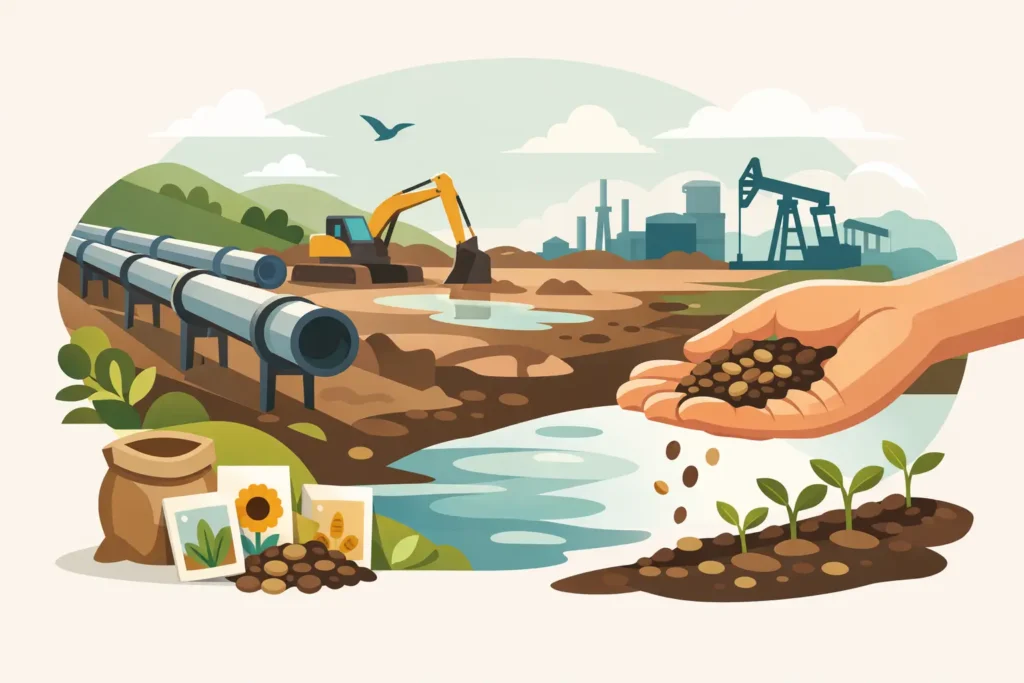
A pipeline right-of-way can cross dry uplands, wet draws, native grassland, cultivated fields, and steep side slopes in the same project. That is why the answer to “what seed suits pipeline sites” is rarely a single species or off-the-shelf mix. Successful pipeline reclamation starts with matching the seed blend to the land that was disturbed, the soil that remains, and the condition the site must achieve over time.
The best blend establishes quickly enough to protect the soil, persists through local weather conditions, and supports the required post-construction land use. It also needs to be practical to seed and maintain across a long, variable corridor. A mix that performs well on a dry, exposed hill may fail in a low-lying area with prolonged moisture, while a highly diverse native blend may not be the right fit for an actively managed agricultural easement.
What Seed Suits Pipeline Sites? Start With the Site Objective
Before selecting seed, define what the restored corridor needs to do. Pipeline sites are commonly seeded for erosion control, vegetation recovery, agricultural productivity, habitat restoration, or a combination of these goals. The target outcome should guide every other decision.
On native or naturalized land, the objective may be to re-establish a plant community that is compatible with adjacent vegetation and supports long-term ecological function. On farmland, the priority may be returning the right-of-way to a productive forage stand, pasture, or crop rotation. In industrial settings, dependable ground cover and stable soils may be the primary need.
The original vegetation is an important reference point, but it is not the only one. Construction can change soil structure, surface roughness, drainage, and compaction. The blend must suit the restored site conditions, not just the pre-construction map. A practical reclamation plan balances the desired end land use with what the site can reasonably support during establishment.
Match the Blend to Soil, Moisture, and Exposure
Soil texture and moisture are often the strongest drivers of seed performance. A seed mix should be built around the conditions likely to remain after topsoil replacement, grading, and compaction relief.
Dry uplands and exposed slopes
Dry, wind-exposed pipeline sections need species that can establish under limited moisture and remain stable through summer heat. Drought-tolerant grasses are often the foundation of these blends because their root systems help bind soil and reduce erosion. Where the reclamation objective supports it, carefully selected legumes or broadleaf species can add diversity, but they should not be included simply to make a blend look more complex.
Fast cover matters on steep slopes, but short-lived species should not dominate the mix if long-term persistence is the goal. A temporary cover crop can be useful where erosion risk is high, provided it will not outcompete the permanent species or create problems during vegetation monitoring.
Moist or low-lying ground
Low areas, drainage crossings, and fine-textured soils require species that tolerate periodic saturation without losing stand density. A blend designed for dry ground can thin quickly in these conditions, leaving openings for weeds and erosion.
Moist-site mixes should still account for the possibility of dry periods later in the season. Pipeline corridors often have variable drainage from one side of the right-of-way to the other. In some cases, separating wet sections from adjacent uplands and applying different mixes is more reliable than using one compromise blend across both areas.
Compacted or low-fertility soils
Compaction is common after construction traffic, particularly at work areas, access routes, and valve sites. Seed alone cannot solve severe compaction. Site preparation, surface roughening, topsoil handling, and appropriate amendment decisions all affect whether a stand takes hold.
That said, certain grasses and legumes are better suited to challenging soils than others. A blend with strong early root development can help stabilize the surface while the site recovers. Fertility should be assessed carefully rather than assumed. Over-fertilizing can favor aggressive weeds and may not support the intended reclamation outcome.
Select Species for Both Early Cover and Long-Term Persistence
A pipeline blend should not be judged only by how green it looks a few weeks after seeding. Early establishment is valuable, especially where soil loss is a concern, but the stand must continue performing after the first growing season.
Grasses are usually central to pipeline reclamation because they establish ground cover, develop fibrous root systems, and tolerate mowing or traffic better than many broadleaf species. The right grass species depends on the moisture regime, soil zone, expected management, and whether the site is returning to agricultural or native use.
Legumes can play an important role where nitrogen contribution, forage value, pollinator resources, or plant diversity are desired. They can be slower to establish and may require different inoculation or management considerations. Their inclusion should fit the project plan and site conditions, not be treated as automatic.
Native species are often appropriate when restoring native landscapes or meeting landowner, regulator, or project-specific reclamation requirements. They can offer strong long-term ecological value, but establishment timelines may differ from introduced forage species. Native mixes also require attention to source, species selection, seeding depth, and weed pressure. A diverse native mix is not automatically a better mix if the species are poorly matched to the site.
For agricultural right-of-ways, forage grasses and legumes may be the practical choice when the land will return to hay or pasture production. In these cases, persistence, recovery after use, and compatibility with the surrounding operation matter as much as initial cover.
Use More Than One Blend When Conditions Change
Long pipeline corridors are rarely uniform. A single blend may simplify logistics, but it can create unnecessary risk when the route crosses several soil types and land uses. Splitting the project into seed zones often produces better establishment and more credible reclamation results.
Typical seed zones might include dry uplands, moist depressions, cultivated land, native grassland, forest margins, and high-erosion slopes. The goal is not to create complexity for its own sake. It is to avoid asking one blend to solve conflicting problems.
This approach is especially useful in Western Canada, where a corridor may move quickly between distinct moisture conditions and soil landscapes. Local knowledge helps identify where a standard mix should be adjusted before seeding begins, rather than after a poor stand requires repair.
Seeding Method Can Change the Right Choice
The same seed blend can perform very differently depending on how it is applied. Drill seeding generally provides more consistent seed-to-soil contact and depth control on accessible ground. Broadcast or hydromulch applications can be useful on steep slopes, rough surfaces, or areas where equipment access is limited, but they require close attention to coverage, incorporation, and erosion protection.
Seed size matters. Small-seeded species should not be buried too deeply, while larger seeds may need firmer placement. A blend with a wide range of seed sizes must be calibrated and handled carefully so that the application rate stays consistent across the site.
Timing matters as well. Spring seeding can take advantage of early moisture, while dormant seeding may suit certain native restoration plans. Summer seeding can work under the right conditions, but heat, dry soil, and weed pressure increase the risk. The right timing depends on the species, local weather pattern, site preparation schedule, and available follow-up management.
Plan for Weed Pressure and Follow-Up
Pipeline disturbance creates openings, and openings invite weeds. A good seed blend reduces that risk by establishing dependable cover, but it does not remove the need for monitoring. Weed pressure should influence species selection, seeding timing, and the choice between a temporary cover and a slower-establishing permanent mix.
Early inspections can identify bare areas, erosion, poor seed placement, or emerging weed concerns before they spread across the corridor. Where reseeding is needed, the cause should be addressed first. Adding more seed to compacted soil, poor topsoil, or an actively eroding slope usually repeats the original problem.
For projects with formal reclamation criteria, document seed lots, application rates, locations, weather conditions, and any site-specific changes. Good records make it easier to evaluate performance and explain why a particular blend was selected.
Build the Blend Around the Land, Not a Product Name
The strongest pipeline seed plan begins with a field-level assessment: soil type, moisture, slope, erosion risk, adjacent vegetation, intended land use, and the required reclamation standard. From there, species can be selected for a clear purpose rather than assembled as a generic package.
Proterra Seeds works with contractors, land managers, and project operators to develop mixes suited to demanding restoration conditions across Western Canada. The practical question is not which seed is most popular. It is which combination can establish reliably, protect the site, and remain appropriate for the land years after construction is complete.
A well-chosen pipeline blend gives the corridor a better start, but long-term success comes from treating seed as part of the reclamation system. Prepare the site well, match the mix to real field conditions, and leave room for monitoring and adjustment as the land recovers.