
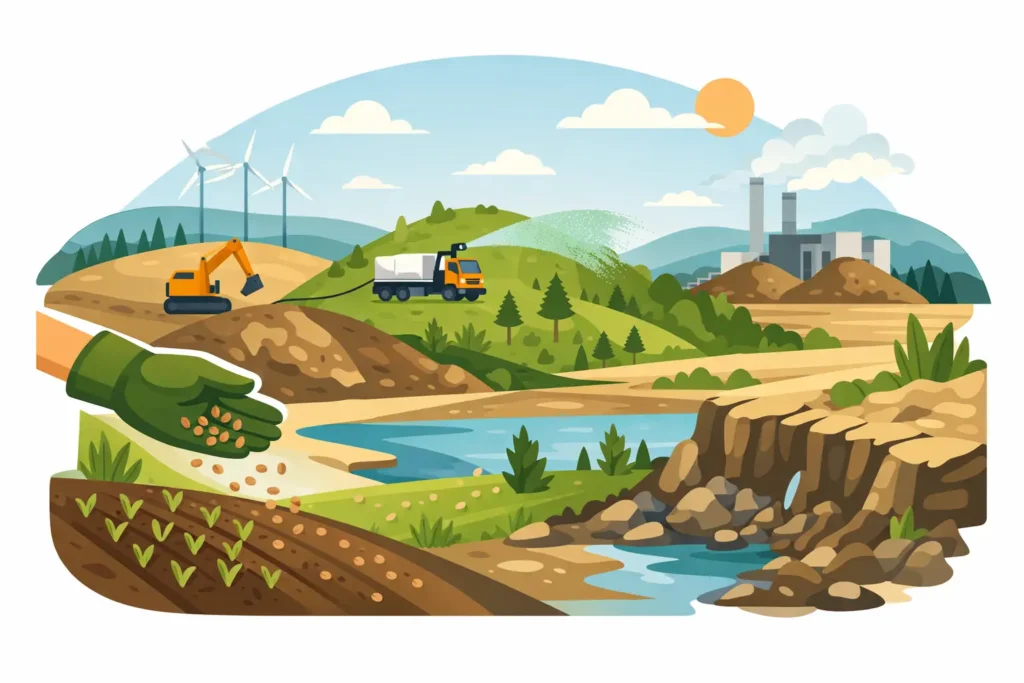
A disturbed site can look ready for seed long before it is ready to support vegetation. Compacted ground, uneven topsoil, poor moisture retention, weed pressure, and a short growing season can all work against establishment. This land reclamation seeding guide focuses on the decisions that give a project the best chance of building stable cover, controlling erosion, and supporting the intended land use over time.
Start With the Final Land Use
Reclamation seeding should begin with the condition the land needs to reach, not simply the need to put green cover on bare soil. A pipeline right-of-way, a renewable energy site, a roadside slope, a lease pad, and a grazing area may all require vegetation, but they do not require the same type of vegetation.
Define whether the site needs quick erosion protection, long-term native restoration, agricultural productivity, compatible vegetation around infrastructure, or a combination of these outcomes. Project approvals, landowner expectations, and local reclamation requirements should guide the plan from the start. A fast-growing cover crop may be useful on a steep, exposed slope, but it should not dominate a site where native species establishment is the long-term objective.
Site conditions matter just as much as the final use. Before selecting a blend, assess the soil texture, available topsoil depth, compaction, drainage, slope, salinity risk, aspect, and existing weeds. In dry or variable climates, moisture availability can be the factor that determines whether a mix performs well or struggles through its first season.
Land Reclamation Seeding Guide: Build the Seedbed First
Seed cannot correct a poorly prepared seedbed. The goal is a firm, reasonably level surface that lets seed make direct contact with soil while still allowing water to infiltrate. Loose, deeply worked soil may look well prepared, but it can dry out quickly, shift in wind or water, and leave seed buried too deeply after rainfall.
Where compaction limits root growth or drainage, address it before final grading. Deep ripping or other loosening methods can help in the right conditions, but they should be used thoughtfully. On erosion-prone slopes, aggressive disturbance can create another problem if the surface is left loose and unprotected.
Replace and spread salvaged topsoil evenly when it is part of the reclamation plan. Avoid creating deep piles in one area and thin coverage in another. Uneven topsoil depth often leads to uneven vegetation, with vigorous growth in some areas and persistent bare ground in others.
Final packing is often overlooked. A firm seedbed helps place small seed at a consistent shallow depth and reduces moisture loss around the seed. As a practical check, a boot print should be visible but not sink deeply into loose soil.
Manage weeds before seeding
Weed control is most effective when it is planned before seed goes down. Existing perennial weeds, volunteer crops, and aggressive annuals can outcompete desirable seedlings for moisture, light, and nutrients. Identify major weed species early and choose a control approach that fits the project schedule, site restrictions, and seed mix.
Avoid assuming that more fertilizer will solve weed competition. Fertility can help where a soil test shows a real deficiency, but excessive nutrient application may favor weeds or fast-growing species over slower-establishing perennials and native plants. Soil testing provides a better basis for amendments than a standard application rate used on every site.
Select a Blend for the Site, Not the Label
The best reclamation mix is rarely the one with the longest species list. A useful blend combines species that fit the soil, climate, moisture regime, and project objective. It should also account for establishment speed, persistence, root structure, and the management the site will receive after seeding.
Grasses are often the foundation of erosion control because their fibrous roots help bind the soil and their seedlings can provide early cover. Forbs can improve biodiversity, pollinator value, and ecological function, although many require careful seed placement and patience during establishment. Shrubs or woody species may be appropriate where the approved end land use calls for them, but they should not be included by default.
Native species can be the right choice for ecological restoration and long-term compatibility with surrounding plant communities. They may establish more slowly than agronomic species, especially on dry, compacted, or low-fertility ground. In some projects, a carefully selected nurse crop or temporary cover can reduce erosion while desired perennial species establish. The trade-off is that the temporary species must not crowd out the long-term mix.
For agricultural reclamation, pasture and forage goals may call for a different balance of grasses and legumes. Legumes can contribute feed value and nitrogen, but they need suitable soil conditions and management. Saline soils, wet depressions, sandy ridges, and heavily shaded areas may each require separate treatment or a distinct blend rather than one mix applied across the entire project.
Seed at the Right Time and Depth
Timing affects both germination and survival. Spring seeding can take advantage of seasonal moisture and a full growing season, but it also coincides with strong weed pressure on many sites. Dormant fall seeding can suit some native species and help crews complete work after the main growing season, but seed must remain in place through winter and avoid germinating during an untimely warm period.
The right window depends on local climate, soil moisture, species selection, and the ability to manage the site after seeding. In Alberta, Saskatchewan, and other cold-region landscapes, a short growing season makes timely preparation especially valuable. Seeding late into dry summer conditions without reliable moisture can leave seedlings exposed at their most vulnerable stage.
Most reclamation seed should be placed shallowly. Small seeds have limited stored energy and may not emerge when buried too deep. Drill seeding is often preferred where terrain and residue allow because it improves depth control and seed-to-soil contact. Broadcast seeding can work well on rough ground, steep slopes, or sites with access limitations, but it usually requires a higher seeding rate and a follow-up packing pass where practical.
Calibrate equipment for the actual blend being used. Seed mixtures often contain species with different seed sizes, densities, and flow characteristics. A drill that applies a clean grass seed uniformly may not distribute a diverse native mix correctly. Run a test, verify output, and document the application rate before covering a large area.
Protect the Site After Seeding
Seeding is the start of reclamation, not the finish line. Newly seeded ground is vulnerable to runoff, wind erosion, traffic, grazing, and invasive weeds. On slopes and exposed soils, erosion-control blankets, mulch, tackifiers, or other surface protection may be justified. The right method depends on slope length, soil type, expected rainfall, access, and the species being established.
Traffic control is equally important. A few repeated equipment passes can compact wet soil, create ruts, and damage emerging seedlings. Mark access routes and keep unnecessary traffic away from seeded areas. If grazing is part of the eventual land use, delay it until plants are firmly rooted and able to recover from defoliation.
Early inspections should focus on patterns, not just whether the site looks green. Bare strips may point to equipment calibration problems. Thin stands on ridges may indicate drought or shallow topsoil. Dense patches of annual weeds may signal a need for timely control before they set seed. Observations made during the first growing season are often the best guide for corrective work.
Measure Success Over More Than One Season
A successful stand does not always look uniform in its first year. Some perennial grasses and native forbs invest heavily in roots before producing much visible top growth. Judging a restoration site too early can lead to unnecessary reseeding or treatments that disrupt species beginning to establish.
At the same time, patience should not become inaction. Track plant cover, desirable species presence, weed pressure, erosion, and bare ground against the project objective. If a section has failed because of washouts, poor soil placement, salinity, or repeated traffic, correct the underlying cause before reseeding. Applying more seed to the same unresolved condition usually repeats the same result.
A practical reclamation plan allows for follow-up over multiple seasons. It recognizes that weather cannot be controlled, while seedbed quality, blend selection, application method, and site protection can. Those controllable decisions carry the most weight in long-term performance.
For demanding sites, the most dependable path is to match the seed mix and method to the land in front of you. Proterra Seeds helps project teams make those choices with blends built around regional conditions, reclamation goals, and the work required after the seed is applied.