
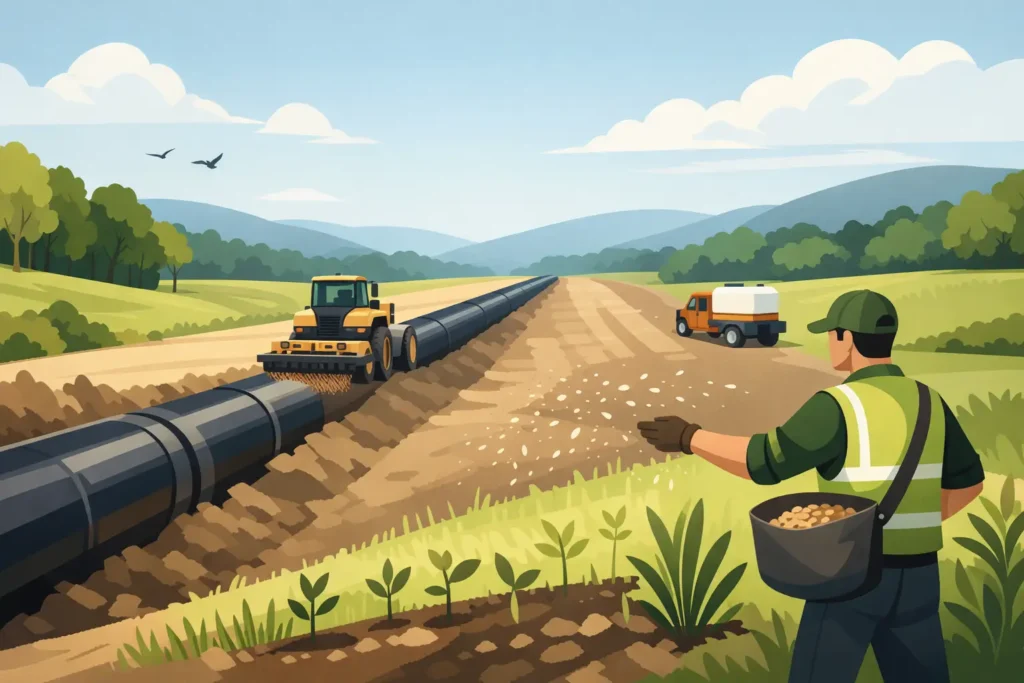
A pipeline corridor can look stable the day crews leave, then start losing topsoil after the first hard rain or spring runoff. That is why a solid pipeline right of way seeding guide matters. Seeding on disturbed ground is not just about getting something green to come up. It is about erosion control, weed pressure, regulatory goals, surface stability, and building vegetation that can persist under real field conditions.
On pipeline projects, the seed mix and the timing of application carry long-term consequences. A right of way may cross native range, cultivated ground, forest edge, low-lying wet areas, and upland slopes in the same stretch. Treating all of it as one uniform seed job usually leads to uneven establishment and unnecessary rework. Good outcomes come from matching the seed blend and the seeding plan to the actual site.
What a pipeline right of way seeding guide should account for
The best pipeline right of way seeding guide starts with one simple point: disturbed land is rarely uniform. Topsoil depth can vary, compaction can change every few hundred feet, and moisture can shift dramatically between slope positions. Even where grading looks consistent, seed performance may not be.
That is why site assessment matters before a blend is chosen. Soil texture, available moisture, salvage quality, slope, aspect, and surrounding vegetation all influence which species belong on the right of way. Land use matters too. A reclaimed corridor through pasture has different expectations than a temporary disturbance across industrial land or a section adjacent to native vegetation.
There is also a trade-off between fast cover and long-term fit. Quick-establishing grasses can help stabilize soil early, but if they are too aggressive for the site, they may crowd out slower establishing species needed for durable reclamation. On the other hand, a mix built only for long-term diversity may leave the surface exposed longer than the project can tolerate. The right answer is usually a balanced mix rather than an extreme one.
Start with the end use, not just the disturbance
Pipeline right of way seeding works best when the post-construction objective is clear from the start. If the goal is agricultural restoration, species selection should support the landowner’s use and the productivity expected after disturbance. If the goal is reclamation on industrial or utility land, persistence, soil holding ability, and compatibility with local vegetation become more important.
In agricultural settings, you may be looking for a forage-compatible mix that can reintegrate with surrounding hay or pasture. In reclamation settings, a blend may need to emphasize native or adapted perennial species that support long-term site recovery without creating management issues later. In some areas, the right approach may involve separate seed prescriptions for different segments of the same right of way.
This is where regional knowledge pays off. Western Canadian conditions often include short establishment windows, variable spring moisture, dry summer periods, and cold winters that test seedling persistence early. A blend that looks good on paper still needs to perform on a corridor exposed to wind, frost, and uneven soil conditions.
Choosing species for a right of way seed mix
A practical seed mix for pipeline work usually includes species that establish with reasonable speed, anchor the soil, and persist without becoming a problem. Cool-season grasses are often the backbone because they provide dependable cover and root mass. Depending on the site, legumes may be included to support nitrogen contribution and stand diversity, though they need to fit the soil and management conditions.
The question is not which species are universally best. It is which species are best for this corridor, this soil, and this reclamation target. On drier uplands, drought tolerance and persistence can outweigh rapid early growth. On moister or heavier soils, species that handle periodic saturation may be a better fit. On steep slopes, root structure and soil-holding ability matter as much as visual cover.
Native versus introduced species is another decision that depends on project requirements, land use, and the expected timeline. Native mixes can be the right choice where ecological restoration goals are front and center, but they often require more patience and stronger expectations around slower establishment. Introduced or agronomic species may provide faster cover in some situations, especially where immediate stabilization is critical. The right plan may use one approach in a sensitive segment and another where the site objective is different.
Timing can make or break establishment
Even a well-designed mix can struggle if it goes on at the wrong time. Seeding windows for pipeline rights of way depend on moisture, temperature, and soil conditions much more than the calendar alone. Spring seeding can work very well when moisture is present and seedbed conditions are suitable, but a drying pattern right after seeding can quickly reduce establishment on exposed slopes.
Late summer or dormant seeding may also be appropriate in some regions and on some projects, particularly when trying to avoid heat stress or fit construction schedules. But those options come with their own considerations. Seed placed too early before a warm spell may germinate at the wrong time. Seed placed too late into poor surface conditions may not get the seed-to-soil contact needed for good establishment.
It depends on the site and the year. That is why seeding plans should stay flexible enough to respond to actual field conditions rather than relying on a fixed date alone.
Seedbed preparation matters more than most crews want to hear
On right of way projects, seedbed preparation is often where good intentions get lost. Compaction, cloddy surfaces, uneven topsoil replacement, and poor surface finish can all limit germination. If seed is applied to a hard, rough, or unstable surface, the stand may come in patchy no matter how well the blend was chosen.
A workable seedbed does not need to be perfect, but it does need enough fine material and enough surface contact for the seed to settle in and access moisture. Excessively fluffy topsoil can dry out quickly, while compacted surfaces can reduce rooting and water infiltration. The goal is a firm, receptive surface with enough roughness to reduce erosion without burying the seed too deep.
That balance is especially important on slopes and in areas where runoff concentrates. If the corridor is prone to washing, seeding should be viewed as part of a larger stabilization plan, not the only tool in the box.
Application method and coverage expectations
Broadcast seeding, drill seeding, and hydraulic methods each have a place on pipeline work. The best option depends on terrain, access, soil finish, and the kind of control you need over seed placement. Drill seeding usually offers stronger placement accuracy and seed-to-soil contact where access allows it. Broadcast seeding can be effective on rough or restricted areas, but it generally benefits from follow-up packing or tracking to improve contact.
Hydraulic application may help on difficult slopes or where mulch is part of the erosion control strategy, though it is not a shortcut around poor seedbed conditions. Method should follow site reality, not habit.
Coverage expectations also need to stay realistic. Uniform emergence across every square foot is rarely what happens on a newly disturbed corridor. Variability is normal. The real question is whether the stand is trending toward functional cover, stabilization, and the desired species composition over time.
Weed pressure and early management
A newly seeded right of way is vulnerable to weed competition, especially where soil disturbance has brought dormant seed to the surface. Fast weed growth does not always mean the seeded stand has failed, but unchecked competition can reduce establishment if it shades or suppresses slower emerging species.
Monitoring in the first growing season is worth the effort. It helps identify whether the seeded species are establishing, whether erosion is starting in specific sections, and whether some areas need additional treatment. A right of way that crosses multiple soil zones may require spot decisions rather than one broad response.
This is another reason custom thinking beats standard mixes. A corridor through dry ground, productive farmland, and reclamation-sensitive land should not be managed as though each segment carries the same risk.
Why custom seed planning usually performs better
A generic blend may be convenient, but pipeline projects rarely are. Corridors cross different soils, moisture regimes, and land uses, and those differences show up quickly after seeding. Custom planning gives project teams a better chance of matching species to actual conditions instead of forcing one mix across every acre.
For contractors, operators, and land managers, that often means fewer surprises during establishment and a better path toward final land performance. For a supplier like Proterra Seeds, the job is not just supplying seed. It is helping make sure the blend fits the corridor, the restoration goal, and the conditions on the ground.
The best pipeline right of way seeding guide is not a rigid formula. It is a practical framework built around site conditions, timing, seed selection, and follow-through. When those pieces line up, seeding stops being a box to check and starts doing the work it is supposed to do – holding soil, supporting recovery, and setting the corridor up for lasting performance.
If you are planning a right of way seeding project, the smartest move is usually the simplest one: match the seed to the land you actually have, not the land you wish you had.