
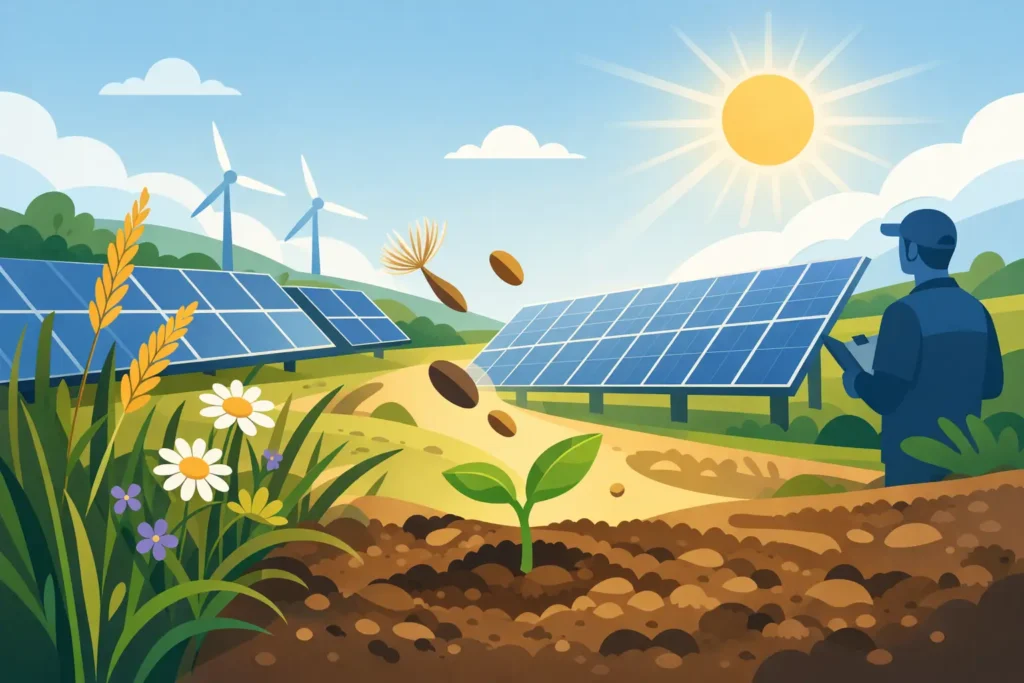
A solar site can look simple on paper – graded ground, panel rows, access lanes, stormwater controls. In the field, it is rarely that simple. The best seed for solar sites has to do more than turn bare soil green. It needs to establish reliably, hold soil in place, stay compatible with panel operations, and keep maintenance demands under control for years, not just one growing season.
That is why a generic grass mix often falls short. Solar developments create a very specific set of conditions. Some areas are heavily exposed to sun and wind. Others sit in repeated shade under panels. Traffic patterns, drainage changes, and compacted soils all influence what will actually persist. If the goal is long-term performance, seed selection has to be tied to how the site will function after construction.
What the best seed for solar sites needs to do
The right mix starts with the job description. On most solar projects, vegetation is expected to stabilize soil, support stormwater management, allow safe access, and avoid interfering with the panels themselves. In some cases, owners also want pollinator value or improved habitat benefits. Those are worthwhile goals, but they only work if the stand is durable enough to handle site conditions.
Low growth habit is usually one of the first priorities. Tall, aggressive species can become a mowing problem and may create operational headaches around panels, fencing, and electrical infrastructure. That does not mean every species in the mix has to be short at maturity, but it does mean growth characteristics matter. A site that needs constant cutting is a site that costs more to manage.
Strong root development is just as important. Solar sites often include slopes, swales, disturbed topsoil, and areas with uneven moisture. Species that knit soil together and improve infiltration tend to pay off over time. This is especially true where runoff control is part of compliance or where exposed soils are vulnerable to wind and water erosion.
Season-long persistence matters too. Some quick-cover species can give a site a good early appearance, but they may thin out fast or leave gaps if they are not paired with longer-lived perennials. On solar projects, a thin stand usually means weed pressure follows. Once weeds gain ground under and between panel rows, maintenance gets harder in a hurry.
Why there is no single best seed for solar sites
If someone asks for the one best seed for solar sites, the honest answer is that it depends on the site and the management plan. There is no universal blend that performs equally well across all soils, rainfall patterns, and construction outcomes.
A sandy, drought-prone site needs a different approach than a heavier clay site that holds moisture. A project designed for low-input maintenance may need a more conservative, durable grass-based mix. A project with environmental targets may justify a broader mix with native species and pollinator-friendly components. Both can be the right answer, but not for the same reason.
Regional adaptation matters as well. In Western Canadian and northern US conditions, winter hardiness, spring recovery, and tolerance to variable moisture can make or break establishment. A mix that looks good in a different climate may struggle badly if it is not suited to the local environment. That is one reason solar seed planning should not be treated like an afterthought at the end of construction.
Grass-first mixes for dependable solar site performance
For many projects, the most dependable answer is a grass-first mix built around low-growing, persistent species. These mixes are often the best fit where the owner wants practical vegetation management, erosion control, and consistent access across the site.
Fine fescues are commonly useful because they tend to offer lower growth, good ground cover, and decent tolerance for lean soils. Sheep fescue, hard fescue, and creeping red fescue can each play a role depending on the site. Their value is not just that they stay relatively manageable. They also help form a tighter stand that reduces open ground where weeds can establish.
In some cases, turf-type species or other well-behaved perennial grasses can be blended in to improve traffic tolerance or broaden adaptation. That said, species selection needs restraint. A mix overloaded with vigorous grasses may solve erosion but create long-term mowing pressure. The goal is balance – enough vigor to establish and persist, but not so much that the vegetation starts working against site operations.
This is also where seed quality matters. Even a smart species list can disappoint if purity, germination, or uniformity are inconsistent. On industrial sites, poor establishment is more than an agronomic issue. It can affect timelines, maintenance planning, and site appearance.
When pollinator-friendly solar mixes make sense
Pollinator habitat gets a lot of attention in solar development, and for good reason. Well-designed vegetation can add ecological value to land that might otherwise be managed as plain cover. But pollinator mixes have to be practical, not just aspirational.
The first question is whether the site can support them. Diverse flowering mixes often need better seedbed preparation, more patience during establishment, and more weed management in the early phase than simple grass stands. They may also respond differently to panel shade patterns and construction compaction. If expectations are not realistic, the result can be disappointment rather than habitat.
The second question is how the site will be maintained. If vegetation will be mowed frequently and uniformly, many flowering species will never express their value. In that case, it may be better to build a lower-growing, more durable base and target pollinator diversity in selected zones rather than across every acre.
Where project goals and management align, native grasses and forbs can be an excellent fit. The key is choosing species that are adapted to the site, compatible with panel layout, and capable of establishing without becoming a maintenance burden. More diversity is not automatically better if the mix is too hard to establish or too tall to manage.
Site conditions that should shape your mix
Good solar seed plans start with the soil, not the seed tag. Construction can leave behind compaction, stripped topsoil, uneven fertility, and poor surface structure. Those conditions directly affect what will germinate and persist.
Soil texture changes the moisture story. Coarser soils dry fast and often favor drought-tolerant species. Finer soils can hold more water but may crust, pond, or stay tight after disturbance. pH, salinity, and residual weed pressure also matter. If a site has problem areas, it often makes sense to design for zones rather than force one blend across everything.
Shade is another factor that gets oversimplified. Solar panels do not create dense woodland shade, but they do create repeated patterns of partial shade and altered moisture. Some species handle that variability better than others. A mix that performs well in open strips may thin noticeably under panel rows if shade tolerance is ignored.
Traffic patterns should also be built into the plan. Access roads, inverter pads, turn areas, and service corridors may need tougher vegetation than less-traveled sections. Treating all acres the same can lead to weak spots in the places that matter most operationally.
Establishment mistakes that cost more later
Even the best seed for solar sites can fail if establishment is rushed. Seedbed preparation, timing, and early management have a major effect on long-term results.
One common mistake is seeding into a poor finish after construction. If the surface is cloddy, compacted, or uneven, seed-to-soil contact suffers and emergence becomes patchy. Another issue is using a mix selected for appearance on paper rather than actual site function. That often leads to species that look promising but do not fit mowing, traffic, or stormwater demands.
Timing matters too. Cool-season species generally establish best when seeded into favorable moisture and temperature windows. Miss that window, and the stand may struggle before it gets rooted. Weed competition is another early threat. If weeds are allowed to dominate during establishment, the seeded stand may never fully catch up.
This is where practical planning helps. A successful solar vegetation program usually includes realistic expectations for year one, not just a final-state vision. Some species establish quickly, others take longer. The right mix accounts for both.
Choosing a mix that fits the life of the project
Solar sites are long-term assets, so vegetation should be chosen with the full life of the project in mind. That means looking past initial green-up and asking harder questions. How often will this stand need mowing? How will it respond to dry years? Will it stay stable on slopes? Can it handle equipment traffic without opening up bare ground?
The strongest mixes are usually the ones built around the site’s actual priorities. For one project, that may mean low-growing perennial grasses focused on control and access. For another, it may mean a broader blend that supports habitat goals while still keeping operations practical. Proterra Seeds works with that reality every day – matching seed strategy to land use, region, and long-term performance instead of forcing a one-size-fits-all answer.
If you are planning vegetation for a solar site, the best place to start is with clear site goals and honest field conditions. The right seed mix should make the project easier to manage after construction, not harder.