
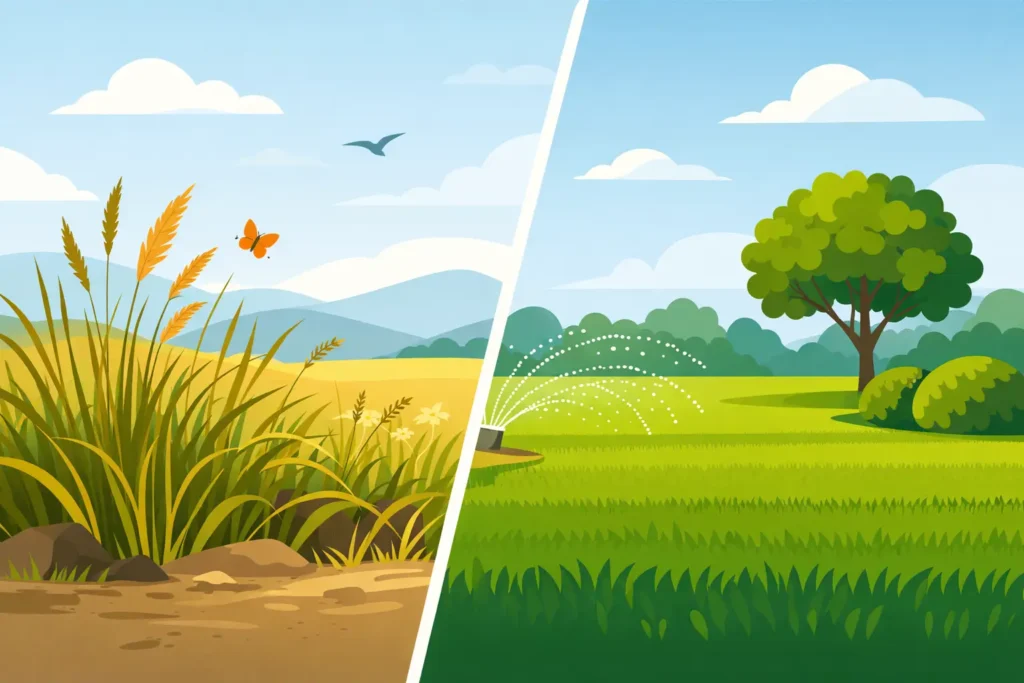
A lawn that looks good in June can fail hard by August if the seed choice does not match the site. That is really the heart of native grass versus turfgrass. This is not just a style decision. For land managers, municipalities, contractors, and property owners, it affects establishment speed, mowing demands, water use, long-term persistence, and how well a site performs under real pressure.
In Western Canada and similar climates, those pressures are not theoretical. Dry spells, short establishment windows, variable soils, traffic, erosion risk, and project timelines all shape what will actually work. The right answer depends less on appearance alone and more on what the land needs to do year after year.
Native grass versus turfgrass starts with purpose
The most common mistake is comparing native grass and turfgrass as if they are interchangeable. They are not. Each serves a different function.
Turfgrass is built for managed surfaces. If the goal is a clean, uniform stand that can handle frequent mowing and regular foot traffic, turfgrass usually makes sense. That is why it remains the standard for sports fields, commercial landscapes, parks, golf environments, and many municipal spaces. It establishes relatively quickly, creates a dense visual finish, and responds well to active maintenance.
Native grass is different. It is usually selected for ecological fit, lower long-term inputs, soil stabilization, habitat value, and adaptation to local growing conditions. On reclamation sites, utility corridors, stormwater areas, roadside projects, and low-maintenance landscapes, native species often align better with the real objective. They may not deliver the same manicured look as turfgrass, but that is often beside the point.
If a site is expected to look like a traditional lawn, native grass can feel uneven or too natural. If a site is expected to restore function, manage erosion, or support biodiversity over time, turfgrass may be the wrong tool.
Where turfgrass performs best
Turfgrass earns its place when appearance, density, and wear tolerance matter most. A well-designed turf stand can create a usable surface quickly and provide a strong finished look for high-visibility projects.
For commercial and municipal applications, that matters. Entrances, active green spaces, common areas, and maintained public sites often need a predictable surface that supports routine use. Turfgrass varieties are typically selected for traits such as fine texture, even growth, recuperative potential, and compatibility with mowing schedules.
The trade-off is management. Turfgrass generally needs more mowing, more fertility planning, and closer water management to maintain performance and appearance. Some sites can support that without issue. Others cannot. A remote site, a low-budget maintenance area, or a disturbed area being transitioned back to function may struggle under the demands of a conventional turf approach.
Another factor is root structure. Turfgrass can provide good ground cover, but many native species develop deeper root systems over time. On sites where soil stabilization and long-term resilience matter more than a short, uniform canopy, that difference matters.
Where native grass has the advantage
Native grass tends to shine when the job is bigger than visual finish. Reclamation, restoration, low-input landscapes, and broad-acre stabilization projects often benefit from species that are naturally suited to local moisture patterns, seasonal stress, and soil conditions.
That does not mean native seedings are effortless. Establishment can be slower, and expectations need to be realistic. Some native species put early energy into root development instead of top growth, which can make a stand look sparse before it matures. For buyers used to fast visual coverage, that can be frustrating unless the project goals are clear from the start.
Still, long-term performance often justifies the patience. Native grasses can help rebuild vegetative function on disturbed land, improve slope stability, support pollinators and wildlife when used in broader mixtures, and reduce the need for intensive mowing and ongoing inputs once established. On many infrastructure and restoration sites, those are the outcomes that matter most.
In places with variable moisture and difficult soils, native-adapted mixtures can also reduce the mismatch between seed and site. That is especially relevant for projects across Alberta, Saskatchewan, and British Columbia where one-size-fits-all seed decisions often create more work later.
Appearance is only one part of the decision
A lot of discussions around native grass versus turfgrass get stuck on looks. That is understandable, but appearance alone can lead to poor decisions.
Turfgrass offers a controlled, familiar finish. It reads as maintained, organized, and intentional in most public and commercial settings. If users expect a lawn, turfgrass delivers what they recognize.
Native grass creates a different visual. Depending on the species mix, it may look looser, taller, more seasonal, and less uniform. For a naturalized area, that is often a strength. For a front entrance or active amenity space, it may not fit the use or the public expectation.
The key is matching visual character to site function. A naturalized stormwater edge should not be judged by lawn standards. A park play area should not be seeded like a reclamation parcel. Good results start when those distinctions are made early.
Maintenance changes the equation
Maintenance capacity is often the deciding factor, even more than soil or climate. A turfgrass area that is not mowed, fertilized, and irrigated as needed will rarely perform as intended. Native grass can lower those demands over time, but it still requires planning during establishment and appropriate management afterward.
This is where buyers need to be honest about what will happen after seeding. If the maintenance crew is stretched thin, if the site is remote, or if ongoing irrigation is limited, a traditional turf spec may create avoidable problems. On the other hand, if the site is a high-profile civic space with regular upkeep built into operations, turfgrass may be fully justified.
There is also the issue of weed pressure. Native stands can be vulnerable during early establishment if site prep is poor or expectations are rushed. Turfgrass can also struggle under competition, but its dense cover and faster finish can help on highly managed sites. Neither option fixes a weak seedbed or poor timing.
Site conditions matter more than preference
Seed selection should respond to soil texture, drainage, salinity, slope, traffic, and intended use. Preference matters, but it comes second.
A dry slope with erosion concerns is a very different challenge from a municipal lawn renovation. A roadside shoulder, a solar site, and a commercial green space may all need grass cover, but they should not be seeded with the same thinking.
That is why custom blends and application-specific planning matter. In some cases, the answer is clearly turfgrass. In others, a native or native-forward blend makes more sense. Sometimes the best solution is a combination approach, with maintained turf in active areas and native grasses in low-use or functional zones. That can improve long-term performance while using maintenance resources where they matter most.
Native grass versus turfgrass in real-world projects
In practice, the choice usually comes down to four questions. What does the site need to do? How much maintenance will it realistically receive? How quickly does it need to look finished? And what does success look like three to five years from now, not just in the first season?
For a school field, commercial frontage, or intensively used public lawn, turfgrass often wins because function and appearance depend on density and recoverability. For a reclamation site, a utility corridor, or a low-maintenance municipal area, native grass often provides a better long-term fit because the objective is stability, adaptation, and persistence rather than a manicured finish.
There is no universal winner in native grass versus turfgrass. The better option is the one that aligns with use, maintenance realities, and site conditions. When those factors are ignored, even high-quality seed can underperform.
For buyers trying to make the right call, the best starting point is not asking which grass is better. It is asking what the land is being asked to do. Once that is clear, the seed decision gets a lot simpler – and a lot more likely to hold up over time.