
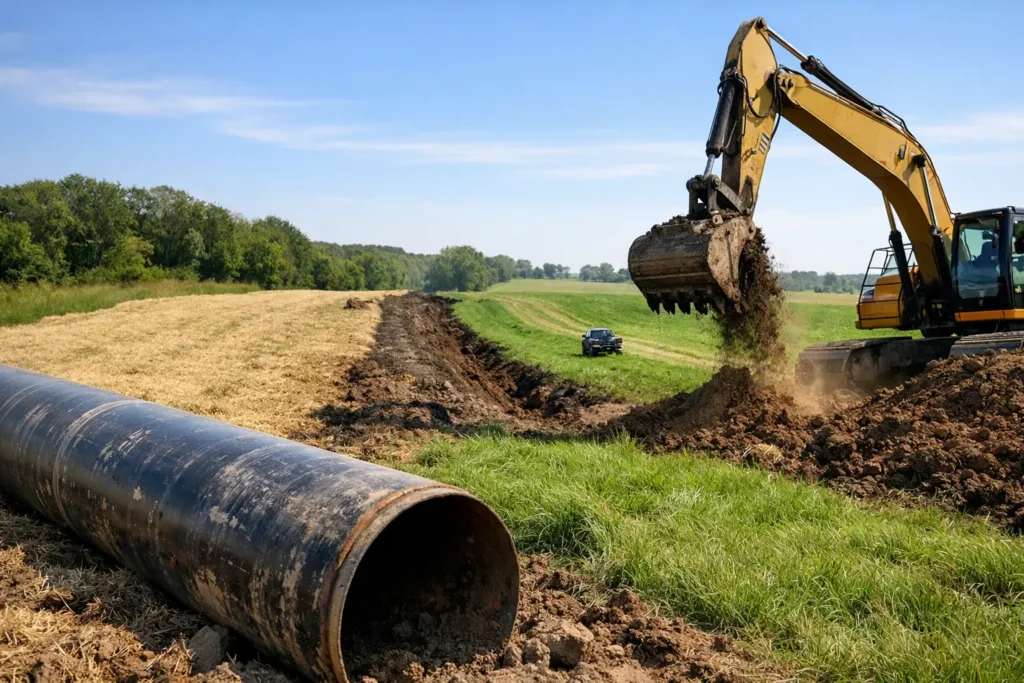
A pipeline right-of-way can be narrow on a map and still leave a lasting mark on the ground. Topsoil gets stripped, native vegetation is disturbed, drainage patterns can shift, and the land often behaves differently long after construction crews are gone. So when people ask what is pipeline reclamation, they are really asking how that land gets put back into working order – ecologically, practically, and over the long term.
Pipeline reclamation is the process of restoring land disturbed by pipeline construction, operation, repair, or decommissioning. The goal is not just to make the site look green again. It is to rebuild stable soil conditions, re-establish appropriate vegetation, control erosion, support the intended land use, and help the site return to a self-sustaining state.
For some sites, that means restoring native plant communities. For others, it means establishing reliable cover that stabilizes soil, protects nearby habitat, and meets regulatory or landowner expectations. In agricultural settings, it may also mean bringing productivity back to cropland or pasture. The right end result depends on where the pipeline is located, what the land was doing before disturbance, and what conditions exist after construction.
What pipeline reclamation actually involves
Pipeline reclamation usually starts well before seed is applied. Successful work depends on how the site was stripped, stored, replaced, contoured, and prepared. If soils are compacted, poorly graded, or mixed incorrectly, vegetation establishment becomes harder and long-term performance suffers.
At a practical level, reclamation often includes soil replacement, contour repair, drainage correction, erosion control, weed management, and revegetation. In many cases, the most visible step is seeding, but seeding is only one part of the system. A good seed mix cannot fully compensate for poor soil handling or an unsuitable seedbed.
This is why pipeline reclamation is part land restoration and part risk management. The land needs to function again, but the site also needs to hold together through wind, rainfall, snowmelt, traffic limitations, and seasonal stress. Establishment in Western Canada can be especially demanding because short growing windows, dry periods, variable soils, and temperature swings all affect outcomes.
Why pipeline reclamation matters
The stakes are higher than appearance. Disturbed corridors can become pathways for erosion, weed pressure, sediment movement, and ongoing land-use conflict if they are not restored properly. A thin stand that looks acceptable in year one may fail under weather pressure in year two.
For industrial operators, reclamation supports compliance, landowner relationships, and long-term site stability. For municipalities and land managers, it helps reduce maintenance issues and protects surrounding land. For agricultural producers, it affects whether a field, hay stand, or grazing area returns to useful production. For everyone involved, poor establishment tends to cost more later.
There is also a difference between short-term cover and durable reclamation. Quick green-up has value, especially for erosion control, but it is not the same thing as restoring site function. Depending on the project, durable reclamation may require persistent grasses, compatible legumes, native species, or a custom mix that balances early establishment with long-term plant community goals.
What is pipeline reclamation trying to restore?
The answer depends on the site. In native landscapes, the target may be ecological integrity – stable soils, appropriate species, and vegetation that fits surrounding conditions. In cultivated land, the target may be return to productivity with minimal long-term yield impact. In utility corridors or industrial settings, the target may center on stabilization, low-maintenance cover, and control of invasive species.
That is why one-size-fits-all thinking usually causes problems. A dry upland site in southern Alberta will not behave like a moist corridor in northeastern British Columbia. A right-of-way crossing pasture has different priorities than one crossing native range or municipal land. Species selection, seeding rate, and establishment timing all need to match the actual site, not a generic specification.
Soil comes first
Most reclamation failures start below the surface. If topsoil and subsoil were mixed, if the ground was left compacted, or if water now collects where it did not before, the vegetation response will reflect those problems.
Healthy soil structure matters because roots need oxygen, moisture, and space to move. A seed mix may germinate well enough after a rain, but weak rooting can lead to thin stands, poor persistence, and bare areas later. On sloped or exposed ground, that quickly turns into erosion risk.
This is why site preparation deserves real attention. Soil salvage, replacement depth, contouring, and seedbed condition all influence how well the reclaimed corridor performs. In many cases, the best revegetation results come from treating soil handling and seed planning as one connected job instead of two separate tasks.
The role of seed in pipeline reclamation
Seed is where reclamation becomes visible, but seed choice should be based on function. Some species establish quickly and provide early cover. Others are slower to start but contribute long-term persistence, root mass, or habitat value. On some projects, a nurse crop may help protect the site during early establishment. On others, it may compete too heavily with slower desired species.
That trade-off matters. A fast stand can reduce erosion pressure, but if it suppresses the long-term mix or does not suit the site, the project may need more intervention later. The strongest reclamation plans balance early stabilization with what the land should look like and do in future years.
Custom seed blends are often the best fit because pipeline corridors cross variable soils, moisture zones, and land uses. The right blend considers factors such as salinity, slope position, topsoil condition, drainage, wildlife considerations, maintenance expectations, and whether the target is native restoration or adapted cover.
For buyers and contractors, this is where regional experience makes a real difference. A mix that performs in one part of Western Canada may not hold up the same way in another. Matching species to local conditions is not just a technical detail – it is often the difference between acceptable establishment and repeated remedial work.
Common challenges on pipeline corridors
Even with a solid plan, pipeline reclamation is rarely simple. Linear disturbances create their own set of problems because a single corridor can pass through multiple site classes in one run. Wet sections, dry knolls, compacted access points, and shaded edges may all need different treatment.
Timing is another challenge. Construction schedules do not always line up with ideal seeding windows. Sometimes the best available option is a temporary stabilization approach followed by permanent seeding when conditions improve. That can be the right call, but only if it is planned rather than treated as an afterthought.
Weed pressure is also common. Disturbed soil creates opportunity for invasive or undesirable species, especially when native competition has been removed. Early monitoring matters because a corridor that gets ahead of you in year one becomes much harder and more expensive to correct.
Then there is the issue of expectations. Some stakeholders want quick visual results, while others are focused on ecological targets that take longer to develop. Good reclamation work accounts for both realities and sets realistic milestones for establishment, density, and long-term performance.
Measuring success over time
A site is not truly reclaimed the day it is seeded. It needs to establish, persist, and function through real weather and seasonal pressure. That means monitoring matters just as much as installation.
Success may be measured by vegetation cover, species composition, erosion resistance, weed control, forage return, or similarity to adjacent land. On agricultural land, landowners may care most about whether the field produces normally again. On native sites, species suitability and long-term trajectory often matter more than early green cover alone.
This is also where patience comes in. Some sites respond quickly, while others need more than one growing season to show where they are headed. The important thing is not whether every square foot looks perfect immediately. It is whether the corridor is moving toward stable, appropriate land performance.
What good pipeline reclamation looks like
Good pipeline reclamation does not call attention to itself years later. Water moves as it should. Soil stays in place. Vegetation is suitable for the site. Landowners can use the land as intended, and the corridor blends back into the surrounding landscape as much as practical.
That result usually comes from good decisions made early – proper soil handling, realistic site assessment, seed blends matched to conditions, and follow-through after establishment. It is straightforward work in principle, but it rewards experience because small mistakes at the start can stay visible for a long time.
For companies, contractors, and land managers working across Western Canada, pipeline reclamation is not just a checkbox after construction. It is the work of putting land back into dependable shape. And when the land has to hold up for years, not just one season, practical planning on the front end pays for itself.
Pingback: Choosing a Pipeline Reclamation Seed Mix - Proterra Seeds | Western Canada's Trusted Seed Supplier
Pingback: How to Choose a Revegetation Seed Mix - Proterra Seeds | Western Canada's Trusted Seed Supplier